Personally and emotionally it surprised me that I could actually stay committed to something so consuming without ruining my life. It’s almost axiomatic that people in the arts have to be willing to jettison their friends, marriages, loves, in order to really push through and break out. That is a hefty quantity of bullshit, and is an excuse for not living a full life and integrating work into it. This more than anything was the most positive outcome for me.
Tag: art
Baffler – A Cottage for Sale
A piece about painter Thomas Kinkade and the California real estate market.
We have to accept that the violent orange glow that emanates from the interior of nearly every house in a Kinkade painting merely indicates that the house is warm and inviting, not burning to the ground. […] He says that as the son of a single mother who worked late, he often came home to a house that was dark and cold, especially in winter. The “Kinkade glow” represents what he wished was there instead. He tells the story more than once, which raises a question or two: Didn’t he maybe just want to burn the place down? Is his art really a form of arson?

HWY 66, New Mexico, 2007, 5 ft x 5 ft, archival digital print by Chung Fanky Chak. I stumbled on his work at Eyedrum this weekend. I also like the five Japan prints in this project.

Confusion by Gary Taxali.

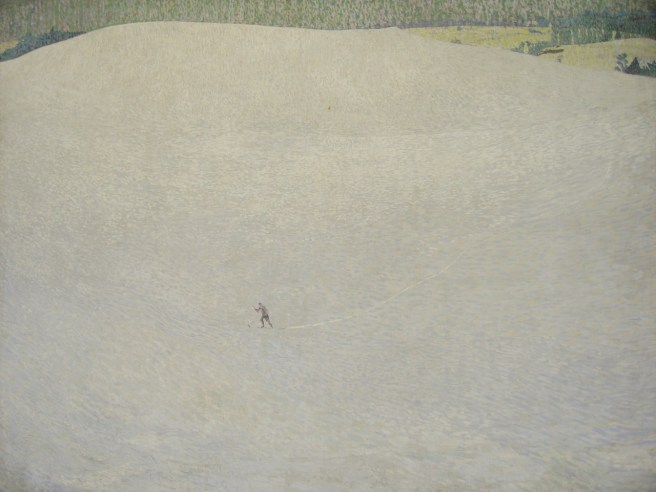
Detail from “Snow in the Countryside” (1909), a woodblock print by Kamisaka Sekka.

Double Page Spread of Electrical Towers, 2002 by Seth for Aimee Mann’s “Lost in Space”. Part of the exhibition for George Sprott 1894-1975. The man has a way with gouache. (via)
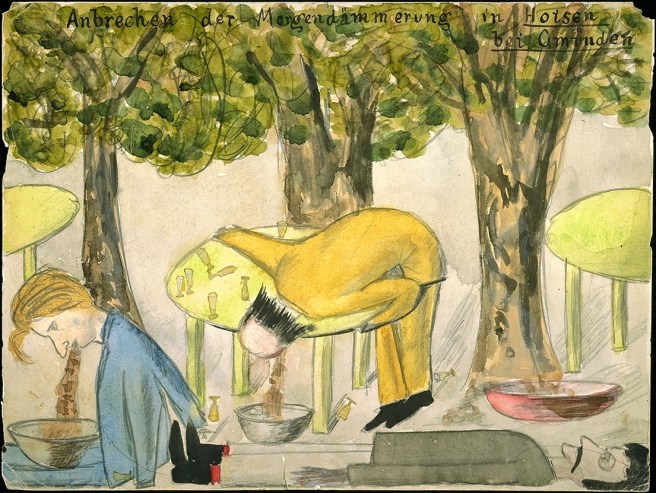
Daybreak in Hoisen near Gmunden by Arnold Schoenberg. Looks like they had a rough weekend. That’s one of many of Arnold Schoenberg’s Paintings and Drawings.
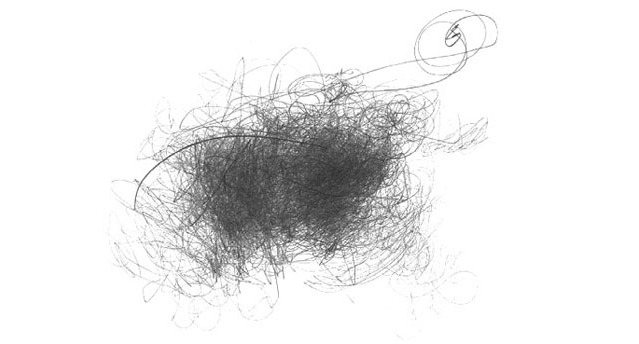
Movement of the hands of conductor Riccardo Chailly while conducting the Concertgebouw Orchestra in Mahler’s Symphony No 4, first movement. Carnegie Hall, New York City, 10 February 2000. Morgan O’Hara has more Live Transmissions pieces here.
The combinatorial agility of words, the exponential generation of meaning once they’re allowed to go to bed together, allows the writer to surprise himself, makes art possible, reveals how much of Being we haven’t yet encountered.
Donald Barthelme, quoted in Toward a Theory of Surprise.
Bicycle Diaries (review: 3/5)

I like David Byrne, but I feel really ambivalent about this book. On the one hand, there are some great gems and little thought-bits that come out of a curious mind. On the other hand, as the title so clearly points out, it’s diaristic. There’s a good amount of day-to-day humdrum “this is what I did here, this is what I did there” stuff to wade through. With that said, here are some parts I especially liked:
On the meta-ness of ringtones:
Ring tones are “signs” for “real” music. This is music not meant to be actually listened to as music, but to remind you of and refer to other, real music… A modern symphony of music that is not music but asks that you remember music.
Although he praises Europe’s cultivated, park-like landscape, in particular the “manicured” blend of man and nature in Berlin, he finds it
a bit sad, I think, that my visual reference for an unmediated forest derives from images in fiction and movies. Sad too that the forest in this preserved area was once quite common, but now lives on mainly in our collective imaginations.
Early in the book he talks about a number of American cities in brief. On the town of Sweetwater, Texas:
I enjoy not being in New York. I am under no illusion that my world is in any better than this world, but still I wonder at how some of the Puritanical restrictions have lingered—the encouragement to go to bed early and the injunction against enjoying a drink with one’s meal. I suspect that drinking, even a glass of wine or two with dinner, is, like drug use, probably considered a sign of moral weakness. The assumption is that there lurks within us a secret desire for pure, sensuous, all-hell-breaking-loose pleasure, which is something to be nipped in the bud, for pragmatic reasons.
And I liked this back-of-the-envelope theory on mating and signaling in Los Angeles:
I don’t know what the male-female balance is in L.A., but I suspect that because people in that town come into close contact with one another relatively infrequently—they are usually physicall isolated at work, at home, or in their cars—they have to make an immediate and profound impression on the opposite sex and on their rivals whenever a chance presents itself. Subtlety will get you nowhere in this context.
This applies particularly in L.A. but also in much of the United States, where chances and opportunities to be seen and noticed by the oppsite sex sometimes occur not just infrequently but also at some distance—across a parking lot, as one walks from car to building, or in a crowded mall. Therefore the signal that I am sexy, powerful, and desirable has to be broadcast at a slightly “louder” volume than in other towns where people actually come into closer contact and don’t need to “shout”. In L.A. one has to be one’s own billboard.
Consequently in L.A. the women, on the face of it, must feel a greater need to get physically augmented, tanned, and have flowing manes of hair that can be seen from a considerable distance.
Summarizing a conversation he had about the creative impulse:
People tend to think that creative work is an expression of a preexisting desire or passion, a feeling made manifest, and in a way it is. As if an overwhelming anger, love, pain, or longing fills the artist or composer, as it might with any of us—the difference being that the creative artist then has no choice but to express those feelings through his or her given creative medium. I proposed that more often the work is a kind of tool that discovers and brings to light that emotional muck. Singers (and possibly listeners of music too) when they write or perform a song don’t so much bring to the work already formed emotions, ideas, and feelings as much as they use the act of singing as a device that reproduces and dredges them up.
In a later part, in the London section, he talks about a new wave of appreciation for the late artist Alice Neel, and touches on the convoluted ways we evaluate and reflect on creative works new and old:
Maybe the work looks prescient? Maybe it looks prescient every decade or so, whenever a slew of younger artists do work that is vaguely similar to hers? In that way maybe she’s being used to validate the present, and in turn the present is being used to validate the past?
And lastly, on PowerPoint:
A slide talk, the context in which this software is used, is a form of contemporary theater—a kind of ritual theater that has developed in boardrooms and academia rather than on the Broadway stage. No one can deny that a talk is a performance, but again there is a pervasive myth of objectivity and neutrality to deal with. There is an unspoken prejudice at work in those corporate and academic “performance spaces”—that performing is acting and therefore it’s not “real”. Acknowledging a talk as a performance is therefore anathema.
Bob Ross: Teacher, Painter, Optimist – PopMatters
An appreciation of the great public television painter. I loved this guy. “This was a man palpably at peace with himself, doing something he loved, wanting nothing more than to include you.”
Jeanne-Claude, Christo’s Collaborator on Environmental Canvas, Is Dead at 74 – Obituary – NYTimes.com
This is a real downer. (via kottke)

Refined?, an art quilt by Linda Gass. (via artscriticATL)

The Van Gogh Letter Sketches. Another great collection from BiblioOdyssey.

Tom Phillips: Paintings and Drawings: Oh Those Reds. Acrylic on canvas, 122 x 25.5 cm, 1969-72.

The Album Covers of Brian Eno.
The album’s pastoral cover art is a detail from After Raphael, a painting by Tom Phillips, Eno’s mentor during his days at Ipswich Art College. (Some believe that the boy in the foreground, with the blond hair and the red beanie, is meant to be Eno.) The back cover depicts the decidedly un-rocking image of Eno sitting up in bed, reading a book – underlining the album’s general vibe of stillness, solitude, and quiet reflection.
Newspaper blackout gratuitous unboxing
As a long-time reader and would-be patron of Austin Kleon and his blackout poems, I was glad to see his work featured on Jen Bekman’s 20×200. I bought How It Works last week. This afternoon I came home and saw that I had received a parcel.

I made my way inside for a better camera and a better view of its labeled glory.

The envelope, constructed of a firm cardboard, features a well-designed exhortation to avoid bending it. One can open it by pulling a strip along the top edge of the reverse side.

Inside, in between two protective boards is a plastic sleeve containing 1) a certificate of authenticity with the artist’s signature and 2) a short document with bio, statement, and information about the print and 3) the print in question.

Aforementioned print uses archival pigment inks on 100% cotton rag paper with a matte finish, and will look rather fetching when I find a frame (Austin recommends this one):


4 Freehand Watermark Tracings, No. 1. I never knew that Steve Reich did some visual art stuff, too.
If people have even a little understanding, it is better to move them than to amaze them.
Andrés Segovia. Inspire vs. impress.
 Mark Larson

