The heavy black menus offer no dishes, only a short manifesto from the chef explaining that he will choose what we eat.
Insomnia
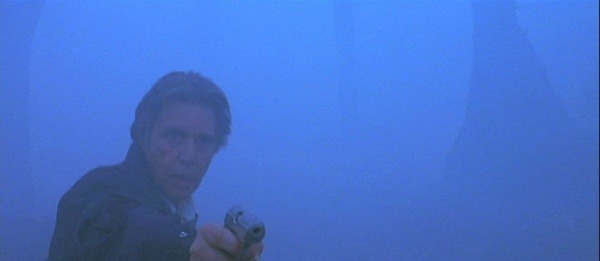
Insomnia. Starts well, but I’d tighten it up a bit. I’d rank this is my 4th favorite Christopher Nolan movie. We need more old, aching heroes. I love seeing old man Pacino tired and cranky, running around trying to not to screw up even more. Kind of like a Harrison Ford hero. My biggest struggle with the movie? Hilary Swank has too much natural toughness and smarts for the role here. I don’t buy her as the aww-shucks/awestruck/wet-behind-the-ears type. Apparently this is a remake of a 1997 Norwegian film.
Basing your friendships on what people have to offer, vs. what you want from them, can make them closer than they’ve ever been.

My notes from Terry Gilliam’s 10 lessons
3. Auteurism is out. Fil-teurism is in.
Being an auteur is what we all dreamed of being, as far [back] as the films of the late ‘50s and ‘60s, when the idea of the auteur filmmaker arrived on the planet. And people kept using that term, and they do with my movies because I suppose they are very individual and they give me all the credit, so they say I’m an auteur. And I say no, the reality is I’m a ‘fil-teur.’ I know what I’m trying to make but I have a lot of people who are around me who are my friends and don’t take orders and don’t listen to me, but who have individual ideas. And when they come up with a good idea, if it’s one that fits what I’m trying to do, I use it. So the end film is a collaboration of a lot of people, and I’m the filter who decides what goes in and what stays out.
4. Put your ideas in a drawer. Take them out as needed.
I do have a drawer in my desk with all the ideas that I have and that I scribbled out. I put them in there and some day I use them. At the beginning of a new film, I often go in that drawer and look at everything I’ve done and see if there are some ideas that might apply to what I’m doing. But things grow, so I just start with a sketch and then refine it. And you do it with other people’s ideas coming in. That’s the fun part.
Zadie Smith has said the same thing about drawers.
On fil-teuring and control, see also Louis CK:
I’m not a dictator, because I’m not in control of anything, I’m just deciding what to try. To me, it’s not that I control a bunch of people, it’s just that nobody controls me. There’s nothing above me except responsibility to the product. That’s the ultimate responsibility, is if the show sucks, then what was the fucking point of being in charge? I’m right about these things on the show, and when I’m not, it’s interesting to watch me be wrong. I don’t think you have to be perfect, you just have to be compelling in the work you do.
The most adult decisions in your life are ones that put severe limits on other possibilities.
Penelope Trunk. Filed under: decisions.
Visions of Light

Visions of Light. If you have the slightest movie nerd or photography tendency, this will be a treat. It’s a documentary about cinematography, told through interviews with cinematographers and lots and lots of clips – I wish I’d taken notes to track them down later. Favorite bits: early silent film and how way, way advanced they were when it comes to lighting and movement; how the dynamism of silent film was lost when the talkies came around (sound recording required isolating/insulating the camera, which was thus rendered largely immobile); how Hollywood starlets formed relationships with the cinematographers who lit them well; early color technique; New York style vs. Hollywood style; film noir roots, style, and influences; and so much more. Great stuff.
Extra Lives (review)

What I love about Extra Lives: Why Video Games Matter is Tom Bissell’s ambivalent relationship with video games. This is a book by an enthusiast, yes (aren’t most books?), but he also hates them sometimes:
I was then and am now routinely torn about whether video games are a worthy way to spend my time and often ask myself why I like them as much as I do, especially when, very often, I hate them. Sometimes I think I hate them because of how purely they bring me back to childhood, when I could only imagine what I would do if I were single-handedly fighting off an alien army or driving down the street in a very fast car while the police try to shoot out my tires or told that I was the ancestral inheritor of some primeval sword and my destiny was the rid the realm of evil. These are very intriguing scenarios if you are twelve years old. They are far less intriguing if you are thirty-five and have a career, friends, a relationship, or children. The problem, however, at least for me, is that they are no less fun.
And that’s the thing. I’m reminded of Daniel Mendelsohn once again, from How Beautiful It Is and How Easily It Can Be Broken:
Strange as it may sound to many people, who tend to think of critics as being motivated by the lower emotions: envy, disdain, contempt even… Critics are, above all, people who are in love with beautiful things, and who worry that those things will get broken.
And Bissell is definitely a critic, and a very good one. He gets really annoyed when video games don’t try hard enough, or try to do things they really aren’t made for. Here he is in the midst of talking about Fallout 3 and other open-world games (the genre at the core of the book) in general:
The art direction in a good number of contemporary big-budget video games has the cheerful parasitism of a tribute band. Visual inspirations are perilously few: Forests will be Tolkienishly enchanted; futuristic industrial zones will be mazes of predictably grated metal catwalks; gunfights will erupt amid rubble- and car-strewn boulevards on loan from a thousand war-movie sieges. Once video games shed their distinctive vector-graphic and primary-color 8-bit origins, a commercially ascendant subset of game slowly but surely matured into what might well be the most visually derivative popular art form in history.
The art comparison comes up a lot. Here he talks about the idea of surrender and participation in art, which gets right to the core of video games’ special offering and really, really difficult challenge:
When I watch a film, the most imperial form of popular entertainment—particularly when experienced in a proper movie theater—I am surrendering most humiliatingly, for the film begins at a time I cannot control, has nothing to sell me that I have not already purchased, and goes on whether or not I happen to be in my seat. When I read a novel I am not only surrendering; I am allowing my mind to be occupied by a colonizer of uncertain intent. Entertainment takes it as a given that I cannot affect it other than in brutish, exterior ways: turning it off, leaving the theater, pausing the disc, stuffing in a bookmark, underlining a phrase. […] Playing video games is not quite like this. The surrender is always partial. You get control and are controlled. Games are patently aware of you and have a physical dimension unlike any other form of popular entertainment.
And later, tying in with Mass Effect, he talks more about the control that video games offer. It’s not just kinetic/spatial; it can be moral:
Games such as Mass Effect allow the gamer a freedom of decision that can be evilly enlivening or nobly self-congratulating, but these games become uniquely compelling when they force you to the edge of some drawn, real-life line of intellectual or moral obligation that, to your mild astonishment, you find you cannot step across even in what is, essentially, a digital dollhouse for adults. Other mediums may depict the necessary (or foolhardy) breaches of such lines, or their foolhardy (or necessary) protection, but only games actually push you to the line’s edge and make you live with the fictional consequences of your choice.
There’s one excellent extended passage—seriously: exciting, edge-of-your-seat writing about a video game—where he talks about a particular moment of Left 4 Dead heroism. I’ll let you find the details in his book, but it’s followed up with this sharp comedown experience:
I then realized I was contrasting my aesthetic sensitivity to that of some teenagers about a game that concerns itself with shooting as many zombies as possible. It is moments like this that can make it so dispiritingly difficult to care about video games.
Delightful sometimes. Infuriating sometimes. That’s video games for you. I haven’t really played video games since I sold my dearly beloved PlayStation and Dreamcast. This book made me miss them.
What Facebook’s IPO means for women | Penelope Trunk Blog
It’s no coincidence that the number-one woman on the list of self-made millionaires is Oprah. She has no kids and no husband. She’s fascinating, nice, and smart. But few of us would really enjoy her life.
Flight of the Concord: The perils of the recording studio by Jeremy Denk – The New Yorker
In the moment of playing, the logistics of just hitting the notes distract you somewhat from the continuous choices you are making. In the edit you have nothing but choice. And yet you feel helpless, since everything has already been played.
Flight of the Concord: The perils of the recording studio by Jeremy Denk – The New Yorker
Following

Following. Christopher Nolan’s first feature film set the trend for his later puzzle-piece, time-shifted narratives. Solid, modern noir. I like seeing early work like this without fancy production, pristine private sets, celebrity talent. My rankings of Nolan movies I’ve seen:
Yeah, after his last two I mostly lost interest in Nolan’s work. This one was good enough to get me curious about Insomnia and The Prestige, though. I’ve also done rankings for Hitchcock, Eastwood, Malick, Wes Anderson, and David Fincher, etc.
I’m not very interested in political satire because it works on the assumption that They Are Assholes. Fiction works on the assumption that They Are Us, on a Different Day.
George Saunders. Re-tumbling this part of a really good interview because it’s an election year. Just doing my part for America.
The point isn’t to achieve everything, just to pay respects to one or two of the things one suspects oneself capable of.
Alain de Botton. Filed under: success.
“25 years of Kylie Minogue in 17 minutes.” (Via Fette & Rohin Guha.)
A pleasure about which I feel no guilt.
(Source: https://www.youtube.com/)
Charles Murray on the New American Divide – WSJ.com
Places to live in which the people around you have no problems that need cooperative solutions tend to be sterile. America outside the enclaves of the new upper class is still a wonderful place, filled with smart, interesting, entertaining people. If you’re not part of that America, you’ve stripped yourself of much of what makes being American special.
Steven Spielberg’s complete movies: I’ve seen every one, and I almost wish I hadn’t – Slate Magazine
One of the weaknesses people have noticed about his work—but have not, I think, yet commented enough upon—is that he can’t do comedy.
Steven Spielberg’s complete movies: I’ve seen every one, and I almost wish I hadn’t – Slate Magazine
Louis CK: Chewed Up

Louis C.K.: Chewed Up. Good stuff. A few of my favorite bits are in this one.
That was the idiot hopefulness of humans, always to love what was unformed.
Chad Harbach in The Art of Fielding. Cf. John Cage:
I am frankly embarrassed that most of my musical life has been spent in the search for new materials. The significance of new materials is that they represent, I believe, the incessant desire in our culture to explore the unknown. Before we know the unknown, it inflames our hearts. When we know it, the flame dies down, only to burst forth again at the thought of a new unknown. This desire has found expression in our culture in new materials, because our culture has its faith not in the peaceful center of the spirit but in an ever-hopeful projection onto things of our own desire for completion.
The Gauntlet
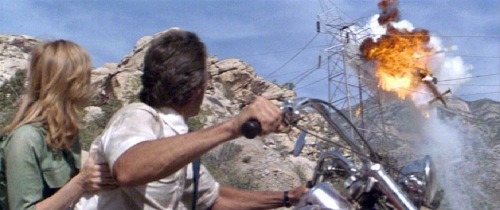
The Gauntlet. They used at least 300-thousand-million bullets in this film. It’s not the best Clint Eastwood movie I’ve seen, not by a long shot, but I went in with appropriate expectations. It’s just a fun and highly ridiculous road trip movie with a loser cop and a clever prostitute. We need more helicopter chases in movies. Interesting parallels with Frank Capra’s It Happened One Night. Check out that promo poster!
My updated rankings for Eastwood’s directing:
- Unforgiven
- Gran Torino
- Million Dollar Baby
- Mystic River (or maybe tied for third)
- The Outlaw Josey Wales
- Changeling
- Play Misty for Me
- The Gauntlet
- High Plains Drifter
- Bird
- Midnight in the Garden of Good and Evil
Are people who dwell on their problems more creative? – Barking up the wrong tree
Because rumination may allow an idea to stay in one’s conscious longer and indecision may result in more time on a given task, it was expected that these two cognitive processes may predict creativity. Self-report measures of rumination, indecision, and creativity were electronically distributed to 85 adults (28 men, 57 women; M age = 32.96 years old). Reflective rumination significantly predicted creativity, moderated by high levels of indecision. This study may resolve previous conflicts between findings on rumination and creativity and introduces indecision as beneficial in the creative process. This study also provided important clinical implications in distinguishing between adaptive and maladaptive rumination suggesting a new cognitive link between creativity and depression.
Insert the “One Single Study Often Means Jack Shit” disclaimer here. But it reminded me of Alain de Botton:
Being cheerful is really no recipe to get down to work: nothing happens until paranoia, jealousy, competitiveness and guilt arrive.
And also of Roz Chast:
I kind of tend to stay up late just about every night, anywhere from 12:30 a.m. to 3 a.m. I putter. I nurse old grudges. I fold origami while nursing old grudges. I think about the past. I wonder if there’s any grudges I should start.
Are people who dwell on their problems more creative? – Barking up the wrong tree
 Mark Larson
