Let the facts write your dreams.
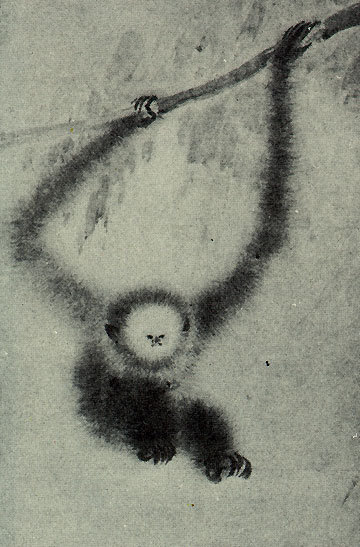
Detail from Monkeys by Hasegawa Tōhaku. This was republished in Aspen,
a multimedia magazine of the arts published by Phyllis Johnson from 1965 to 1971. Each issue came in a customized box filled with booklets, phonograph recordings, posters, postcards — one issue even included a spool of Super-8 movie film.
Awesome. Archived at Ubuweb.
Mechanical watches partake of what my friend John Clute calls the Tamagotchi Gesture. They’re pointless in a peculiarly needful way; they’re comforting precisely because they require tending.
William Gibson. This is the last time I’m gonna plug Distrust That Particular Flavor, I promise. The John Clute essay he’s referencing is in The Book of End Times.
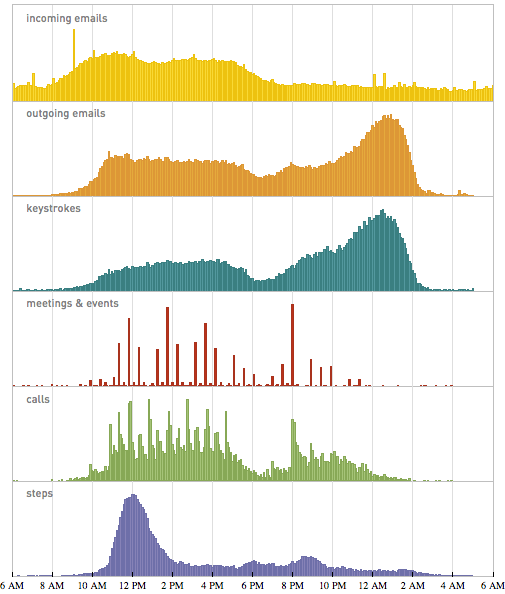
Stephen Wolfram Blog : The Personal Analytics of My Life. (via)
My consistent experience has been that the more routine I can make the basic practical aspects of my life, the more I am able to be energetic—and spontaneous—about intellectual and other things.
Words to Be Aware Of – Lone Gunman
Wish. Try. Should. Deserve.
Last year at a dinner party, I was seated near an overweight man who was eating heaping helpings of roast beef, bread, vegetables, and potatoes. During the meal, when he heard me mention that I specialized in addiction therapy, he said, “I’m a food addict. I’ve tried everything–Weight Watchers, The South Beach, raw food, Atkins, low-fat diets. Nothing works for me.” I looked at him and said, “Have you tried suffering?” He laughed out loud, as if I was joking. I wasn’t joking.
An excerpt from the opening of a later chapter of Unhooked, which I really liked. Great book on addictions of all sorts (cigarettes, weed, alcohol, porn, gambling, the internet, exercise, food…), how they develop and sustain, the value of therapy, relationships, change, case studies. The chapter continues…
A therapist should not strive to make you happy. Living well, even suffering well, are more attainable goals than being happy, regardless of what the advertising world, Hollywood, the Hallmark card company, and the pharmaceutical industry would have us believe.
Reminds me of Marcus Aurelius:
Remember too on every occasion which leads thee to vexation to apply this principle: not that this is a misfortune, but that to bear it nobly is good fortune.
n 1: Listening to Books
The essayist Sven Birkerts claims that all good reading involves self-mediation, effort, “collaboration” between the reader and the book, whereas audio books “determine” everything—“pace, timbre, inflection”—for the “captive listener.” The blogger and critic Scott Esposito is less careful to mask his snobbery: “Don’t go pretending like you’re some kind of big-time reader because you consumed the complete works of Balzac via mp3. No, you’re some guy who listened to an iPod while cooking dinner.” And when a New York Times reporter asked Harold Bloom a couple of years ago what he thought of audio books, the great Yale humanist told her that “deep reading really demands the inner ear as well as the outer ear.” It requires, he continued, the use of “that part of you which is open to wisdom. You need the text in front of you.” This sounds to me somewhat peculiar, but a lot of people basically agree with it. They believe that whatever part of you is “open to wisdom” is a part that can be activated only through the eyes.
Unless, of course, you are blind. In which case everything is obviously completely totally different.
Post-industrial creatures of an information economy, we increasingly sense that accessing media is what we do. We have become terminally self-conscious. There is no such thing as simple entertainment. We watch ourselves watching. We watch ourselves watching Beavis and Butt-head, who are watching rock videos. Simply to watch, without the buffer of irony in place, might reveal a fatal naiveté.
You can get hooked on anything used to change how you feel.
Take Shelter

Take Shelter. This one isn’t great as a thriller, because you go in thinking the guy’s gonna be a lunatic and you don’t buy for a second that it’s not just all in his head. BUT, and this is huge, it’s really, really good just as a movie about mental illness. I don’t think I’ve seen many movies this convincingly sympathetic. Often when I see extreme psychological issues on screen (recently: Antichrist, Repulsion, Black Swan) it feels like an excuse for spectacle, it’s motive, it’s entertainment. Michael Shannon’s paranoia just breaks him, and you see the overwhelming shame and terror he feels about his own condition and how it threatens his family. In that, this is very successful. It’s like Martha Marcy May Marlene in that way. Jessica Chastain is my favorite actress that I didn’t know existed until last month. I also liked director Jeff Nichols’ movie Shotgun Stories.
A book exists at the intersection of the author’s subconscious and the reader’s response. An author’s career exists in the same way. A writer worries away at a jumble of thoughts, building them into a device that communicates, but the writer doesn’t know what’s been communicated until it’s possible to see it communicated.
William Gibson. Reminds me of Umberto Eco:
I always assume that a good book is more intelligent than its author. It can say things that the writer is not aware of.
And Montaigne:
An able reader often discovers in other men’s writings perfections beyond those that the author put in or perceived, and lends them richer meanings and aspects.

William Gibson referred to history as “that other form of speculative fiction”. Came across it in his new collection that I have been and will continue quoting for a while. (via)
The Making of OutKast’s Aquemini | Creative Loafing Atlanta
Andre 3000:
When you rap and say anything kinda conscious, all the conscious people approach you. So after ATLiens I got it all – from books on sex to [metaphysics] and religion. But you also get introduced to a lot of fake phony ass people, and I addressed it in the song. You find some of the fakest people with dreads pouring oils on you. And it’s really kind of mind-blowing when you’re a young person and you start to find out some of this is bullshit, so then you’re just out there searching.
(via)
Conspiracy theories and the occult comfort us because they present models of the world that more easily make sense than the world itself, and, regardless of how dark or threatening, are inherently less frightening.
William Gibson, from an essay collected in Distrust That Particular Flavor, which I recommend. This quote reminds me of Tyler Cowen on storytelling.
Certified Copy

Certified Copy. It’s really brilliant, and it’s kinda hard to talk about this movie without spoiling it. There’s a lovely parceling out of information here, the way you learn more about the protagonists. The reveals are like, “Oh… oooohhhh…”, not like, “But he’s ACTUALLY a GHOST!” In any case, the surprises depend on you coming to a conclusion, one way or another, and the way the movie unfolds, you have to question what you come up with. Much of the conversation in the movie works around ideas of authenticity (cf.), subjectivity, pretense, conviction, truth. Art and relationships are alike in that way. I’ve heard Colin Marshall praise director Abbas Kiarostami many times, and now I feel like a fool for not seeking out his work sooner. Watch this!
Had the concept of software been available to me, I imagine I would have felt as though I were installing something that exponentially increased what one day would be called bandwidth, though bandwidth of what, exactly, I remain unable to say.
William Gibson on reading Borges’ Tlön, Uqbar, Orbis Tertius for the first time. Filed under: Borges; William Gibson.
Country Music, Openness to Experience, and the Psychology of Culture War | Big Think
What high-openness liberals feel as mere nostalgia, low-openness conservatives feel as the baseline emotional tone of a recognizably decent life. If your kids don’t experience the same meaningful things in the same same way that you experienced them, then it may seem that their lives will be deprived of meaning, which would be tragic. And even if you’re able to see that your kids will find plenty of meaning, but in different things and in different ways, you might well worry about the possibility of ever really understanding and relating to them. The inability to bond over profound common experience would itself constitute a grave loss of meaning for both generations. So when the culture redefines a major life milestone, such as marriage, it trivializes one’s own milestone experience by imbuing it was a sense of contingency, threatens to deprive one’s children of the same experience, and thus threatens to make the generations strangers to one another. And what kind of monster would want that?
(via)
Country Music, Openness to Experience, and the Psychology of Culture War | Big Think
Get Him to the Greek

Get Him to the Greek. Ehhhhh.
When we’re shown an image we tend to let our guard down. People learn how to read critically and think critically, but I don’t believe we learn how to see critically.
Pocketful of Dough – gourmet.com
You want to go to the hottest restaurant in town. You have no reservation. Bruce Feiler has a plan for you.
How to bribe without being or feeling skeezy. (via)
 Mark Larson