The fastest way to change yourself is to hang out with people who are already the way you want to be.

Hoffman & Casnocha. Warren Buffett agrees:

Hang around people who are better than you all the time. You do pick up the behavior of people who are around you. It will make you a better person. Marry upward. That is the person who is going to have the biggest effect on you. A relationship like that over the decades will do nothing but good.

If I can stretch this a bit, they don’t even have to be alive! See Austin Kleon:

The great thing about dead or remote masters is that they can’t refuse you as an apprentice. You can learn whatever you want from them. They left their lesson plans in their work.

If it’s common now for men and women to be friends, why do we so rarely see it in popular culture? Partly, it’s a narrative problem. Friendship isn’t courtship. It doesn’t have a beginning, a middle and an end. Stories about friendships of any kind are relatively rare, especially given what a huge place the relationships have in our lives.

William Deresiewicz. Alexander Nehamas talks about this in his Philosophy Bites interview (also in the book):

It is close to impossible, for example, to recognize that a painting depicts two (or more) friends without a title to that effect or some similar literary artifice or allusion. The reason is that friends can be doing anything together and no single event is ever enough to indicate the presence of friendship.

He goes on to make useful analogies with the arts in general. You come to know a friend like you recognize a painter’s style: you can’t predict them necessarily, but you can see how things fit the pattern, once the friendship has “time to develop in the first place and time to flourish.” There’s also the idea that friends, and art, are things we use to become our individual, differentiated ourselves. Like Deresiewicz said elsewhere,

Introspection means talking to yourself, and one of the best ways of talking to yourself is by talking to another person.

Via Matt Thomas’ weekly NYT Digest, for which I am always grateful.
The bogus religiosity which now surrounds original works of art, and which is ultimately dependent on market value, has become a substitute for what paintings lost when the camera made them reproducible. Its function is nostalgic. It is the final empty claim for the continuing values of an oligarchic, undemocratic culture. If the image is no longer unique, and exclusive, the art object, the thing, must be made mysteriously so.

John Berger, Ways of Seeing (via jenbee). Okay, two things here. One, it brings me back to The Authenticity Hoax again (I wrote about why you should read it). Andrew Potter:

Can you see what is happening here? It is the return of the aura, of the unique and irreproducible artistic work. Across the artistic spectrum, we are starting to see a turn toward forms of aesthetic experience and production that by their nature can’t be digitized and thrown into the maw of the freeconomy. One aspect of this is the cultivation of deliberate scarcity, which is what Alec Duffy is doing with his listening sessions. Another is the recent hipster trend to treat the city as a playground—involving staged pillow fights in the financial district, silent raves on subways, or games of kick the can that span entire neighborhoods. This fascination with works that are transient, ephemeral, participatory, and site-specific is part of the ongoing rehabilitation of the old idea of the unique, authentic work having an aura that makes it worthy of our profound respect. But in a reversal of Walter Benjamin’s analysis, the gain in deep artistic appreciation is balanced by a loss in egalitarian principle.

And two, made me think of any time someone writes a “Why ___ Matters” essay. See: swan song.

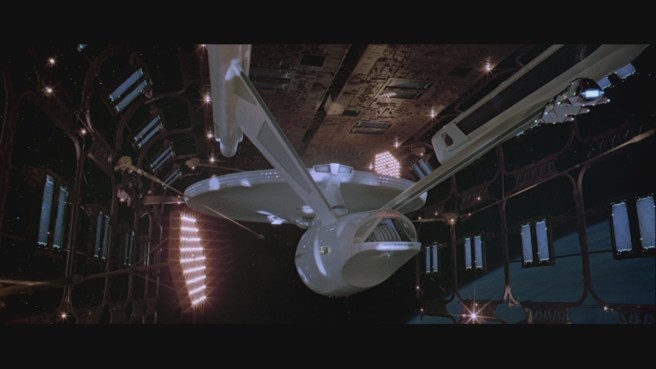
Star Trek: The Motion Picture

Star Trek: The Motion Picture. And so it begins. I’m not sure if I want to watch all of the Star Trek movies, but at least the first few and the most recent one. Spoiler: there are no dramatic gun battles or explosions at the climax. This is mostly brainy. I thought the 10-minute interlude with Starship Enterprise flyby porn was a nice touch. I miss the days when they’d build big crazy sets instead of using CGI. The soundtrack here has a case of Last of the Mohicans-itis: when in doubt, play the rousing main theme. I didn’t remember that I’d seen this one until the last scene, which I take as a good sign. Nice twist.

It’s an odd feature about the way human beings work that there are many things that we’re interested in that we don’t know if it’s acceptable to be interested in them. […] I think that’s the role of many, many art forms–to legitimate certain questions and certain sensitivities.

Alain de Botton in Philosophy Bites. This reminds me of some of Tyler Cowen’s arguments in The Age of the Infovore:

Sociological approaches to cultural taste often imply that taste differences are contrived, artificial, or reflect wasteful status-seeking. The result is that we appreciate taste differences less than we might and we become less curious. Neurological approaches imply that different individuals perceive different cultural mysteries and beauties. You can’t always cross the gap to understand the other person’s point of view, but at the very least you know something is there worth pursuing.

It was only later that I realized the value of being bored was actually pretty high. Being bored is a kind of diagnostic for the gap between what you might be interested in and your current environment.

Clay Shirky. (via merlin) Reminds me of Scott Adams in the WSJ last August:

I’ve noticed that my best ideas always bubble up when the outside world fails in its primary job of frightening, wounding or entertaining me.

Filed under boredom.

All you had to do was look at each of your players and ask yourself: What story does this guy wish someone would tell him about himself? And then you told the guy that story. You told it with a hint of doom. You included his flaws. You emphasized the obstacles that could prevent him from succeeding. That was what made the story epic: the player, the hero, had to suffer mightily en route to his final triumph. Schwartz knew that people loved to suffer, as long as the suffering made sense. Everybody suffered. The key was to choose the form of your suffering. Most people couldn’t do this alone; they needed a coach. A good coach made you suffer in a way that suited you.

Chad Harbach, The Art of Fielding (via Austin Kleon)

How Do You Make Life-Changing Decisions? | RyanHoliday.net

Books. Books. Books. People have been doing [whatever it is your deciding about] for a while now. They’ve been moving West, leaving school, investing their savings, getting dumped or filing for divorce, starting businesses, quitting their jobs, fighting, dying and fucking for thousands of years. This is all written down, often in the first person. Read it. Stop pretending you’re breaking new ground.

How Do You Make Life-Changing Decisions? | RyanHoliday.net

13 Assassins

十三人の刺客 (13 Assassins). One important thing others movies can learn from this one: the diplomatic boardroom plotting in the first part of the film is perfectly balanced with an absurd(ly fun) bloodbath at the end of the movie. I’m pretty sure there was some Japanese cultural nuance here that I just didn’t get, but I still dig it. Great directing and great acting. Also, be ye warned, there is one scene early in the movie that I just can’t unsee.

God with magnificent irony / gives me at once both books and night.

Jorge Luis Borges, in Poem About Gifts. Disclaimer: translated, paraphrased. He almost certainly has blindness in mind when referring to night, but it reminded me of me complaining on Twitter:

Every night the same fruitless bedtime prayer: “Dear God, please let me stop getting sleepy so I can read more. Amen.”