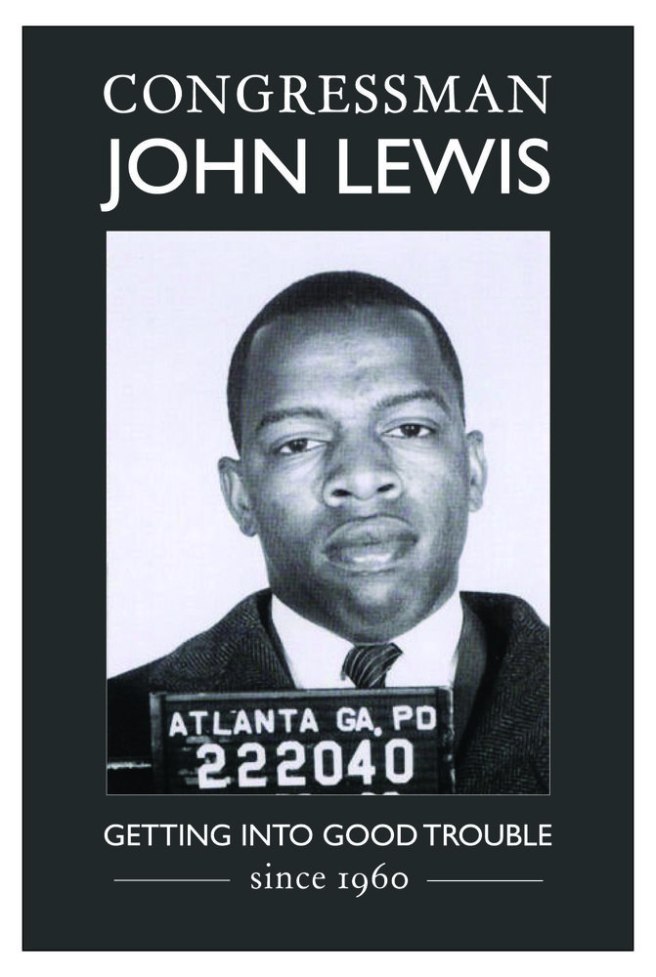
John Lewis, OG. (via)
John Lewis, OG. (via)
Making a choice and trying it is an important career skill. And choosing something practical, that people get paid well for, is an important life skill.

Long-time readers will recall that I loved The Bin Ladens, a previous book by Steve Coll. So, I was really glad to get a copy of Private Empire in the mail a few weeks ago1.
This one doesn’t have the same narrative drive as The Bin Ladens (it’s not as biography-based, for one), but it’s dang good. It covers the modern history of ExxonMobil from the 1970s, 80s, and beyond, just touching on the old Standard Oil days briefly here and there. The bookends are disasters: Exxon Valdez and Deepwater Horizon. It’s an ominous way to open and close the book, but those parts—like the middle sections on ExxonMobil’s involvement in Indonesia, Nigeria, Equatorial Guinea, Saudi Arabia, Qatar, Russia and elsewhere—are really fair and thoughtful. I’d wager that public opinion weighs pretty heavily against ExxonMobil, so a lot of this is good corrective or at least perspective. Think of it as a healthy re-complication of the simpler stories you might hear or assume, whatever your stance.
My favorite parts of this book weren’t the environmental concerns or the human rights horrors or the tangled geopolitical wrangling so well documented here, but the perspective on the business side. It woke me up to the sheer nerve (impudence?), courage (recklessness?), and (evil?) genius it takes to run a business like this. It’s incredible. Things I hadn’t thought much about before:
If anything, Coll errs on the side of detail. There were times I wondered why I was reading about so-and-so’s time in college or career trajectory, when I knew I wasn’t going to remember it and they wouldn’t be mentioned after the next 7 pages. But it’s that careful, steady, inclusive approach, carried out over hundreds of pages, that makes it easier to trust Coll’s sense for the nuances in really sensitive topics. Think “oil industry” or “global corporation” and try not to have a strong gut reaction. I’d thank this book for tempering my knee-jerk response on a lot of topics. Life is messy. I’m really glad I read this one.
—
1. Disclosure: I got it for free on the condition that I write about it. I would have gotten it for free from the library anyway because I like Coll’s writing. But just so you know.
Moving on doesn’t mean you’ll never feel bad about something again.
HEY WHO WANTS BURGERS
AND BEER.
PARTY FOR PEOPLE GRADUATING AND WHO ARE THIRTY
AND FOR EVERYONE
FOR SUMMER
OUTSTANDING FOOD
AND DRINKS
MUSIC
FERRIS WHEEL, BOUNCY CASTLE
SKEET SHOOTING
PINATA
LADIES AND GENTLEMEN MR. RICK SANTORUM
TV
I couldn’t not share it.
Meant to post this a couple months ago. I was commissioned by a friend. After a couple experiments with scotch tape and newspaper, I laid out the hide and got to work:

Then I spent roughly 900 hours punching holes and sewing:

Not too shabby.

My hindsight hunch is that I should have reinforced this better. Time will tell:

Dyed and ready for action:

Fits the 13-inch model like a dream. Other things I’ve made: a super-simple wallet, a leather tray.

Melancholia. I really wish I’d seen this on the big screen. Depression, death and the end of life on Earth! Some parallel construction here with Antichrist: the super-slow-motion theatrical overture and introduction of themes, and then a brief journey to an isolated setting where the rest of the film takes place. It’s like Trier is controlling the variables of society, technology, etc. so he can run this storytelling experiment on three subjects. Speaking of, great cast. Kirsten Dunst, Charlotte Gainsbourg, and Kiefer Sutherland are all excellent. Side characters are good for color and occasional comic relief (see: plate-breaking scene). The recurring use of the Tristan & Isolde prelude is a smart choice. And it’s gorgeous. I do wonder how this movie would feel different if the setting were not so ridiculously wealthy and comfortable.
I’ll call this my favorite Lars von Trier film, though it’s only the third. Dancer in the Dark would be probably be second, followed by Antichrist. I’ve heard good things about Dogville. The Boss of It All and The Five Obstructions look interesting.
A good rule of thumb is that diversity of opinion is essential anytime you don’t know anything about something important.
People who are smart and energetic are often angry. Not at each other, usually. Rather, they’re angry that we’re “not there yet,” i.e. that they have to solve X when they should be working on some greater problem Y.
Rick Ross – Here I Am. Ross wins some serious bonus points from me by sampling my favorite Stevie Wonder album.
It’s almost intimidating to have someone be that attentive to you.

“THE IRON LEG”
Dirk Nowitzki showed the world his step back jumper. Kobe Bryant watched Dirk win the 2010-2011 NBA Championship. Now, Kobe shoots Dirk’s step back jumper.
Some people might slight Bryant for so clearly jacking “The Iron Leg.” Not me. I think it’s incredible. And awesome.
Dirk created the best post-Olajuwon post move in basketball, Kobe understood it’s value, and put it in his game. That’s why he’s great — anything to get better. Last night, Bryant used it in the Playoffs.
You know, imitation is the highest form of flattery, but before you go thinking Kobe’s handing out compliments…
“I improved his move. I can shoot mine from the three-point line. He can’t do that… Dirk does it well, I do it better. Mine’s a little sexier.”
-Kobe Bryant
Lethem on art and identity and betrayal:
We are so prone to feeling betrayed by the artist in some way. Because the art does something so extraordinary to us that then we find out some detail. “Oh! He stole that from Willie Dixon.” “Oh! He beat his wife.” “Oh! He picks his nose in public.” “Wait a minute. He made that thing that changed my life. This is incongruent. I don’t like it!” That’s why we get so betrayed by the knowledge of appropriations, because we’re holding art to this very weird standard where it is actually about us. It’s about our own lives.
On T.S. Elliott and art that lets you cite:
T.S. Elliott has this appendix to The Wasteland where there are all these citations. We’ll put aside the fact that probably no one ever bothers to read that. But it’s there. He tried. It’s right there. But if a painter makes a canvas, it does not have room for footnotes on it. And a lot of art, the form doesn’t invite the same kinds of embrace of transparency. The specific gestures just don’t work. So what do you do? There might be follow-up. You could speak in an interview, you could make a gesture. But you know what? Not everyone wants to do that. Not everyone wants to be interviewed about their work at all. They want to just make it. And that’s okay.
On Led Zeppelin and Willie Dixon vs. Paul Simon and Graceland, and the axes of judging appropriation:
There are sort of two primary axes on which we make the individual judgment. One is: degree of transformation and the other is degree of transparency and or citation. In other words, how much do they really make something different out of what they appropriated? And how much did they make it easy to see that there was someone else’s gesture behind their own?
The iron rule of life is that only 20% of the people can be in the top fifth. That’s just the way it is.
6. Read obituaries. They are just like biographies, only shorter. They remind us that interesting, successful people rarely lead orderly, linear lives.
7. Your parents don’t want what is best for you. They want what is good for you, which isn’t always the same thing. There is a natural instinct to protect our children from risk and discomfort, and therefore to urge safe choices.

Thin Ice. It never quite hit the right rhythm on the funny parts, and the soundtrack wasn’t sure what kind of story this was, but this was a decent, moderately entertaining movie until the last five minutes when it turned into Ocean’s Eleven. There are twists, and then there are twists that undermine everything you just saw. Turns out, the movie wasn’t about the movie you thought you were watching! Disappointing.

Out of Sight. This was sooooo much better than I expected. Lots of good writing and shooting here. If you’re gonna watch a movie that’s not outlandishly amazing, might as well choose one that’s really, really good.
Instagram filters are just how we’ve convinced ourselves to put up with looking at each other’s inane snapshots.
If we can manufacture a good guy, we can exalt him. If we can manufacture a bad guy, we can degrade him. If we can’t decide, we can argue and call each other names. But more than anything complicated, the dialectic is always about deciding who is the bigger asshole.
s
Champion Trees in ATL – Google Maps.
Located on this map are numerous city and state champion trees- the largest of their species in the area. Also noted are some historically significant or otherwise significant trees worth visiting.
 Mark Larson