The secret is that the shit is fun to me. Finding a new groove to make a new song, that shit is fun. When you get the beat right and then the hooks and the bridges and the lyrics and it all comes together it’s like this feeling that you get like you hit the jackpot. I can only describe it as trying to unlock the combination to a safe. Once you get inside it, boom.
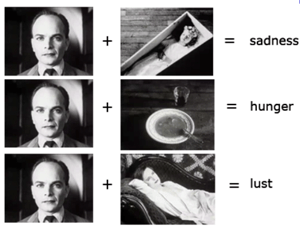
From the excellent Cutters’ Way: The Mysterious Art of Film Editing, an illustration of the Kuleshov Effect.
The implication is that viewers brought their own emotional reactions to this sequence of images, and then moreover attributed those reactions to the actor, investing his impassive face with their own feelings. Kuleshov believed this, along with montage, had to be the basis of cinema as an independent art form.
Bright Lights Film Journal :: Cutters’ Way: The Mysterious Art of Film Editing
An essay on the hidden, underappreciated geniuses behind great films: the editors.
[Walter] Murch played a vital part in shaping four of Coppola’s most celebrated films — The Godfather, The Godfather, Part ll (1975), The Conversation, and Apocalypse Now — but was noticeably absent from the director’s more ponderous projects in the eighties: One From the Heart (1982), The Cotton Club (1984), Peggy Sue Got Married (1986), and Tucker: The Man and His Dream (1988). Some people might not see that as a coincidence.
On the magic of cuts and juxtapositions in films. They’re like dreams, or like thought.
What is it that makes cutting work? How is it that we accept such a violent transition — whether it be from a wide shot to a close-up, from Paris to the Sahara desert, or from the seventeenth century to the present — as a cut? “Nothing in our day-to-day experience seems to prepare us for such a thing,” Walter Murch observes. “From the moment we get up in the morning until we close our eyes at night, the visual reality we perceive is a continuous stream of linked images: In fact, for millions of years — tens, hundreds of millions of years — life on Earth has experienced the world in this way. Then suddenly, at the beginning of the twentieth century, human beings were confronted with something else — edited film."11 What prepared them for this? Not painting, not theater, not even literature, cinematic as some of Dickens’s scenes now appear. Murch speculates that it was dreams. "We accept the cut because it resembles the way images are juxtaposed in our dreams,” he writes. “In the darkness of the theater, we say to ourselves, in effect, ‘This looks like reality, but it cannot be reality because it is so visually discontinuous; therefore, it must be a dream.’"12 Director John Huston saw it differently. Cinema, he said, was not just a reflection of our dream lives but the very essence of conscious thought, with its fitful jumble of visuals and sound: "To me the perfect film is as though it were unwinding behind your eyes, and your eyes were projecting it themselves, so that you were seeing what you wished to see. It’s like thought. It’s the closest to thought process of any art.”
Also cool sections in there about the Ralph Rosenblum/Woody Allen partnership; the influence of Russians like Eisenstein, who began as editors; how the nature of editing work led to opportunities for women; digital editing; and more.
Bright Lights Film Journal :: Cutters’ Way: The Mysterious Art of Film Editing
Cato Unbound » Why Online Education Works
Very interesting perspective. I like this bit on lectures and attention spans:
Online education can also break the artificial lecture length of 50–90 minutes. Many teaching experts say that adult attention span is 10–15 minutes in a lecture, with many suggesting that attention span has declined in the Internet era. A good professor can refocus the attention of motivated students over longer periods. Nevertheless, it is clear that the standard lecture length has not been determined by optimal learning time but by the high fixed costs of traveling to school. Lower the fixed costs and lectures will evolve to a more natural level, probably between 5–20 minutes of length—perhaps not coincidentally the natural length of a lecture is probably not that different from the length of a typical popular music track or television segment.

Blood on the Moog » CultureRamp. A good series on using synthesizers in violent movies. (via)
We had zero business plan or experience, but it’s amazing what desperation will do for you.
Ryan Peake, lead guitarist for Nickelback.
One reason crime movies tend to be intrinsically interesting is that the supporting characters have to be riveting.
Roger Ebert in his review of Gone Baby Gone.
Gone Baby Gone

Gone Baby Gone. I kinda wish the movie had stopped after the second voiceover. It would have been amazing (if maybe predictable in an ambiguous, artsy way). But it’s a genre film, so it kept going, and while the second, twisty act was a little mystery-novel page-turner-y, Ben Affleck does a great job with it. I assume he was being more or less faithful to the source. Great, great cast. The end offers an interesting tension between Monaghan’s ethic-of-care/consequentialist perspective and Casey Affleck’s ethic-of-justice/deontological take. I also like the sound in this one, working with the full range. I’m not sure whether it’s better or worse than The Town, which I mean as a compliment to both.
Other great movies that are heavy on the Boston:
- Mystic River
- The Social Network, sorta
- The Town
- The Departed
- Good Will Hunting
- Next Stop Wonderland
The Town

The Town. I would have preferred less gunfire and more of everything else, but geez. Affleck. Dude can direct! I’m excited to see what else he comes up with. Gotta check out Gone Baby Gone and Argo soon. Also, I love Renner in this. What a nut.
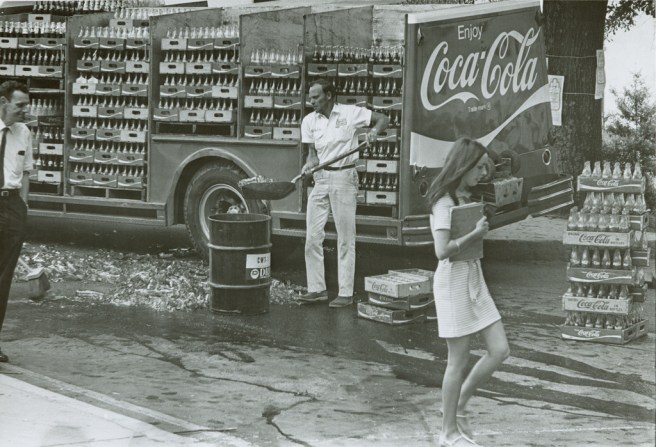
Clean-up from a Coca-Cola spill on campus. Hazards of Emory student life.
Casablanca, or, The Clichés are Having a Ball – Umberto Eco
When all the archetypes burst in shamelessly, we reach Homeric depths. Two cliches make us laugh. A hundred cliches move us.
Four Weddings and a Funeral
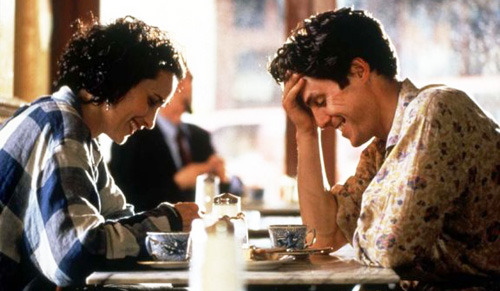
Four Weddings and a Funeral. Andie MacDowell’s character is the worst. Don’t do it, Hugh! Great supporting characters. This had much more subtlety and color than I expected.
It seems to me that if a work has something remarkable to say, then someone who wants to whistle it will find something in it to whistle.
Elliott Carter. RIP. Cf. Will Oldham:
It seems to me that the ears that are listening make more difference than the way the music sounds.
Who will write the last tweet?
Outlaw: Josey Wales. Good discussion of Eastwood’s self-awareness, and lots of historical context I never knew about.
(Source: https://player.vimeo.com/)
Festina lente – Wikipedia, the free encyclopedia
A classical adage and oxymoron meaning “make haste slowly” or “more haste, less speed”. It has been used as the motto of many people including the emperors Augustus and Titus, the Medicis and the Onslows.
Slow is smooth; smooth is fast. (via)

The Cost of Higher Education — Crooked Timber
Suppose you wanted to go live at a luxury resort for four years. You’d expect that to cost, wouldn’t you? (No one is going to write an editorial raging about how if you wanted to live at Club Med it would cost you at least $50,000 a year – probably more.) So why are people surprised that it costs a lot – really a lot – to send a kid to college for four years? College is the sort of thing that seems like it should cost a lot: beautiful buildings on nice land, nice gym, nice green spaces, expensive equipment, large staff that have to be well-paid because they provide expert services. If you want to be puzzled about something, figure out how and why it was ever cheap, not why it costs now.
An essential aspect of a painter’s canvas and a musical instrument is the immediacy with which the artist gets something there to react to. A canvas or sketchbook serves as an “external imagination”, where an artist can grow an idea from birth to maturity by continuously reacting to what’s in front of him.
Learnable Programming. Also:
As a child, you probably had the experience of playing with a construction kit of some kind – Legos, or Erector Sets, or even just blocks. As a first act before starting to build, a child will often spread out all of the parts on the floor. This provides more than simply quick access. It allows the child to scan the available parts and get new ideas. A child building a Lego car might spot a wide flat piece, and decide to give the car wings.
Yelp Hates on Museums | Los Angeles County Museum on Fire | ARTINFO.com
A critic who thought the Frick Collection “sucked” would not have a job. Yelp’s reviews are infinitely more democratic, written by anyone who cares to write them. That includes not a few masochists who hate museums and go anyway. There might be something to that. If a certain percentage of Yelpers find LACMA or the Frick boorrriinnnnggg, it might be worth knowing—to others who are thinking of going and worry they might be bored stiff. Serious critics almost never address that audience or that concern.
Cf. The Onion: Whole Museum Visit Spent Feeling Guilty About Moving On From Paintings
Yelp Hates on Museums | Los Angeles County Museum on Fire | ARTINFO.com
 Mark Larson