I called around and managed to get a lot of expired stock donated. I also used tungsten-based 35mm slide film to storyboard the movie – this really helped me show the various labs what the final film would look like and thus negotiate prices with them. They are much more likely to give you a discount when they think you’re someone that might be back one day with a bigger budget.
IllumiRoom: Peripheral Projected Illusions for Interactive Experiences. We are closer and closer to Infinite Jest. I haven’t read the book, so I’m not totally sure what that means. But this looks cool.
Tim Brando, Chris Broussard, and giving credit where credit is due – SBNation.com
Debate whether [Jason Collins] is a hero or not in your world, but he’s leading by example for a small subset of people who need examples, and doing so positively: with love, and work, and still more work. The two are ultimately indistinguishable when done right, and what they leave behind is the capacity to pass that work forward.
Tim Brando, Chris Broussard, and giving credit where credit is due – SBNation.com
It really got to me when someone asks what I did for a living and I realized I didn’t have a good answer. And it was just, I don’t know, it was like I’m in my apartment alone all day editing this thing that I’m calling a film but it wasn’t actually a film yet. So yeah, there’s a couple of times where I just gave up and decided I was going to go back and get a job and actually have a good answer to what I did for a living. That was going to be that.
The Taxman Cometh – The Daily Beast
There’s this dispute in Minnesota where an artist couple has been claiming tax deductions to keep doing their various art things. Trouble is, in the eye of the law, you can’t claim deductions unless you’re (on the way to) running a business that makes profit. Years and years of losses or minimal profit are just asking for an audit. Hilarity ensues.
It’s so hard with a word processor to know what a revision is.
Primer

Primer. It was early on in the film when I stopped trying to understand the technical details. Just let it ride for now and watch it again soon. Very cool movie. There’s a fine line in (many genres but especially in) science fiction where budgets force decisions about how you show crazy things. I love seeing the conservative work-arounds. You reduce the spectacle so you can preserve the speculative heart of the thing. This not all science fiction, though. There’s a good human core about invention, entrepreneurship, risk, paranoia, trust, etc. Looking forward to seeing Shane Carruth’s Upstream Color this week.
In a tone that grew more defiantly nonchalant with every update, the pilot advised us that some of our bags would arrive on a future flight. Even with routine debacles such as this it’s rare to be promised future bullshit while the current bullshit is still very much in progress. Sorry ‘bout that, folks.
The Goonies

The Goonies. A friend had never seen it, so we had to correct that. I remember a period of my life where I watched this every afternoon for a couple weeks straight, and knew that, any day now, I’d have an adventure, too. It still holds up. I certainly miss the days before VFX when moviemakers would build ridiculous sets. A huge sailing ship, in a large pool of water, in a vaulted cave? That’s still amazing.
The Problem With Public Shaming | The Nation
Vigilante justice is a tricky thing.

Out in the Great Alone. Brian Phillips (@runofplay) makes feature writing look easy, somehow. Good stuff. Previously, at Wimbledon.
To the Wonder

To the Wonder. This is probably a Malick-fans-only affair, given that he’s brought all his Malickisms to expected highs/belabored lows. So I liked it, naturally. It’s very chopped and fragmented, both within scenes and through time, but there is a clear arc here. Yet maybe it’s understated enough that you get as much drama out of it as you put in. The thing starts with Kurylenko’s narration, her camera, her self-documentation, so there’s an interpretation that most of it is her record. Regardless, just that little bit of self-shot camerawork helps to set up the interiority of the rest.
Affleck is given almost nothing to say, and he’s muted repeatedly even when it looks like he’s saying something. And the voices we can hear from other characters, it’s often just barely. The dance analogy I’ve heard fits well. Where words are absent, gesture and music have to carry it. It’s also like, y’know… silent film. Great score, though you too may chuckle if you’re familiar with some of the music selected (e.g. Górecki, Rachmaninov, Wagner).
Ridiculous desktop wallpaper camera porn abounds. Malick needs to sell his b-roll for the TVs in waiting rooms and airports. I love the transition from the water shot of coastal France to the tall grass in the States. And another transition from the sunlit exteriors of the U.S. to the damp claustrophobic fluorescence of Paris at night. And that final shot. Man. That made it all worth it for me.
Themes. Taking it back to the early sequence at Mont Saint-Michel shows the two becoming one, a little island drawing off from the rest. And the first early versions of how the camera is drawn, again and again, to light, tracking toward windows and doors, trying to get up and out. So that’s love as a combinatory force, bringing two into one, making the inside the outside, drawing you out of yourself (note the barely furnished home). So there’s love as awesome, and there’s love as absent. Bardem carries this part. Note how he’s sequestered himself inside too much. By the end, maybe he’s trying a little harder. Or praying at least, girding himself to get out there again, narrating a common excerpt from St. Patrick’s Breastplate:
Christ with me,
Christ before me,
Christ behind me,
Christ in me,
Christ beneath me,
Christ above me,
Christ on my right,
Christ on my left,
Christ when I lie down,
Christ when I sit down,
Christ when I arise,
Christ in the heart of every man who thinks of me,
Christ in the mouth of everyone who speaks of me,
Christ in every eye that sees me,
Christ in every ear that hears me.
I liked Pico Iyer’s review. Ebert’s take will continue to be good for extra-filmic reasons. And the Terrence Malick community blog has a nice blow-by-blow.
My Terrence Malick rankings and reviews:
- Days of Heaven
- The New World
- Badlands
- To the Wonder
- The Tree of Life
- The Thin Red Line
Nitsuh Abebe on the Punk Movement — New York Magazine
By the time punk swept the U.K., the sound had cut itself back to the sinew and muscle of early rock and roll, yes, but it had also excised one of the key things that made early rock and roll captivating to young people, which was some sense of sexual urgency—swing, groove, sly vocal implication. All were traded for happy hectoring and desiccated angularity. The guitars may have a kinship with Chuck Berry, but the barking does not.
Ergo, punk never had much appeal for me.
Green Screen: The Lack of Female Road Narratives and Why it Matters
To offer some context for my perspective, the year I was fifteen I hitchhiked 15,000 miles alone, mostly through truck stops. By the time I was nineteen I had hitchhiked another 5,000 miles through Turkey, Greece, and pre-war Yugoslavia, also alone. Those years were a time of misery and terror, but they were also transformative. Every day I bounced wildly between danger, high comedy, and extreme loneliness—which is to say that it was also an adventure, and that inside all the high stakes turmoil was a nascent self that was trying to become, to change, to step out into the world as an adult.
But there is no female counterpart in our culture to Ishmael or Huck Finn. There is no Dean Moriarty, Sal, or even a Fuckhead. It sounds like a doctoral crisis, but it’s not. As a fifteen-year-old hitchhiker, my survival depended upon other people’s ability to envision a possible future for me. Without a Melvillean or Kerouacian framework, or at least some kind of narrative to spell out a potential beyond death, none of my resourcefulness or curiosity was recognizable, and therefore I was unrecognizable.
Green Screen: The Lack of Female Road Narratives and Why it Matters
State your needs, don’t test people on them.
Quaker Mode – The Pastry Box Project | 22 April 2013, baked by Mike Monteiro
The incredibly great thing about Quaker meetings is that everyone just sits there. Silently. And they talk only if the spirit moves them to talk. They only open their mouths if it improves on the silence. I’m gonna repeat that phrase because I love it so fucking much: “if it improves on the silence.”
When we were staying over at grandma’s house, when me and my brother and sister were getting annoying, we knew fun time was over when Grandma would say firmly, “Okay. Let’s play Quaker.” The three of us then groan and sigh and collapse on the floor, mortally wounded, sulky, resentful. Quiet time had begun. I hated that “game” so much. Mike Monteiro’s idea sounds good, though.
Quaker Mode – The Pastry Box Project | 22 April 2013, baked by Mike Monteiro
Bringing Up Baby

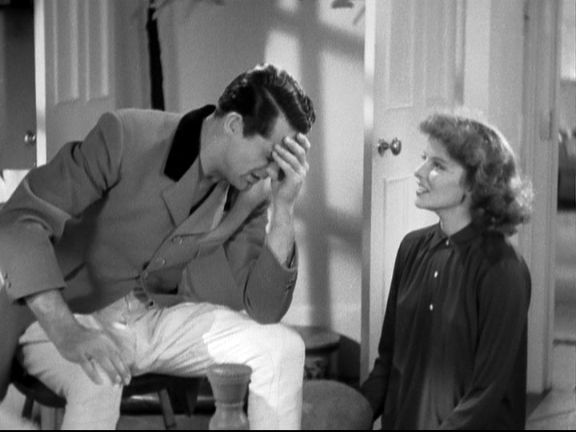
Bringing Up Baby. Too much of a muchness w/r/t silly characters and storytelling contortions to keep the laughs coming. Of all the Cary Grant I’ve seen, this is the first straight-up goofy comedy role (sillier than in The Philadelphia Story). He’s got a knack for it, apparently. I love seeing a new side of an actor I know mostly for being dashing. Favorite Howard Hawks movies? Gotta take Scarface over The Big Sleep, and then this one after Gentlemen Prefer Blondes.
The Place Beyond the Pines

The Place Beyond the Pines. It’s a bummer that the wind goes out of the sails when Gosling leaves the screen, but that’s still to his and the director’s credit for those parts of the movie. And Mendes was fantastic. What a talent. I just wish the third act hadn’t run out of gas. But, then again, I think that’s partly me being snob-weary-dreary-bonehead, “Oh, another fathers and sons tale” and not wanting to give in to it. It’s good, though. Derek Cianfrance’s Blue Valentine is pretty sharp, too.
I think we have to be frugal with our photo-viewing. I love it when you find a photo from a time you’ve forgotten about – one that, maybe, someone else had possession of. It makes you realise how linear and reductive memory is.
Why it’s ok to buy books and not read them
I used to feel guilty about books I own but haven’t read. They’d sit in piles making me feel unworthy as a writer, and reader. And no matter how many books I’d read in a year, I’d always find myself buying more. I couldn’t win. It was a destructive cycle and it drove me mad. One day I realized there was another way to frame my behavior. The goal should not be efficiency because efficiency makes you conservative. As a writer I need an ambitious curiosity, not a safe one. It’s good to take bets on books at the limits of my comfort zone.