The economics here are really interesting. Clever stuff.
Dinner is the theater as food paparazzi converge – latimes.com
News to me: “Nikon, Olympus and Sony sell cameras that offer ‘cuisine’ or ‘food’ settings, which adjust to enhance colors and textures on close-ups.”
And there’s this: “Lefebvre happily cooked a private dinner for 18 food bloggers. His wife set up a portable light box in a corner of the dining room. Even before the bread plates hit the table, the crowd went nuts. As each new dish arrived, the bloggers rushed over to the light box to get the shot, then returned to their seats.”
Dinner is the theater as food paparazzi converge – latimes.com
Then That’s What They Called Music! | The A.V. Club
“We begin a journey through pop’s recent past by examining the bestselling, major-label NOW That’s What I Call Music compilations.”
Most culture is dark matter.

Britain Closes Airspace as Volcanic Ash Spreads – NYTimes.com. Eyjafjallajökull is erupting. So strange to remember I hiked by it just a year and a half ago. More photos on Flickr.

The Ice Balloon – S. A. Andrée’s North Pole balloon expedition : The New Yorker. I wish this weren’t behind a paywall, because non-subscribers are missing out on a wonderful piece of writing. (Photo of the fallen balloon by Nils Strindberg, from the Grenna Museum.)
The life I have chosen gives me my full hours of enjoyment for the balance of my life. The Sun will not rise, or set, without my notice, and thanks.
Winslow Homer, in a letter to his family. (via)
kerouac’s rules for spontaneous prose
1. Scribbled secret notebooks, and wild typewritten pages, for yr own joy
2. Submissive to everything, open, listening
3. Try never get drunk outside yr own house
4. Be in love with yr life
5. Something that you feel will find its own form
6. Be crazy dumbsaint of the mind
7. Blow as deep as you want to blow
8. Write what you want bottomless from bottom of the mind
9. The unspeakable visions of the individual
10. No time for poetry but exactly what is
11. Visionary tics shivering in the chest
12. In tranced fixation dreaming upon object before you
13. Remove literary, grammatical and syntactical inhibition
14. Like Proust be an old teahead of time
15. Telling the true story of the world in interior monolog
16. The jewel center of interest is the eye within the eye
17. Write in recollection and amazement for yourself
18. Work from pithy middle eye out, swimming in language sea
19. Accept loss forever
20. Believe in the holy contour of life
21. Struggle to sketch the flow that already exists intact in mind
22. Dont think of words when you stop but to see picture better
23. Keep track of every day the date emblazoned in yr morning
24. No fear or shame in the dignity of yr experience, language & knowledge
25. Write for the world to read and see yr exact pictures of it
26. Bookmovie is the movie in words, the visual American form
27. In praise of Character in the Bleak inhuman Loneliness
28. Composing wild, undisciplined, pure, coming in from under, crazier the better
29. You’re a Genius all the time
30. Writer-Director of Earthly movies Sponsored & Angeled in Heaven(via Alabama Arkansas)

NEWSPAPER BLACKOUT IS OUT TODAY!
Hey Tumblr friends — my new book is out today! Would love a reblog if you can spare one…
The wait is over, folks! Don’t forget your free shipping.
Pitchfork: Why We Fight: Why We Fight #1
“Why celebrate pretense and bold gestures in pop music, but get weirdly skeptical of them in the indie world?” See also part 2.
What I’ve been reading, vol. ii
I’m back for a second reading round-up (previously). With these out of the way, I can turn to a nice stack of fiction, and after that, I’m going to do a little overhaul and start prioritizing some of the recommendations I’ve gathered. As for these, I’d say #5, #6, and #8 were the best of the bunch:
1. The Jazz Ear. Ben Ratliff met with jazz musicians and listened to music with them. It sounds like such a great idea, but I think it fails in that people who play music aren’t always good at talking about it. (I should mention that I generally like Ratliff’s writing for the New York Times.) I thought the most interesting bit on creativity came from the interview with Maria Schneider, who uses one art to understand another:
When she composes, she often plays a sequence into a tape recorder, then gets up to play it back, and moves around the room to the phrases of the music, seeing how it feels when danced. “It helps me figure out where things are, and what needs to be longer.”
2. The Maltese Falcon. I loved the movie. I found the book didn’t have the snappy pace I was hoping for. Good story, though.
3. The Year of Living Biblically. Good ol’ DNF. I realized I wasn’t that interested, but I hear good things.
4. But Beautiful. Author Geoff Dyer calls it “imaginative criticism”. It’s a creative sort of nonfiction where he imagines vignettes based on the facts of some famous jazz people’s lives. More about the personalities and trials than the music. I couldn’t get in to it.
5. Blues & Chaos: The Music Writing of Robert Palmer. This is a good collection that’s particularly strong in the blues, but covers a really wide range. Many of the pieces are short ones written for newspaper, so you’ll find it easy to flip through. I liked it.
6. How Markets Fail: The Logic of Economic Calamities. The best part, which I do recommend checking out, is the first 1/3, which reviews the historic of economic thought with a special focus on theories of market efficiency and failure (e.g. Smith, Keynes, Hayek, Walras, Pareto, Fama, Arrow, etc). The rest of the book explores some recent thinkers and our current crisis/recession thing. I didn’t find it nearly as interesting as the first part, but maybe that’s because I’ve read so much about the crisis already.
7. Riders of the Purple Sage. DNF. Didn’t read enough to speak for it. I’m still interested in reading some westerns.
8. The Greek Poets: Homer to the Present. This was nice to read just before bedtime. Sleepiness and inattention kept me from diving into the longer ones, but I bookmarked a bunch of the shorter ones that I liked. Generally, I liked the ancient stuff much more than the old and the modern. Here are a few:
Written by Anacreon, translated by Barbara Hughes Fowler:
I boxed with a harsh opponent,
but now I look up, I raise my head,
and owe great thanks that I
have escaped in every respect
the bonds of Love
Aphrodite made tough.
Let someone bring me wine in a jar
and water that bubbles.
Written by Menander, translated by Philip Vellacott:
By Athene, gentlemen, I can’t find a metaphor
To illustrate what has happened—what’s demolishing me
All in a moment. I turn things over in my mind.
A tornado, now: the time it takes to wind itself up,
Get nearer, hit you, then tear off—why, it takes an age.
Or a gale at sea; but there, you’ve breathing-space to shout
“Zeus save us!” or “Hang on to those ropes!” or to wait
For the second monster wave, and then the third, or try
To get hold of a bit of wreckage. But with me—oh, no!
One touch, one single kiss—I’d had it, I was sunk.
Written by Callimachus, translated by Frank Nisetich:
There’s something hidden here, yes, by Pan,
by Dionysos, there’s fire under this ash.
Careful, now: don’t get too close! Often a river
eats away at a wall, bit by bit, invisibly.
Even so, Menexenos, I fear you’ll slip
under my skin and topple me into love.
I also liked several from Palladas. One translated by Edmund Keeley:
This is all the life there is.
It is good enough for me.
Worry won’t make another.
Or make this one last longer.
The flesh of man wastes in time.
Today there’s wine and dancing.
Today there’s flowers and women.
We might as well enjoy them.
Tomorrow—nobody knows.
Another from Palladas translated by Dudley Fitts:
Praise, of course, is best: plain speech breeds hate.
But, ah, the Attic honey
Of telling a man exactly what you think of him!
And one last one from Christophoros of Mytilene, translated by Peter Constantine:
How much better if an ox were to sit on your tongue
than for your poems to plod like oxen over fields.
9. Drive: The Surprising Truth About What Motivates Us. This was okay. It is hard to write a great business book.
10. The Adventures of Johnny Bunko: The Last Career Guide You’ll Ever Need. I like the efficiency of this one. It’s a nice kick in the pants/attitude adjustment. It doesn’t do much more than get a basic, broad message across in 20 or so minutes, and it that sense, probably is the last career guide you’ll need.
Why not try a formal picnic for a change? – Miss Manners
Hear, hear. The fact that this seems novel and exciting is telling:
The motto of informality is: “Let’s do things the easiest, most convenient way and never mind how they seem, because nobody is paying any attention, anyway.”
Formality says: “Yes, it does matter, and the surrender of individuality to high group standards is a trivial sacrifice to the overall beauty of the thing.”
At a formal picnic, people do not wear exercise clothes, serve food in packages from the store, eat wandering around whenever they feel like it or treat bits of paper as napkins, cardboard as plates and plastic as flatware.
Food is served on non-absorbent materials, to be eaten with unbreakable utensils, and the fact that a table cloth, napkins, dishes and cutlery will have to be washed afterward is accepted as one of the burdens of civilization.
[…]
Dress does not begin with a surrender to the heat, but the optimistic, if vain, idea that one can rise above it, so to speak. Gradual reactions, such as fanning, forehead mopping and the rolling up of sleeves or baring of feet to dangle in creeks, are considered more exciting than just starting out by sweating into one’s gym suit.
If you’re dancing and not within two people of a girl, you’re doing it wrong.
To Catch a Thief

To Catch a Thief. It’s a romance packaged in a crime movie, and it’s quite good. Not fantastic, maybe not even great, but thoroughly enjoyable. Definitely feels shorter than it is. I expected the camerawork and direction to be more Hitchcockian (the faux diamond scene is an exception). I still don’t think I get Cary Grant, but I definitely want to see more Grace Kelly films. And I have to mention that first kiss. In context, it is absolutely incredible. Just jaw-dropping.
First Camera, Then Fork: People Who Photograph Food and Display the Pictures Online – NYTimes.com
“One guy arrived with the wrong lens or something on his camera and left his wife sitting at the table for an hour while he went home to get it.”
First Camera, Then Fork: People Who Photograph Food and Display the Pictures Online – NYTimes.com
Taipei Story

青梅竹馬 (Taipei Story). Directed by Edward Yang, who was part of that early Taiwanese New Wave thing. I’ve got a lot of patience for day-to-day slice-of-life movies, but found this a little too fragmented. I also think it suffered from a crummy translation (or, the translation was accurate and the writing was just that awkward). The scenes set at night seemed much better than the daytime ones, but I’m not sure why.
Ravi Shankar at 90: The Man and His Music
Nice birthday blowout over at NPR, including Indian Classical Music 101. (via)
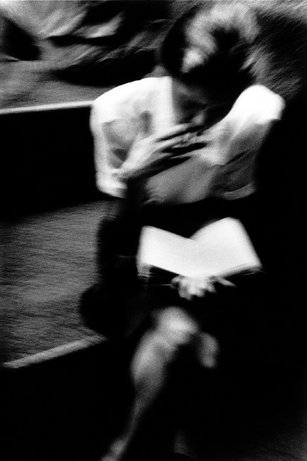
SYDNEY, Australia—An office worker on Pitt Street Mall reads a book during lunch hour, 1999.
 Mark Larson