
WHISK AWAY: Red and Blue Velvet Cake. It was delicious.
WHISK AWAY: Red and Blue Velvet Cake. It was delicious.
[The Große Fuge is] an absolutely contemporary piece of music that will be contemporary forever.
-Igor Stravinsky
Nice visualization, too.

Five reasons to drink sake. E.g. “To refuse the future.” (via)
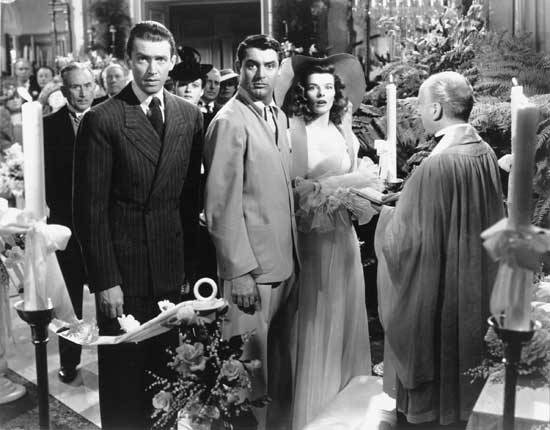
The Philadelphia Story. A very good movie. Hepburn and Stewart and Weidler steal the show here. I still don’t understand the appeal of Cary Grant.
This is so wonderful. We’re all living even further in the future than other people’s crazy dreams.
From a wish list of scientific advancements compiled by chemist and inventor Robert Boyle, who in 1662 discovered that the pressure and volume of a gas are inversely proportional, a property now known as Boyle’s Law. The list, which dates from the 1660s, is on display this month at the Royal Society of London, as part of the institution’s 350th anniversary celebration.
- The Prolongation of Life
- The Recovery of Youth, or at Least Some of the Marks of It, as New Teeth, New Hair Colour’d as in Youth
- The Art of Flying
- The Art of Continuing Long Under Water, and Exercising Functions Freely There
- The Cure of Wounds at a Distance
- The Cure of Diseases at a Distance or at Least by Transplantation
- The Attaining Gigantick Dimensions
- The Acceleration of the Production of Things out of Seed
- The Transmutation of Metalls
- The Making of Glass Malleable
- The Making Armor Light and Extremely Hard
- The Transmutation of Species in Mineralls, Animals, and Vegetables
- The Emulating of Fish Without Engines by Custome and Education Only
- The Practicable and Certain Way of Finding Longitudes
- The Use of Pendulums at Sea and in Journeys, and the Application of It to Watches
- A Ship to Saile with All Winds, and a Ship Not to Be Sunk
- Freedom from Necessity of Much Sleeping Exemplify’d by the Operations of Tea and What Happens in Mad-men
- Pleasing Dreams and Physicall Exercises Exemplify’d by the Egyptian Electuary and by the Fungus Mentioned by the French Author
- Great Strength and Agility of Body Exemplify’d by That of Frantick Epileptick and Hystericall Persons
- Varnishes Perfumable by Rubbing
- A Perpetuall Light

Gran Torino. Weaknesses up front: there’s some lazy writing, some bad acting, and Eastwood’s estranged family seems excessively caricatured. BUT, I thought the overall story arc here (themes: growing old; American confronting the Other; reluctantly becoming a better person) was really interesting and I never thought of switching it off. It had some good food-for-thought staying power after it ended. And Clint Eastwood gets a co-writing credit for the movie’s theme song.
[$10,000] wouldn’t go so far now, and yet most of the reasonable necessaries of life cost less to-day than they did two generations ago. The difference is that we need so very many comforts that were not invented in our grandfather’s time.
And also:
It is man’s peculiarity that nature has filled him with impulses to do things, and left it to his discretion when to stop. She never tells him when he has finished. And perhaps we ought not to be surprised that in so many cases it happens that he doesn’t know, but just goes ahead as long as the materials last.
The Tyranny of Things by Edward Sandford Martin – The Oxford Book of American Essays
Bad poets just bore us, but bad critics mislead us.

“Flirting is a woman’s trade, one must keep in practice.”
— Charlotte Brontë, Jane Eyre
I’m 1/3 of the way into Jane Eyre at the moment, and I’m pretty sure this is the mental image I’ll have from now on.

Berlin, North Dakota. A Google Maps view of the small town where my father’s father grew up, and where my grandfather’s father is buried. I remember stopping by here on a family road trip out West a couple decades ago. I thought it was cool. Big land, big sky. And it was also awkward. The town had, as I recall, a population of 38 or so. Nothing happening. Dad was getting all sappy and wistful about this place, where he’d never spent much time anyway. It was nice for a bit, seeing Grandpa’s old stomping grounds, the school, the gym where he played basketball. But I eventually I got to thinking, come’on, y’know, let’s get to the Tetons already. At least Mount Rushmore or something. This place is windy and tired. And now I’ve gotten to an age where I want to go back and sort of wander around. Walk through some fields and daydream about where I came from and the generations that got me here.

I wrote this a long time ago, it seems, and never got around to pushing the publish button. Just a few notes I typed while I was using it…
I liked these three articles related to the iPad:

Awesome book. I thank Justin for the recommendation. What you have in The Happiness Hypothesis: Finding Modern Truth in Ancient Wisdom is a perfect balance between nerdy science/philosophy and distilled layman’s explanations. Jonathan Haidt is so efficient with this book. It’s an impressive balance of general theory and immediately useful information. Below lie a bunch of quotes or scraps I found particularly worthwhile. You can find a lot more in Derek Sivers’ notes for the book, which I recommend very much for a solid overview. Read this book, y’all.
—
Scandal is great entertainment because it allows people to feel contempt, a moral emotion that gives feelings of moral superiority while asking nothing in return. With contempt you don’t need to right the wrong (as with anger) or flee the scene (as with fear or disgust). And best of all, contempt is made to share. Stories about the moral failings of others are among the most common kinds of gossip.
Set for yourself any goal you want. Most of the pleasure will be had along the way, with every step that takes you closer. The final moment of success is often no more thrilling than the relief of taking off a heavy backpack at the end of a long hike. If you went on the hike only to feel that pleasure, you are a fool.***
“Things won are done; joy’s soul lies in the doing.” -Shakespeare
The human mind is extraordinarily sensitive to changes in conditions, but not so sensitive to absolute levels.
Conditions include facts about your life that you can’t change (race, sex, age, disability) as well as things that you can (wealth, marital status, where you live). Conditions are constant over time, at least during a period in your life, and so they are the sorts of things that you are likely to adapt to. Voluntary activities, on the other hand, are the things that you choose to do, such as meditation, exercise, learning a new skill, or taking a vacation. Because such activities must be chosen, and because most of them take effort and attention, they can’t just disappear from your awareness the way conditions can. Voluntary activities, therefore, offer much greater promise for increasing happiness while avoiding adaptation effects.
“Happiness formula”: H = S + C + V (set point, conditions, voluntary activities)
External conditions with significant impact on your happiness, that you can never fully adapt to: Noise. Commuting. Lack of control. Shame. Interpersonal conflict.
Variety is the spice of life because it is the natural enemy of adaptation.
The extensive regulation of sex in many cultures, the attempt to link love to God and then to cut away the sex, is part of an elaborate defense against the gnawing fear of mortality.
Our life is the creation of our minds, and we do much of that creating with metaphor. We see new things in terms of things we already understand: Life is a journey, an argument is a war, the mind is a rider on an elephant. With the wrong metaphor we are deluded; with no metaphor we are blind.
Religious experiences are real and common, whether or not God exists, and these experiences often make people feel whole and at peace.
Life is much like a movie we walk into well after its opening scene, and we will have to step out long before most of the story lines reach their conclusions.
—
***This reminds me of one of Chris Willett’s rules for long-distance hiking. #1: If you’re not enjoying yourself, you’re doing something wrong. [I construe broadly the term “enjoying” here]. To round out the list, Rule #2: Never leave good trail for bad. Rule #3: Only a great fool leaves a dry place.
Man, The Point seems like a fantastic magazine (see also). This is one of the better DFW appreciations I’ve read, looking past the form and into the function, his mission, if we may call it that. Special focus is given to E Unibus Pluram and Infinite Jest. It’s one of those articles that makes me want to read more. Great, great stuff.
Death is Not the End – David Foster Wallace: His Legacy and his Critics – The Point Magazine
Glances are the big guns of the virtuous coquette; everything can be conveyed in a look, and yet that look can always be denied, because it cannot be quoted word for word.
One of the best things I’ve read this summer. Great writing. Well worth the time. (via)
The essence of passionate love, what grants it the nobility that the others do not possess, is what Stendhal calls crystallization. Just as the naked branch of a tree will gather diamond-like crystals if it is dropped into a salt mine, a lover will gather perfections about the crooked timber of his beloved.
Love in the Age of the Pickup Artist: Stendhal Among the Seducers – The Point Magazine
It kind of gives you hope. If you do creative work, there’s a sense that inspiration is this fairy dust that gets dropped on you, when in fact you can just manufacture inspiration through sheer brute force. You can simply produce enough material that the thing will arrive that seems inspired.
The Wrong Stuff: On Air and On Error: This American Life’s Ira Glass on Being Wrong
More specifially, on books about “how to succeed”:
It is perfectly obvious that in any decent occupation (such as bricklaying or writing books) there are only two ways (in any special sense) of succeeding. One is by doing very good work, the other is by cheating. Both are much too simple to require any literary explanation.

 Mark Larson