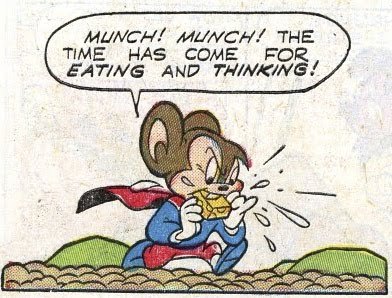
My two favorite things!
I love the intense facial expression.
Oh hell yeah. (via). À la Holst:
It’s just my interpretation of what each planet sounds like… I’m gonna go off on that. Just all instrumental. I’ve been studying the planets and learning the personalities of each planet.
Dr. Dre To Release Instrumental Hip-Hop Album About The Solar System | Gigwise
Not everyone agrees with my No Rules Rule. Siiiiiiigh. Naturally. After all, this is America, where the only art more popular than the art itself is the art of being a dick about the art. Same as baseball, jazz, porn, and every other invented-for-fun pastime, drinking is rife with fundamentalist nutjobs (see “purists”) who have one way of doing things–by the book. And not that book either. This book, with the leather binding and 6pt Century Gothic. The old one.

Helen DeWitt, Chart 2008
The things that drive us crazy don’t do so once a month, or once a week, or even once a day: we have to fight them minute by minute, hour by hour.
In a fascinating piece over at Incongruous Quarterly, DeWitt recalls charting her year. The red blocks signify days she didn’t smoke, didn’t drink, or went to the gym. Very Lodwickian.
I like this kind of essay. The dude had never played video games before! I wish he’d chosen a broader variety of games, but it’s nice to have a fresh perspective. You take a lot of this for granted when you grow up with it:
The second thing I learned about video games is that they are long. So, so long. Playing one game is not like watching one ninety-minute movie; it’s like watching one whole season of a TV show—and watching it in a state of staring, jaw-clenched concentration. If you’re good, it might take you fifteen hours to play through a typical game. If you’re not good, like me, and you do a fair amount of bumping into walls and jumping place when you’re under attack, it will take more than twice that.
If you aren’t having no fun, die, because you’re running a worthless program, far as I’m concerned.
What do people want from Art? I don’t know the full answer, but one thing I’m increasingly sure of is that they want life. They want the sense that there is something going on, that something real and exciting and of its moment has been captured […]
In an age of digital perfectibility, it takes quite a lot of courage to say, “Leave it alone” and, if you do decide to make changes, quite a lot of judgment to know at which point you stop. A lot of technology offers you the chance to make everything completely, wonderfully perfect, and thus to take out whatever residue of human life there was in the work to start with. […] It’s a misunderstanding to think that the traces of human activity — brushstrokes, tuning drift, arrhythmia — are not part of the work. They are the fundamental texture of the work, the fine grain of it.
The person leading the Well-Planned Life emphasizes individual agency, and asks, “What should I do?” The person leading the Summoned Life emphasizes the context, and asks, “What are my circumstances asking me to do?”
(via)
Who had light and who did not? What did different types of people do with their newfound hours? How did street lighting change public behavior? (Once drinkers could move safely between taverns, instead of perching on a single tavern stool all night … the streets became far rowdier; prostitutes previously confined to brothels could now sell their wares al fresco.) With increased mobility and safety, those who could afford lighting stayed up later. Sleeping in became a mark of prestige. Meanwhile, those who lived near the gasworks — never located in a city’s high-rent district — endured foul-smelling and dangerous emissions.
(via)
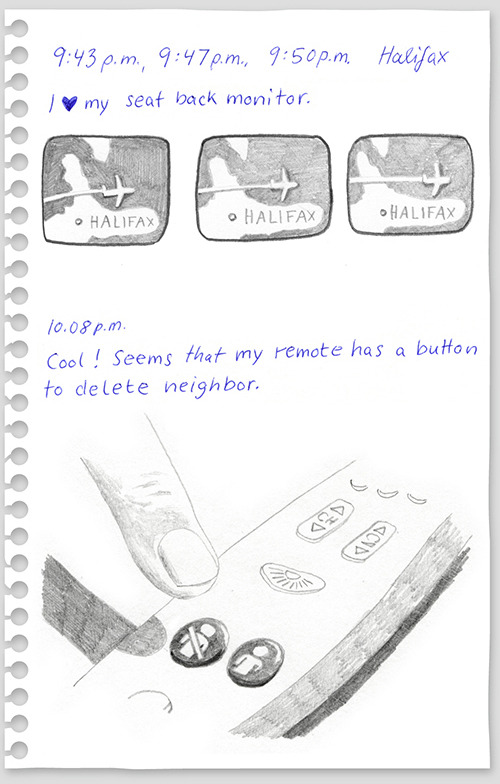
Red Eye – Abstract City Blog – NYTimes.com. “A visual diary documenting a flight from New York to Berlin (with a layover in London).” I, too, ♥ my seat back monitor.
When you think about it, rules for drinking are not so different from rules for writing. Many of these are so familiar they’ve become truisms: Write what you know. Write every day. Never use a strange, fancy word when a simple one will do. Always finish the day’s writing when you could still do more. With a little adaptation these rules apply just as well for drinking. Drink what you know, drink regularly rather than in binges, avoid needlessly exotic booze, and leave the table while you can still stand.
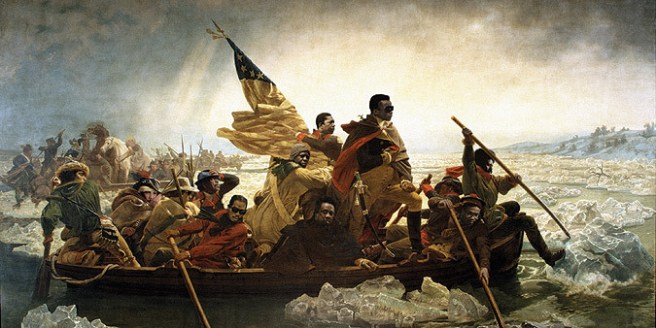
“Jazzcats Crossing the Hudson is an 1851 oil-on-canvas painting by German American artist Emanuel Gottlieb Leutze. It pre-emptively commemorates the arrival in New York City of jazz greats Miles Davis, John Coltrane, Sun Ra, Pharoah Sanders, Steve Kuhn and others. The painting is remarkable for the fact that it was created decades before the birth of any of these jazz artists.”
via mastertone
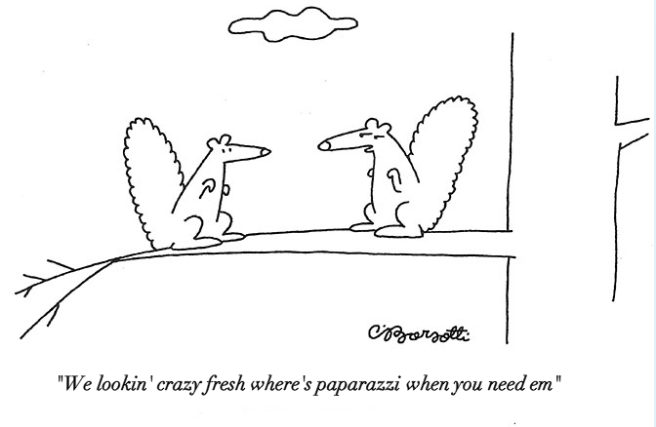
Kanye West’s tweets meet The New Yorker’s Cartoon Caption Contest. The results are hilarious!
Thanks Josh A. Cagan (@joshacagan on Twitter) for these amazing mash-ups – you made our morning!

Bande à part (Band of Outsiders). I didn’t dig this one very much, but at least watch the dance scene. I stopped paying full attention about half-way into it. This Criterion essay covers it well.
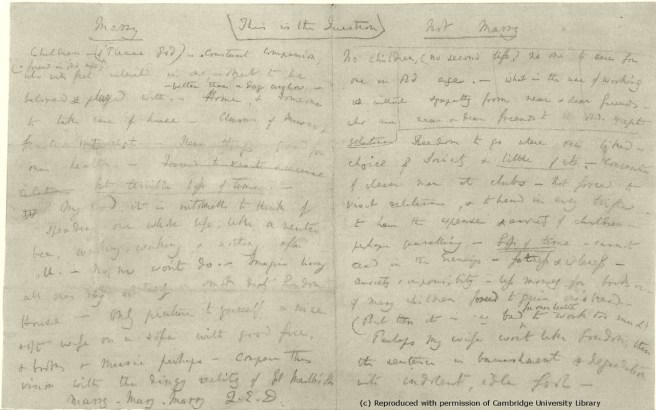
This is the Question, Charles Darwin writes at the top of the page. Each half of the page is a list brainstorming his two options with Emma Wedgewood:
To Marry…
Children — (if it Please God) — Constant companion, (& friend in old age) who will feel interested in one, — object to be beloved & played with. — —better than a dog anyhow. — Home, & someone to take care of house — Charms of music & female chit-chat. — These things good for one’s health. — Forced to visit & receive relations but terrible loss of time. —
My God, it is intolerable to think of spending ones whole life, like a neuter bee, working, working, & nothing after all. — No, no won’t do. — Imagine living all one’s day solitarily in smoky dirty London House. — Only picture to yourself a nice soft wife on a sofa with good fire, & books & music perhaps — Compare this vision with the dingy reality of Grt. Marlbro’ St.
or Not Marry?
No children, (no second life), no one to care for one in old age.— What is the use of working without sympathy from near & dear friends—who are near & dear friends to the old, except relatives
Freedom to go where one liked — choice of Society & little of it. — Conversation of clever men at clubs — Not forced to visit relatives, & to bend in every trifle. — to have the expense & anxiety of children — perhaps quarelling — Loss of time. — cannot read in the Evenings — fatness & idleness — Anxiety & responsibility — less money for books &c — if many children forced to gain one’s bread. — (But then it is very bad for ones health to work too much)
Perhaps my wife wont like London; then the sentence is banishment & degradation into indolent, idle fool —
The final result:
Marry — Marry — Marry. Q.E.D.
He also goes on to wrestle with the question of marrying sooner vs. later. (via)
See also: lay it all out where you can look at it.
His rules seem reasonable. (via)
(1) The number of guests should follow Chesterfield’s rule: no fewer than the Graces (i.e., three), no more than the Muses (i.e., nine).


 Mark Larson