We do not bring in compensation consultants and we don’t have a human resources department, legal department, etc. That makes life way too complicated, and people get vested in going to conferences.
Ideas and views that differ from one’s own should not be targets for demolition, but whetstones for sharpening one’s own thoughts.
Philip Ball in the preface to his very good book, The Music Instinct.
The Shadow Scholar: The man who writes your students’ papers tells his story – The Chronicle of Higher Education
From my experience, three demographic groups seek out my services: the English-as-second-language student; the hopelessly deficient student; and the lazy rich kid.
Of all the duties required of the professional critic, the least important–certainly the least enduring–is the verdict.
Anthony Lane. (via)
La Collectionneuse
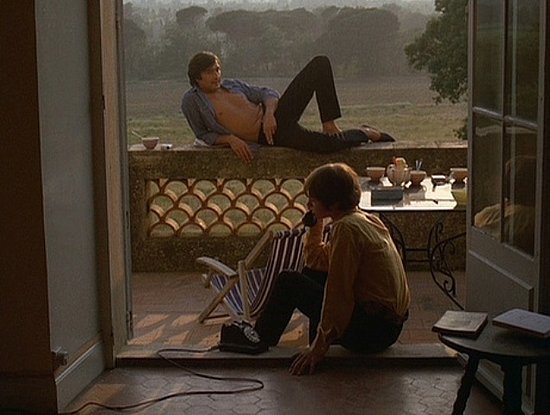
La Collectionneuse. One of Éric Rohmer’s Six Moral Tales. Like Roman Holiday, this one centers on a question that doesn’t get answered until the last minute. It wasn’t as much pure fun, but I still respect a patient movie. From Phillip Lopate’s Criterion essay:
Here we see one of Rohmer’s most original tropes: the tepid attraction. It flies in the face of all cinematic convention, which dictates that the encounter of a good-looking man and a good-looking woman must lead to grand narrative passion. […] Rohmer views the problems of indolent, potential-laden, prolonged youth in this film from the perspective of the middle-aged artist, who knows that the clock is ticking.
<param name="movie" value="http://www.youtube.com/watch?v=PqDWxub_nAU
Alton Ellis – What Does It Take To Win Your Love. Those rhythm and lead guitar lines are dope. That riff you recognize is Harvey Fuqua’s work, later immortalized by Kenny G.
(Source: http://www.youtube.com/)

About Costa Rica, Nicaragua, their mutual border, and Google | Ogle Earth. (via)
Nicaragua did not mistakenly enter Costa Rican territory because it relied on Google Maps. Ortega’s justification for Nicaragua’s actions appeal to documents from the 19th century; Pastora’s mention of Google Maps is just a taunt.
This whole thing, after going to Nicaragua last winter, makes me wonder:
Is there a (preferably German) word for the residual interest/affection you feel about places you’ve visited only for a short time?
“Nostalgia” is too yearn-y and past-oriented. It’s more like wanting to be in touch with the Now that you’re missing over there.

Marilyn Monroe’s Stuffing Recipe. Found in the new book, Fragments.
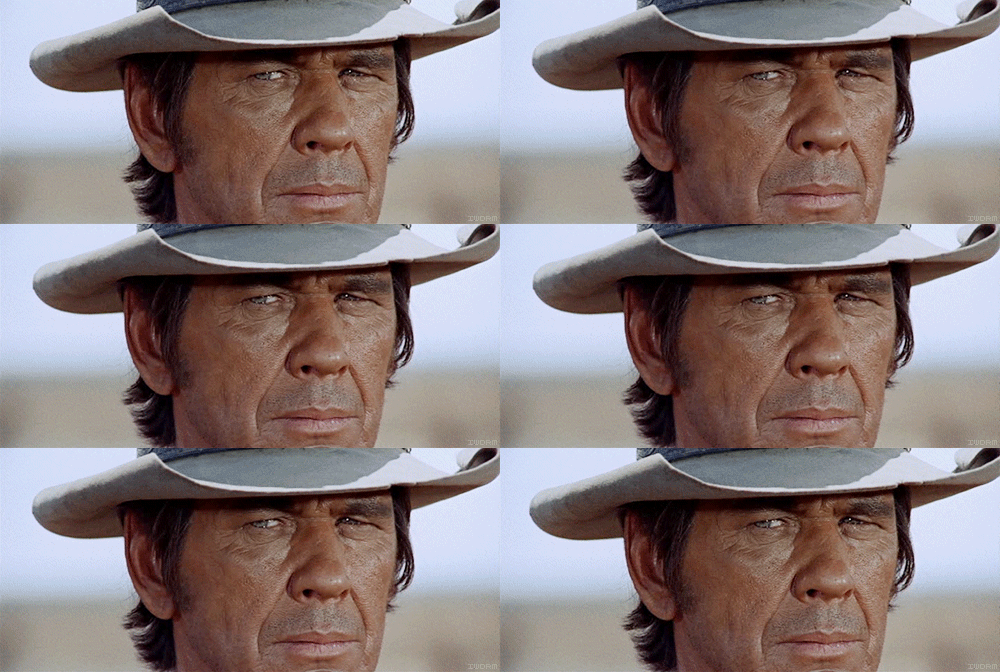
“Yeah, go on. Play Harmonica. Play, so you can’t bullshit.”

“Whenever I hear the word ‘culture’, I bring out my checkbook.”
Jean-Luc Godard’s crack is a variation on a line from Hanns Johst’s play Schlageter.
If you are dependent on borrowed money, you have to wake up every day worried about what the world thinks of you.
Warren Buffett. The context for this was the Bear Stearns meltdown, but it applies to so much more.
Hangin’ Around with Zach Galifianakis :: North Carolina State University
DP: Finally, if you could give one bit of advice to NC State students, what would it be?
ZG: There is more to life than college. Use your time in college and grow. There are some people who are still playing beer pong in their late 20s. Do not do that.
Hangin’ Around with Zach Galifianakis :: North Carolina State University

Philosophy Bites: Gideon Rosen on Moral Responsibility
Great episode this week.
Balanced Arguments Are More Persuasive — PsyBlog
Not Your Parents’ Audiobook: David Byrne’s “Bicycle Diaries”
David Byrne’s successful book, Bicycle Diaries, probably would have sold just fine as a traditional audiobook, as well. However, never one for the status quo, Byrne wanted to do something a little more interesting than simply reading the book in silence and releasing it as a download or cd. Instead, he looked to other successful audio formats for inspiration, namely NPR shows that incorporate scene sounds and podcasts.
I was pretty ambivalent about the book, but maybe ambient sound would have kicked it up a notch, especially for a work so linked to its geography. Great idea. Download the intro and hear some samples.
Not Your Parents’ Audiobook: David Byrne’s “Bicycle Diaries”
Monty Python – Novel Writing. Live broadcast of Thomas Hardy writing “The Return of the Native”. (via)
He dips the pen… in the ink AND HE’S OFF… it’s the first word BUT IT’S NOT A WORD. Oh no! It’s a doodle way up on the top of the left-hand margin. It’s a piece of meaningless scribble!
(Source: https://www.youtube.com/)
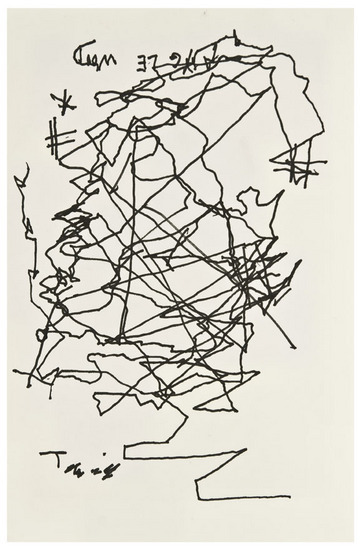
Jorge Luis BORGES (Argentinian, 1899 – 1986) Self-portrait. ink on paper
8 3/4 x 6 inches (225 x 150 mm)When he drew this, because Burt Britton asked him to, Borges was blind.
Weirdly, Cormac McCarthy also did a self-portrait for Britton. Other writers in the collection: Joan Didion, Edward Gorey, Roald Dahl, Margaret Atwood, Saul Bellow, Norman Mailer, Maurice Sendak, John Updike, and Tom Wolfe.
Scene from the 1971 George Englund film Zachariah
So Elvin Jones walks into a saloon, shoots a dude dead and then plays the fuck out of the James Gang’s drums, basically fulfilling every fantasy you ever had. Because, yeah. Also? WHAT DIMENSION IS THIS FROM? I DON’T EVEN. I CAN’T. OMGGFNFG
(Source: https://www.youtube.com/)

 Mark Larson