oldhollywood:

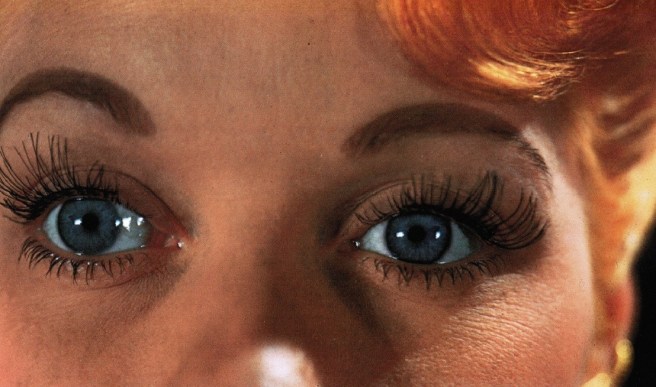
“I am not funny. My writers were funny. My directors were funny. The situations were funny…What I am is brave. I have never been scared. Not when I did movies, certainly not when I was a model, and not when I did I Love Lucy.”

Lucille Ball (Rolling Stone, June 23, 1983) (photo by Walt Sanders for LIFE, 1943, click to enlarge)

They get one letter from me every couple of years. And basically it says, run this business like it’s the only business that your family can own for the next 100 years. You can’t sell it. But every year don’t measure it by the earnings in the quarter that year. Measure it by whether the moat around that business, what gives it competitive advantage over time has widened or narrowed. If you keep doing that for 100 years, it’s going to work out very well. Then I tell them basically if the reason for doing something is everybody else is doing it, it’s not good enough. If you have to use that as a reason, forget it.

Warren Buffett’s thoughts on building a business work well on a personal scale, too. Build your moat, make it bigger. See also Douglas Adams’ career advice (via):

If you want something extraordinary, you have two paths: 1. Become the best at one specific thing. 2. Become very good (top 25%) at two or more things. […] Capitalism rewards things that are both rare and valuable. You make yourself rare by combining two or more “pretty goods” until no one else has your mix.

Poignance Measured in Digits – New York Times

July 16, 1989 article by Hans Fantel. He writes about a CD his father gave him, a Vienna Philharmonic performance of Mahler’s 9th–the very show that they’d attended together 50 years earlier, which also happened to be the last the Vienna Philharmonic would give before Hitler rolled in.

But it wasn’t the music alone that cast a spell over me as I listened to the new CD. Nor was it the memory of the time when the recording was made. It took me a while to discover what so moved me. Finally, I knew what it was: This disk held fast an event I had shared with my father: 71 minutes out of the 16 years we had together. Soon after, as an “enemy of Reich and Fuhrer,” my father also disappeared into Hitler’s abyss.

That’s what made me realize something about the nature of phonographs: they admit no ending. They imply perpetuity.

All this seems far from our usual concerns with the hardware of sound reproduction. But then again, speculating on endlessness may be getting at the purposive essence of all this electronic gadetry – its “telos,” as the Greeks would say. In the perennial rebirth of music through recordings, something of life itself steps over the normal limits of time.

(via Alex Ross’ new book)
Poignance Measured in Digits – New York Times

Le Samouraï

Le Samouraï. When I came across this I was thinking something along the lines of “Alain Delon as assassin ≈ Cary Grant as Treadstone asset”. Count me in. Four minutes into the movie we get a bit of pulsing ostinato organ riff and somehow I knew I’d love it. (There’s also some great diegetic jazz later in the film.) Early on, Delon goes out to do a job BUT he screws up pretty big. He gets arrested, we get a long, fascinating ensemble interrogation scene (François Périer is great) and the rest of the movie unfolds in a taut but not frenzied way. Great movie. David Thomson’s Criterion essay.

He chose a way of death guaranteed to bring down a hailstorm of prying analytical chatter far in excess of anything he had experienced while he was alive. This is the paradoxical allure of suicide: to leave the chattering world behind and yet to stage-manage the exit so that one is talked about in the right way.

Alex Ross on Kurt Cobain. From the obituary that first appeared with slightly different wording in the New Yorker. [$]

The Searchers: Radiohead’s unquiet revolution – The New Yorker

Alex Ross on tour with Radiohead. I like this bit from Nigel Godrich on Radiohead’s ongoing effort to figure out their sound and musical directions. At one point,

People stopped talking to one another. ‘Insanity’ is the word. In the end, I think the debate was redundant, because the band ultimately kept doing what it has always done—zigzagging between extremes. Whenever we really did try to impose an aesthetic from the outside—the aesthetic being, say, electronic—it would fail. All the drama was just a form of procrastination.

The Searchers: Radiohead’s unquiet revolution – The New Yorker

I read an interview with Tom Waits, around the time of his album “Rain Dogs,” in which he talked about how you come to a point on an instrument where you have to stop playing it and find another instrument that you don’t know what you’re doing with. Part of songwriting is having that naïve excitement about not quite realizing why you’re getting off on it, because you haven’t had time to pull it apart yet. Songwriting relies on not pulling things apart: the best ideas are the simple ideas.

Thom Yorke in an interview with Alex Ross.

The difference between potential and output comes from human qualities. You can make a list of the qualities you admire and those you despise. To turn the tables, think if this is the way I react to the qualities on the list, which is the way the world will react to me. You can learn to turn on those qualities you want and turn off those qualities you wish to avoid. The chains of habit are too light to be felt until they are too heavy to be broken. You can’t change at 60; the time to look at that list is now.

Warren Buffett on habits and being a better person. Ties in with some of my thoughts on a well-balanced life earlier this year. Write it down, check in every so often, re-calibrate as needed.

What I’ve been reading, vol. iv

Gotta say, these past two months have been pretty good for reading. From the most recent to the more distant in time:
1. Why Mahler?. This might be better for people who already care at least a little bit about Mahler, one of those characters that lends to incompleteness. Like talking about his music. Too vast, too contradictory, too universal, too personal. Still, it’s a breezy, rangy biography mixed with some memoir, and it’s a good read.

2. Listen to This. Alex Ross is one of my favorite writers. This book is mostly a collection of stuff he’s written for The New Yorker. The essays I dog-eared most heavily were Chacona, Lamento, Walking Blues, Infernal Machines, The Storm of Style, Song of the Earth, Verdi’s Grip, and his writings on tour with Radiohead and Bob Dylan were interesting, too. He’s also got a great audio guide for Listen to This like the one for The Rest is Noise (which is awesome).

3. The Art of Non-Conformity. Got curious about this one because I recognized the brand. The blog is better.

4. The Music Instinct. Author Philip Ball struck me first and foremost as a very fair writer. It seems like he doesn’t have very many bones to pick, aside from the fact that we should stay open-minded and open-eared. The first 60-70% of the book, the best part, is nerdy stuff about music theory—the science of pitch, scales, harmony, timbre, rhythm, etc. He’s glad to branch out across the world and not just focus on Western tradition. I found it quite good.

5. The Substance of Style. Couldn’t finish. Seemed sort of argument-by-anecdote-y, which is fine, but not what I wanted at the time.

6. The Art of Travel. This is mostly worthwhile, the first half in particular. Each section centers around a topic (Anticipation, Curiosity, the Exotic, the Sublime, etc.), a tour guide of sorts (e.g. Huysmans, Humboldt, Baudelaire, Flaubert, Van Gogh), and de Botton’s own observations and musings. It’s a good, quick read.

7. The Book of Basketball. I thought it was awesome. Rare to find any book, nonfiction or otherwise, that keeps you up late a few nights in a row.

8. On Kindness. Another one that I really, really liked and shared a bunch of quotes from. Great brain food here.

9. Steppenwolf. I read this one right after “The Moviegoer”, below. They both deal with existential angst, but this one is much more over-the-top, orotund, and, um, German. I think you could get your time’s worth just reading the first 40 pages or so.

10. The Moviegoer. I liked this one alright. Nothing much happens in the story, but the narrator’s struggles—with his own ambivalence, with relating to people, with finding satisfaction outside of passive distractions, etc.—were good food for thought.

11. Jane Eyre. This was a bit of a drag. Either I’m a curmudgeon with no heart or it’s kind of boring. This was, however, the first book I read mostly on my iPad, so it was nice to have that experience. I would have shared a bunch of quotes and bon mots, but, alas, as of now there’s no way to export highlights from iBooks other than tedious cut and paste. Maybe get to that later…

I think I’m due for some more fiction soon. More of what I’ve read lately can be found in volumes one, two, and three.