Playboy Interview: Metallica (April 2001)

This interview is packed with wonderful tidbits. James Hetfield on day jobs and the early tour routine:

We worked at day jobs. After that, we’d throw parties, take the furniture out of the house and smash the joint. We smashed dressing rooms just because you were supposed to. Then you’d get the bill and go, “Whoa! I didn’t know Pete Townshend paid for his lamp!” Come back off the tour and you hadn’t made any money. You bought furniture for a bunch of promoters.

Hetfield on growing up differently from Lars Ulrich:

I could afford maybe one record a week, and he would come back from the store with 20. He bought Styx and REO Speedwagon, bands he’d heard of in Denmark. I would go, “What the fuck? Why did you buy Styx?“

Kirk Hammett on Hetfield’s Nothing Else Matters:

All I could think of at the time was, James wrote a fucking love song to his girlfriend? That’s just weird.

Hetfield on alcohol abuse and parenthood:

You can’t be hung over when you got kids, man. “Dad, get the fuck off the couch!” Well, they don’t say that—yet.

Ulrich on Matt Damon:

PLAYBOY: Your wife, Skylar, used to date Matt Damon, and he made her the model for the female lead in Good Will Hunting. A few years ago, Matt described you as “a fucking rock star who’s got $80 million and his own jet—a bad rock star, too.”

ULRICH: He said that before we met. And he’s apologized about a hundred times. The first five times I saw him, he would spend 10 minutes apologizing profusely. He really is a sweetheart.

Ulrich on collecting art:

Hanging out backstage with Kid Rock is an amazing turn-on, no less so than sitting and staring at my Dubuffet for an hour with a fucking gin and tonic.

Playboy Interview: Metallica (April 2001)

On the first tour through America, my spandex—I fucking hate saying, “my spandex”. It’s a pretty evil phrase.—They were wet from the night before, and I was drying them by the heater. A big hole melted right in the crotch. It was like, “They’re like pantyhose.” I just opted to keep my jeans on, and that was the best thing that ever happened.

austinkleon:

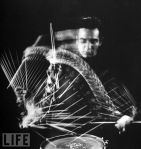
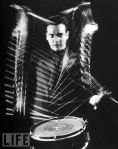
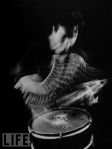
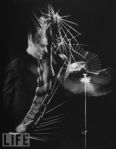
Drummer Gene Krupa performing at Gjon Mili’s studio. NYC, 1941

*Amazing* photographs from LIFE Magazine’s photo archives. Originally featured in the July 9th, 1941 article, “GENE KRUPA SHOWS HOW TO PLAY DRUM IN THESE FANTASTIC SOUND PICTURES.

In these unusual shots Krupa illustrates some rudiments of drumming. They were taken by Gjon Mili’s multiple-exposure camera so you could follow the track of Krupa’s drumsticks whizzing through the air. But they are interesting also as impressionistic portraits of sound, suggesting the rhythmic pandemonium of a Krupa jam session.

….As a drum historian, he likes to tell how Napoleon Bonaparte was once defeated by Russians who were roused to a fighting frenzy by Cossack drummers. Says Krupa proudly, “I have Cossack blood myself.”

Also, be sure to follow the LIFE Tumblr.

The Simple Art of Murder – Raymond Chandler

Chandler on the detective story and how it resists criticism. This bit reminded me of Joan Acocella’s recent article about Stieg Larsson:

The murder novel has also a depressing way of minding its own business, solving its own problems and answering its own questions. There is nothing left to discuss, except whether it was well enough written to be good fiction, and the people who make up the half-million sales wouldn’t know that anyway.

A bit cynical, but there you go. Also provocative:

There are no vital and significant forms of art; there is only art, and precious little of that. The growth of populations has in no way increased the amount; it has merely increased the adeptness with which substitutes can be produced and packaged.

And of course:

Everything written with vitality expresses that vitality; there are no dull subjects, only dull minds. All men who read escape from something else into what lies behind the printed page; the quality of the dream may be argued, but its release has become a functional necessity. […] I hold no particular brief for the detective story as the ideal escape. I merely say that all reading for pleasure is escape, whether it be Greek, mathematics, astronomy, Benedetto Croce, or The Diary of the Forgotten Man. To say otherwise is to be an intellectual snob, and a juvenile at the art of living.

See also Woody Allen on escapism. The next-to-last paragraph about the nature of the crime/detective story hero is also worthwhile.

The Simple Art of Murder – Raymond Chandler

Besides, I am destined to perish, definitively, and only some instant of myself can survive in him. Little by little, I am giving over everything to him.

From Borges’ short story Borges and I, which, even though it’s so short, I’ve tumbled before. My reading of his work has been scattered (I picked up a few different collections to fix that), but it almost always hurts my brain in a good way. For the volume of imagination and inventiveness and ideas in such efficient form, I remain convinced that the right Borges at the right time can be more worthwhile than entire literature classes.

Raymond Chandler – The Simple Art of Murder

Chandler on the detective story and how it resists criticism. This bit reminded me of Joan Acocella’s recent article about Stieg Larsson:

The murder novel has also a depressing way of minding its own business, solving its own problems and answering its own questions. There is nothing left to discuss, except whether it was well enough written to be good fiction, and the people who make up the half-million sales wouldn’t know that anyway.

A bit cynical, but there you go. Also provocative:

There are no vital and significant forms of art; there is only art, and precious little of that. The growth of populations has in no way increased the amount; it has merely increased the adeptness with which substitutes can be produced and packaged.

And of course:

Everything written with vitality expresses that vitality; there are no dull subjects, only dull minds. All men who read escape from something else into what lies behind the printed page; the quality of the dream may be argued, but its release has become a functional necessity. […] I hold no particular brief for the detective story as the ideal escape. I merely say that all reading for pleasure is escape, whether it be Greek, mathematics, astronomy, Benedetto Croce, or The Diary of the Forgotten Man. To say otherwise is to be an intellectual snob, and a juvenile at the art of living.

See also Woody Allen on escapism. The next-to-last paragraph about the nature of the crime/detective story hero is also worthwhile.

Raymond Chandler – The Simple Art of Murder

Besides, I am destined to perish, definitively, and only some instant of myself can survive in him. Little by little, I am giving over everything to him.

From Borges’ short story Borges and I, which, even though it’s so short, I’ve tumbled before. My reading of his work has been scattered (I picked up a few different collections to fix that), but it almost always hurts my brain in a good way. For the volume of imagination and inventiveness and ideas in such efficient form, I remain convinced that the right Borges at the right time can more worthwhile than entire literature classes.

When I begin working on a film, it’s like standing on shaky ground. I never know where I’m standing. My only sure footing is to make the movie. If the movie moves me and interests me, I presume it will move and interest others. At the same time, if I’ve made a good movie, I try not to repeat it.

La Ventana (The Window)

La Ventana (The Window). Antonio is an ailing old man whose estranged son is coming to visit. He gets a haircut, retrieves the special bottle of champagne, goes for a walk, has the piano tuned. Movies like this are proof that you don’t need dramatic twists, revelations, surprises or other antics to make a worthwhile film. Even predictable is fine if you’ve got a premise you’re willing to follow for a few minutes and a world with a few characters you’re willing to care about. This one was really nicely done.

There’s Blake flying up for an offensive rebound, soaring higher, and higher, and then a little bit higher … and we’re sitting there in awe, and we’re gasping for air … and right at the moment of truth, we realize one of the following four things:

A. Blake is about to make the single greatest highlight in the history of professional basketball.
B. Blake is about to give us the highlight of the night.
C. Blake can’t pull this off because the degree of difficulty is too high, but he’s trying anyway.
D. Blake is going to break his neck or land in a such a way that his leg flies off his body and lands in the fifth row.

Those are the four options EVERY time he goes in the air. Watching it unfold reminds me of watching my 3-year-old son, who’s equally fearless (and dangerous).

There’s Blake flying up for an offensive rebound, soaring higher, and higher, and then a little bit higher … and we’re sitting there in awe, and we’re gasping for air … and right at the moment of truth, we realize one of the following four things:

A. Blake is about to make the single greatest highlight in the history of professional basketball.
B. Blake is about to give us the highlight of the night.
C. Blake can’t pull this off because the degree of difficulty is too high, but he’s trying anyway.
D. Blake is going to break his neck or land in a such a way that his leg flies off his body and lands in the fifth row.

Those are the four options EVERY time he goes in the air. Watching it unfold reminds me of watching my 3-year-old son, who’s equally fearless (and dangerous).

Marginal Revolution: Sex and Statistics or Heteroscedasticity is Hot

Alex Tabarrok mulls over the recent OkTrends post on the Mathematics of Beauty.

I think there are certain types of beauty that greatly attract some men but repel others. Analagously, some people will pay hundreds of dollars for an ounce of caviar that other people won’t eat for free. The reason some people love caviar, however, is not that other people dislike it. Instead, it just so happens, that the thing that some people love is the very thing that repels others. We see the same phenomena in art, some people love John Cage, other people would rather listen to nothing at all. ;)

Now if we mix in this kind of beauty–beauty over which there are violent disagreements–with the kind that most people do agree upon (think Haagan-Dazs vanilla ice cream) then I suspect that it will appear that lower rankings increase messages. But what is really going on is that high rankings–conditional on their also being many low rankings–actually signal an extra strong attraction. Someone who tells you that John Cage is their favorite composer is telling you more than someone who says Aaron Copland is their favorite composer.

Marginal Revolution: Sex and Statistics or Heteroscedasticity is Hot