Say What?: An Interview with Etymonline.com’s Douglas Harper | David C. Carver | Drunken Koudou
Steve Reich’s “Clapping Music” performed by Lee Marvin and Angela Dickinson. (via) A scene from Point Blank, I believe. Here’s the score.
(Source: https://www.youtube.com/)

Potlatch: The Politics of the Thumb.
The thumb-press is a straight-forward mode of manual expression, in which the user makes a traditional fist, but then manoeuvres the thumb from its position clasped over (or under the fingers) and lays it gently on top of the index finger as a hint of diplomacy.
Atlanta by car, 1991. As Pecanne Log points out: killer soundtrack.
(Source: https://www.youtube.com/)
Wind & Wonder: the Great Mississippi River Balloon Race by Brian Blickenstaff – Norman Einstein’s Sports & Rocket Science Monthly
Double Indemnity

Double Indemnity. This one is very good. Very cynical, not as nearly as complicated as some other noir, just a tight, direct story. You have to wonder why the characters let themselves get caught up like this. They might wonder the same thing. Good performances all around, but again I find myself especially impressed with Edward G. Robinson. The other time I saw him was in Key Largo.
Strange as it may sound to many people, who tend to think of critics as being motivated by the lower emotions: envy, disdain, contempt even… Critics are, above all, people who are in love with beautiful things, and who worry that those things will get broken.
The Mad Men Account by Daniel Mendelsohn | The New York Review of Books
Although I can’t vouch for anything beyond the second season, Mendelsohn’s critique seems fair. (via)
Worst of all—in a drama with aspirations to treating social and historical “issues”—the show is melodramatic rather than dramatic. By this I mean that it proceeds, for the most part, like a soap opera, serially (and often unbelievably) generating, and then resolving, successive personal crises (adulteries, abortions, premarital pregnancies, interracial affairs, alcoholism and drug addiction, etc.), rather than exploring, by means of believable conflicts between personality and situation, the contemporary social and cultural phenomena it regards with such fascination: sexism, misogyny, social hypocrisy, racism, the counterculture, and so forth.
A few years ago, I read a collection of Mendelsohn’s criticism, most of it anyway, and found it quite enjoyable.
The Mad Men Account by Daniel Mendelsohn | The New York Review of Books
You can tell when rhetoric is empty — and therefore should be cut — because it would never be possible to say the alternative.
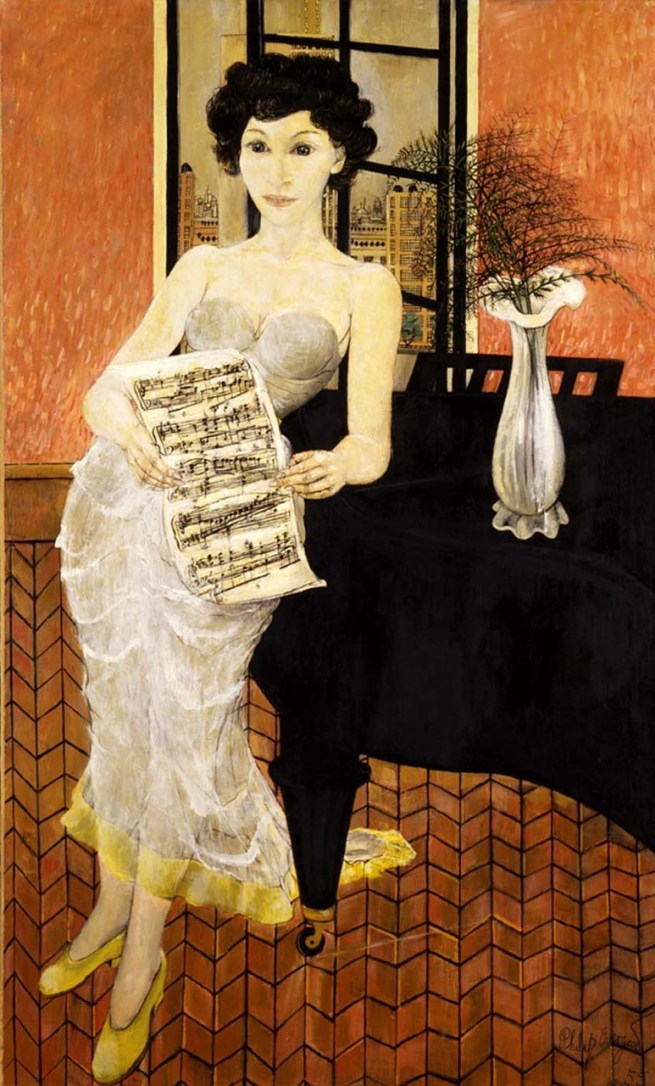
Woman at the Piano by Philip Evergood, 1955.
My Father’s Fashion Tips – GQ
The turtleneck is the most flattering thing a man can wear because it strips a man down to himself—because it forces a man to project himself. The turtleneck does not decorate, like at tie, or augment, like a sport coat, or in any way distract from what my father calls a man’s “presentation”; rather, it fixes a man in sharp relief and puts his face on a pedestal—first literally, then figuratively. It is about isolation, the turtleneck is; it is about essences and first causes; it is about the body and the face, and that’s all it’s about.
Music is not ruined by other people liking it. Discovering things for the first time can still be the source of great pleasure, even when everyone else in the world has already heard it.
Riff Market: Theoretically Unpublished Piece About Girl Talk
I endorse this criticism, particularly regarding the uniformity of timbre/texture/tempo. And/or I’m just old and cranky and don’t understand kids these days. (via)
With Girl Talk, we get that blissful moment of recognition without having to suffer through the next three minutes and thirty seconds remembering exactly why it hasn’t been Hammertime for more than a decade now.
Also:
Girl Talk’s insistence on not being a pure DJ is a key to why the music sounds like it does, why it has only one speed, one timbre, and one density: if he lets a sample or phrase or loop breath on its own without some kind of additional percussion or secondary element, he is violating his own semantic scruples. Rule Number One of Girl Talk Club: Everything must be mashed at all times or otherwise the whole musique concrete / “art compounded from other art” rationale falls away, and Gillis is “just a DJ.”
This was intriguing, but has maybe been true for decades:
With Girl Talk compositions, one wonders how much of Gillis’s ease is a testament to his technical prowess, and how much is just an articulation of the fact that pop music has become increasingly standardized.
And also:
Forget art. The question is, without a public hungry for the references, is Feed the Animals anything at all? Does Girl Talk hold up as “music” without all the extratextual information? If you had no idea about mash-ups or hip-hop or “No Diggity” or “Epic” by Faith No More would you really be all that impressed? It would just be a long stream of unstructured pop drone. Imaginary straw-men that have lived in a underground bunker for fifty years would totally hate Girl Talk!
Riff Market: Theoretically Unpublished Piece About Girl Talk
Every NBA Slam Dunk Contest Video Visualization
We broke down every NBA slam dunk contest (1984 to 2010) by dunk, year, and score. You can see video footage of the actual dunk by clicking on the circles in the graph.
Racing Up the Empire State Building – NYTimes.com
The way to kick [competitors] in the gut is to surge… But who does that? A guy who’s trained to do it for the last six months.
Love has never failed. It has won every battle. And today and forever more it will go on undefeated.
R. Kelly in an interview with Will Oldham. I had no idea he started as a busker.

What’s in a Surname?. (via) “A new view of the United States based on the distribution of common last names shows centuries of history and echoes some of America’s great immigration sagas.” (Map: Mina Liu; Oliver Uberti, NGM Staff. Source: James Cheshire, Paul Longley, and Pablo Mateos, University College London.)
The Problem With Memoirs – NYTimes.com
There was a time when you had to earn the right to draft a memoir, by accomplishing something noteworthy or having an extremely unusual experience or being such a brilliant writer that you could turn relatively ordinary occurrences into a snapshot of a broader historical moment. Anyone who didn’t fit one of those categories was obliged to keep quiet. Unremarkable lives went unremarked upon, the way God intended.
Fight Club
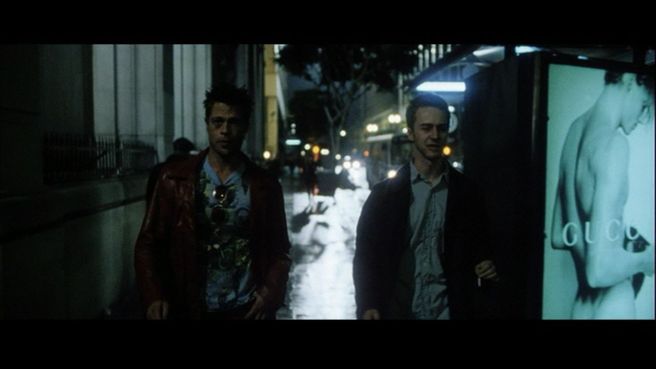
Fight Club. This was kind of boring. (Zodiac is by far the best of the three David Fincher films I’ve seen. Seven was worthwhile, but hasn’t aged well. I wonder where The Social Network will rank when I see it.)
Best Beer Bars 2011 – RateBeer
I can walk to #4 and drive to #7 in like 8 minutes. We’ve also got the #12 retailer. I love Atlanta.
 Mark Larson