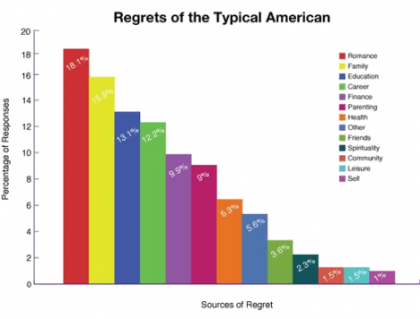
Regrets of the Typical American. And I like this bit from the abstract of the study: “inaction regrets lasted longer than action regrets”.
Regrets of the Typical American. And I like this bit from the abstract of the study: “inaction regrets lasted longer than action regrets”.
I haven’t had trouble with writer’s block. I think it’s because my process involves writing very badly.
“Would the Summer of Love have ever happened without Stanley, the reclusive acid impresario who turned on the world?”
He did not, contrary to popular lore, release a product called Purple Haze; in interviews, he sounded quite miffed that anything emerging from his laboratory could be thought to cause haziness rather than the crystalline clarity for which he personally vouched.
Owsley Stanley, Artisan of Acid, Is Dead at 76 – NYTimes.com
This just in: Neuroimaging researchers discover the area of the brain responsible for overinterpreting scientific results.
The powers that be in Las Vegas figured out something long before neuroscientists at two Duke University medical schools confirmed their ideas this week: Trying to make decisions while sleep-deprived can lead to a case of optimism.
Add in the usual required dose of skepticism required for science journalism, sure. I still think this is interesting and the risk-taking aspect seems to tie into both 1) late-night bouts of creativity and 2) survival situations. Both of which can make you feel a little psychotic in the moment and can be kind of horrifying in hindsight after you’ve regained your right mind.
Should you stay up all night gambling in Vegas? – Barking up the wrong tree

The Magician (Self-Portrait with Four Arms) by René Magritte, 1952. Sometimes I wish I could do this.
The “rural purge” of American television networks (in particular CBS) was a series of cancellations between 1969 and 1972, the majority of which occurred at the end of the 1970-71 television season, of still popular rural-themed shows and shows with demographically-skewed audiences. (via sleevia)
Huh.
Chairman Mao’s 30 Greatest Hip-Hop Demos. I know the instinct is to complain about these things and surely my inner nerd is gritting his teeth on some fronts but come the fuck on… I hadn’t even heard a good chunk of this stuff. And they have entire tapes up there! Just be excited, listen and stfu.
Françoise Hardy – Ce Petit Cœur. Good lord.
“Here is a list of popular endings to New York Times pieces. It’s totally free.” A few of my favorites… (via)
- The apartment is really that small, and people really do live there, but somehow it just works for them.
- The old restaurant/bar is unaffected by changes to its neighborhood.
- Though restaurant’s use of sustainable ingredients attracts a young, creative clientele, buttoned-up, more conservative patrons will also enjoy the food.
- The neighborhood’s recent gentrification has not always been a smooth cultural and economic transition for longtime residents.
- The situation in that country you’ve been hearing about is even worse than you thought.
- It’s not worth it to spend 36 hours in a place to which roundtrip airfare is $2,500.
- Maureen Dowd disapproves.
Behind the Paywall: How New York Times Articles End | VF Daily | Vanity Fair
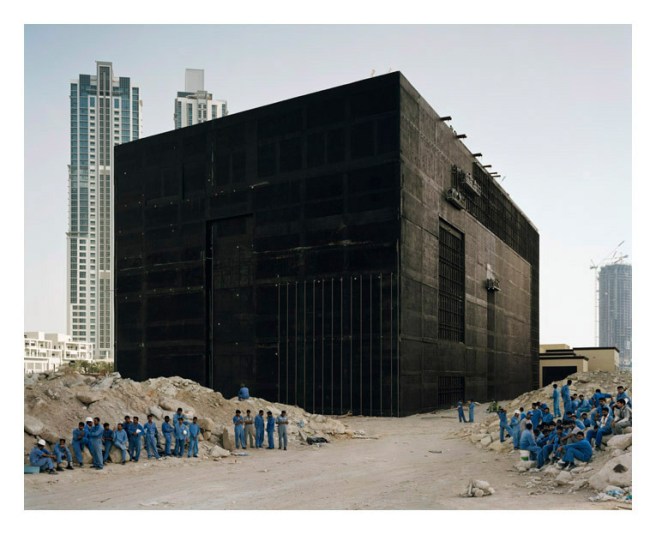
Cooling plant (Dubai) 2009 by Bas Princen. I love this photo. Came across it in the current issue of Harper’s.

Los Angeles-based artist Steve Roden has worked in an overwhelming variety of forms throughout his career, creating everything from conceptual recordings and sound installations to color field paintings and experimental films. For his latest project, Roden has teamed up with Atlanta-based record label and publisher Dust-to-Digital to release a book and two cds culled from his extensive collections of early photographs and 78 rpm recordings. (via Preview: Steve Roden’s collections at the Contemporary | Atlanta A&E Blog)
It might reasonably be said that all art at some time and in some manner becomes mass entertainment, and that if it does not it dies and is forgotten.
You cannot meet someone for a moment, or even cast eyes on someone in the street, without changing. That is my subject.
When you visit New York City, you worry about whether you are being a tourist, about whether you are doing as the locals do. Same with visiting Paris, Rome, London. But in Las Vegas, everybody is a tourist. Anybody who’s not a tourist works in the tourism/hospitality industry. There is no real thing. It’s fake all the way to the bottom. The very idea of a sprawling, water guzzling city that sits in the middle of barren desert is too absurd to take seriously.
See also Richard Thompson & Communicatrix on cultural neutrality.
Ben Casnocha: The Blog: Las Vegas: Authentically Unauthentic
 Mark Larson