The Naked Prey

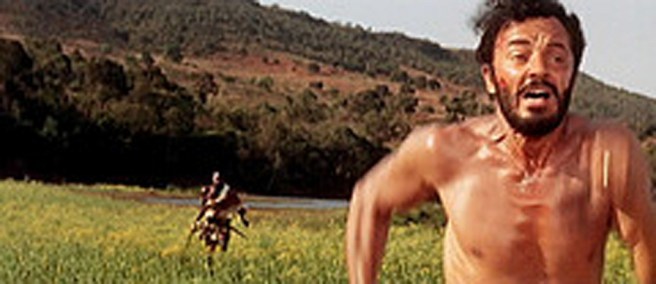
The Naked Prey. Speaking of chase movies stripped down to loincloths… This one was inspired by the true(ish?) story of John Colter’s escape from the Blackfeet in 1809, but it’s set in the African savannah somewhere. A safari trip goes wrong because the financial backer is a jackass and Cornel Wilde, the guide who’s been there enough to pick up a few languages, ends up running from the locals. It’s pulpy popcorn stuff, but there’s an interesting balance in how everything is portrayed. This is not the Africa with the sunsets and acacia trees and newborn knock-kneed giraffes. This is the dusty, thorny one with all the snakes. Neither hunters nor prey are acting all that honorably or dishonorably, they’ve just been reduced and everyone’s running on instinct and resourcefulness. Ebert didn’t like it much, for fair reasons that seem to related to having scene this kind of absurd stuff before, but I think that non-realistic ≠ non-enjoyable. The script could probably fit on a page or two. The soundtrack is almost entirely percussion. Plot aside, there’s some really great nature interludes that reminded me of how much I loved wildlife film when I was a kid.

Albums Recommended in “Dirty South”

Ben Westhoff’s Southern hiphop starter kit listed at the end of the book. FYI.

The 2 Live Crew Is What We Are – The 2 Live Crew
We Can’t Be Stopped – Geto Boys
The Fix – Scarface
Diary of the Originator: Chapter 12 – June 27th – DJ Screw
Ridin’ Dirty – UGK
On Top of the World – Eightball & MJG
Most Known Unknown – Three 6 Mafia
Aquemini – OutKast
Soul Food – Goodie Mob
400 Degreez – Juvenile
Ghetto D – Master P
Country Grammar – Nelly
Aaliyah – Aaliyah (Anil Dash approved!)
Under Construction – Missy Elliot
Lord Willin’ – Clipse
Kings of Crunk – Lil Jon & the East Side Boyz
Down with the King – T.I. hosted by DJ Drama
Get Ya Mind Correct – Paul Wall and Chamillionaire
We the Best – DJ Khaled
Souljaboytellem.com – Soulja Boy
Tha Carter III – Lil Wayne
Murder Was the Case – Gucci Mane

Albums Recommended in “Dirty South”

The New Atlantis » GPS and the End of the Road

One of the better essays I’ve read this year. I ended up browswing the site and Instapapering a bunch of other stuff. (via)

It is another paradox of [On the Road and Huckleberry Finn] that the supposed escape from civilization in large part consists of escape to civilization, or at least to its lesser-known boroughs. In each case, their travels are set against the grandeur of the natural world, but the scenes of their adventures are composed of unknown people in unfamiliar places. The “promise of every cobbled alley” is wrapped up in the possibility of the stranger — more fully, the chance encounter with the mysterious stranger in the enchanted place.

Seen in the right way, what the two novels show us is not the virtue of quitting civilization, but the freedom that comes from finding our own way through a world that is not of our own making.

Also:

Go to a city and find your way to somewhere new; take a walk or a drive through the streets of Washington, D.C., and you will begin to feel how it is a different place from Austin or San Francisco or Paris or New Orleans — how your possibilities for action are different and so too your possibilities for being.

The New Atlantis » GPS and the End of the Road

The Seventh Seal

Det Sjunde Inseglet (The Seventh Seal). First time I’d seen anything from Ingmar Bergman. Strange reaction to this one: when I was watching it, I wasn’t swept away. It was good, shot beautifully, funnier than I expected, etc. etc. But afterward, I kept thinking about it, turning it over, remembering scenes. Those ideas of morality, religion, existence, fear, and vulnerability in a meaningless universe have some staying power. You can definitely see why Woody Allen loves his work. Allen recommends starting with this one, Wild Strawberries, The Magician, Cries and Whispers, and Persona.

Murder, My Sweet

I don’t know which side anybody’s on. I don’t even know who’s playing today.

Murder, My Sweet. Not excellent, not bad. Every new character brings a new complication to the story. Plenty of the snappy writing that you’d expect from Raymond Chandler. (Other film noir I’ve watched.)

Apocalypto

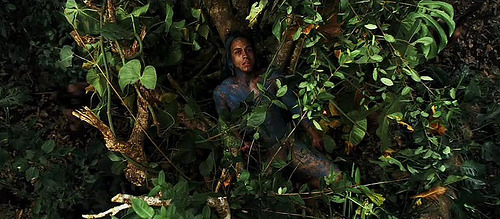
Apocalypto. I got a kick out of this one. At its heart, it’s a chase movie, stripped down to loincloths. It did not at all feel like 140 minutes. Many thanks to the Battleship Pretension episode on Mel Gibson’s directing for spurring me to watch it.

If you’ve seen Braveheart or The Passion of the Christ, you’ll be prepared for the frequent, unsubtle graphic violence. I cringed a lot, but that’s okay. Actually, funny thing when I was watching, the violence actually got me curious about psychological health in ancient times. Given that levels of violence, trauma, and death were much higher than today, you have to wonder.

I’m not suggesting that this movie is historically accurate in any way. That’s very much beside the point, I think. Every movie set in the past gets something wrong. It’s just context, people. Not a documentary. I think that some folks have gotten up in arms about the depiction of the Mayans is actually kind of a bonus – it hasn’t really been explored on film, so they’d like to get it right. Understandable. The benefit for the viewer, accuracy aside, is that the novelty forces your attention. It’s all in Yucatec Maya language, so you have to keep your eyes on the screen for subtitles. Clothing and environment are novel. You probably don’t recognize any of the actors, so you can come to watch their performance without any expectations. When I watched Brief Encounter I had a similar reaction to an unknown-to-me cast:

One of the most enjoyable things about old/foreign movies is that I often don’t know the cast. It can feel more immediately immersive to see the characters as characters, rather than recognizing actors and trying to set aside that I know they’re portraying people. There’s no baggage, no expectations, no known quirks or ticks. It all feels very fresh.

Along the same lines, familiar scenes feel less loaded. There’s a slave-trading scene that’s somehow more touching because it’s Mayans selling Mayans, rather than whites selling blacks. Put a familiar, undeniable evil in a different cultural frame, and you feel it more powerfully, I think. You can’t bring your baggage as easily. I feel no hesitation in recommending this one.

Martin Luther King Jr. National Memorial Opens in Washington – NYTimes.com

There is always an element of kitsch in monumental memorials, a built-in grandiosity that exaggerates the physical and spiritual statures of their human subjects. That is one of the purposes of turning flesh into imposing stone.

Via. See also Dennis Dutton on kitsch:

According to Tomas Kulka, the standard kitsch work must be instantly identifiable as depicting “an object or theme which is generally considered to be beautiful or highly charged with stock emotions.” Moreover, kitsch “does not substantially enrich our associations related to the depicted subject.” The impact of kitsch is limited to reminding the viewer of great works of art, deep emotions, or grand philosophic, religious, or patriotic sentiments.

Martin Luther King Jr. National Memorial Opens in Washington – NYTimes.com

The pretender: Dana Spiotta’s persuasive performances—By Jonathan Dee (Harper’s Magazine)

Part of the fascination rock stars, even those of the wannabe variety, hold for fiction writers must have to do with the degrees of mediation in an artist’s relationship to his or her audience. What would it be like to jump the gap between oneself and the presentation of one’s own art? In live performance the feedback is instant, for better or worse, and the artist’s presence as a conduit for his or her work is a precondition for that work’s existence.

I’ve tagged a lot of things with performance/audience.

The pretender: Dana Spiotta’s persuasive performances—By Jonathan Dee (Harper’s Magazine)

Only part of us is sane: only part of us loves pleasure and the longer day of happiness, wants to live to our nineties and die in peace, in a house that we built that shall shelter those who come after us. The other half of us is nearly mad. It prefers the disagreeable to the agreeable, loves pain and its darker night despair, and wants to die in a catastrophe that will set back life to its beginnings and leave nothing of our house save its blackened foundations.