The Usual Suspects

The Usual Suspects. I’d already heard so much about this movie that I went in jaded and suspicious and looking for clues. I figured out the Big Thing early, was underwhelmed, had a hard time staying awake during the last 1/3, gained no satisfaction from being right, and then I woke up and spoiled it on Twitter (spoiler!). I do think great stories withstand spoilers. This might not be one, but there’s good camera and cast and characters. I bet this was fun to make.

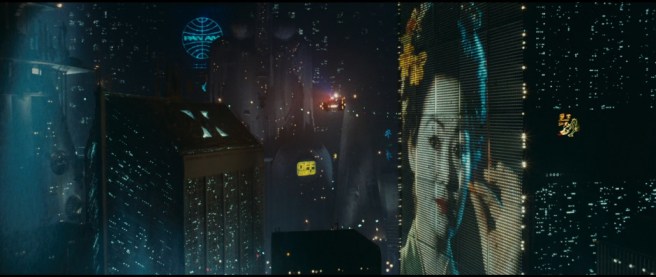
Blade Runner

Blade Runner (Final Cut). Dang. Like Alien, this one holds up so, so well. Incredible movie. Cast, sets (!), shots, sound, score. I love the eye imagery and symbolism throughout. Themes of empathy, memory, humanity. Deckard has a sweet bachelor pad. If I were more of a jerk, right around now I’d take a second to mention how bad Prometheus was in comparison. Night and day.

Let me never fall into the vulgar mistake of dreaming that I am persecuted whenever I am contradicted.

Ralph Waldo Emerson. (via). Cf. Victor Hugo:

Let’s not bring flame where light is enough.

And Jay-Z:

It’s hard to beat the entertainment value of people who deliberately misunderstand the world, people dying to be insulted, running around looking for a bullet to get in front of.

Meal entering vehicle window = tacky, suburban, boring, junk food. Meal exiting vehicle window = cool, urban, hip, adventurous.

Chiasmus – Wikipedia, the free encyclopedia

the figure of speech in which two or more clauses are related to each other through a reversal of structures in order to make a larger point; that is, the clauses display inverted parallelism.

So they’re mirrored (like the shape of the letter X… Greek letter chi… chiasmus…). Think ABCCBA, or ABCDEDCBA, or whatever. This is really common in the Bible, e.g. Isaiah 6:10:

A “Make the heart of this people fat,
B and make their ears heavy,
C and shut their eyes;
C lest they see with their eyes,
B and hear with their ears,
A and understand with their heart, and convert [return], and be healed.”

And in songwriting, e.g. Snoop’s Gin and Juice:

I got my mind on my money, my money on my mind.

Or the wisdom of Stephen Stills:

If you can’t be with the one you love, honey / Love the one you’re with.

You also see chiastic structure for an entire work, like the Song of Songs or Paradise Lost.

Man, I really like words.

Chiasmus – Wikipedia, the free encyclopedia

Mad Love: The Surrealism of the Supernatural Romantic Melodrama, Part One « The Third Meaning

I hadn’t considered this. Socio-cultural roots of the modern fantasy melodrama?

Part of what makes supernatural romantic melodramas stories of amours fou, arguably, is how they go about addressing a fundamental problem for the love story in the contemporary social context: how do you erect obstacles between the couple? If they are in love enough for us to be invested in their situation, how can you have a plausible enough obstacle for them to have to overcome in order to be together? Unless you want to do a period picture (be it Thomas Hardy, Far from Heaven or The Notebook), class, nationality, religion, and other aspects of social background just aren’t sufficiently convincing barriers to a Western audience, even if really they should be; we have all been raised, mostly by movies and pop songs, to believe that True Love Conquers All.

Mad Love: The Surrealism of the Supernatural Romantic Melodrama, Part One « The Third Meaning

Striptease has become less interesting since they did away with the costumes. It’s become Newtonian. The movement of bodies through space, period. It can get boring.

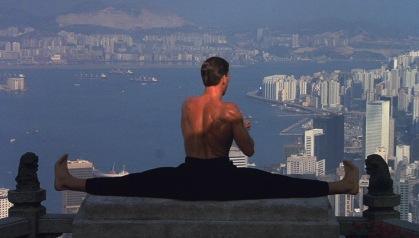
Bloodsport

Bloodsport. ★★★★★. Finally saw it on the big screen. And there’s nothing like seeing a movie with a crowd that cares as much as you do. This movie is one of the first things I remember me and my big brother bonding over, so I’ve lost all critical perspective. That actually might have happened before I saw the movie, when my brother told me about the shin scene (spoiler!). I was horrified/sold. I love how briskly it all moves. Backstory and dialogue are mostly functional. A route from A to B. We all know why we’re here: fights! Surprisingly good soundtrack, though. I haven’t met anyone who’s seen this that didn’t love Paco. And there’s a young Forest Whitaker!

Preface otherwise banal life wisdom with “My father once taught me…” (or similar) and it then becomes rich with generational credibility.

Contagion

Contagion. Pretty good. Deliberate, precise, dispassionate. It’s not a weepy melodrama. The point is to get a sense of all the moving parts. I’d call it scifi, but in the less-fantastical sense of exploring a hypothetical that isn’t (yet!?!!?!?!) true. Jude Law’s blogger/gadfly was a hoot. Another good score by Cliff Martinez (Cf.). This is only the third Steven Soderbergh movie for me, outside of the Ocean’s trilogy.

Very few things happen at the right time, and the rest do not happen at all: the conscientious historian will correct these defects.

Herodotus, or so Mark Twain would have us believe in the intro to A Horse’s Tale. Reminds me of Oscar Wilde in The Decay of Lying:

The ancient historians gave us delightful fiction in the form of fact; the modern novelist presents us with dull facts under the guise of fiction.

Lord help me I just started reading the Histories.

Laconic (adj.) – Online Etymology Dictionary

I never knew the word was connected with the Spartans. Awesome:

“concise, abrupt,” 1580s, probably via L. Laconicus, from Gk. Lakonikos, from Lakon “person from Lakonia,” the district around Sparta in southern Greece in ancient times, whose inhabitants were famously proud of their brevity of speech. When Philip of Macedon threatened them with, “If I enter Laconia, I will raze Sparta to the ground,” the Spartans’ reply was, “If.”

One source of this story is Plutarch’s On Talkativeness.

Laconic (adj.) – Online Etymology Dictionary

“Drive”: Memory Lane « The Third Meaning.

So much film geekery is informed, more or less directly, by the Manny Farber discourse on such action-oriented fare that its cred as ‘termite art’ comes already embossed on its metallic exterior by virtue of its generic/critical positioning even before consideration of the specifics of the individual case. […]

Drive is, then, a contribution to its particular kind of silent-tough-guy, hyperstylized, cool crime film. But what it adds is filigree. It’s a baroque, decadent, intensification of and comment on those aspects of Melville, Hill and Mann that Refn fetishizes, film geek that he is, and it appeals to other film geeks, like me, who share his tastes.