Heat

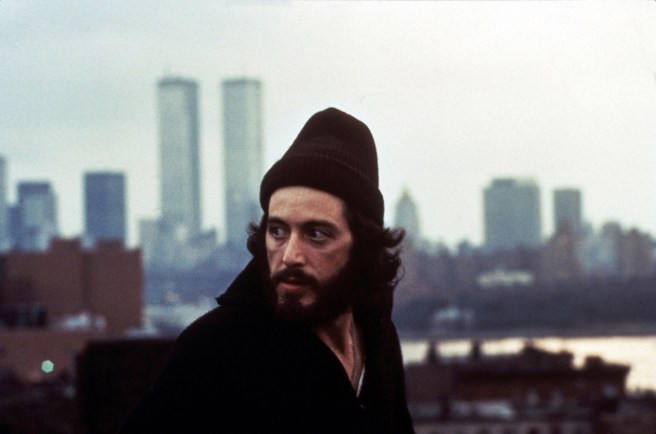
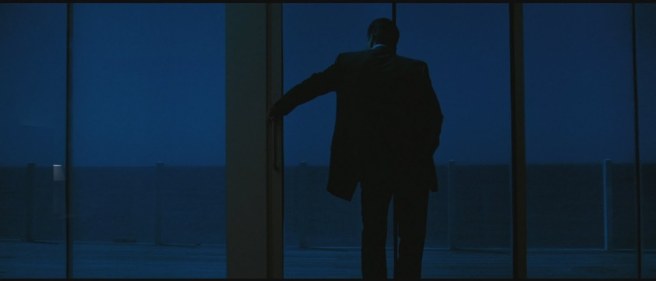
Heat. My third viewing (first, second). This is officially my second favorite movie after Out of the Past.

It seems like (Pacino’s) Hanna has more fun than (De Niro’s) McCauley does. Maybe I’m projecting, and he’s just more fun to watch because he’s more exasperated and has the power to say whatever he wants. He definitely smiles more. His stakes are lower in a way. He’s got a day job, a sense of purpose, even if home life is a wreck. Note the close of the hospital scene, when he’s paged back into action, he gives his wife a smile before an almost gleeful run down the stairs, back to the chase. Compare to the ending, where there’s no triumph on his face. More like disappointment.

McCauley is always more restrained, as he always has less room for error. (Hanna asks him, “What are you, some kind of monk?”). After two really upsetting phone calls (one with adversary Van Zandt, one with his partner Trejo at the breakfast joint), he doesn’t slam the phone or toss it, but seems to pause, gather himself, and return the phone to rest.

At the diner with Hanna, McCauley mentions that recurring dream of running out of time. Note how, towards the end, when he’s looking to find Waingro, Eady and Nate mention/ask him about the time he has left before he catches his flight out of the country. A guy who does things like to wrap his glasses in paper napkins loses his usual discipline, and things go haywire.

One last thing: I love how the music is so supportive. It’s there in subtle ways like in the drive-in money exchange, where much of the tension rides on the music, but it’s not until the fade-out that you realize the music is even there. It’s present in more obvious ways like in the nighttime balcony romance, with that noodly jazz guitar playing behind soft, gauzy synth curtains. Lord, I love that.

Other movies I re-watched this year include Winter’s Bone, Melancholia, Mission Impossible, Days of Heaven, Blade Runner, Bloodsport, The Last of the Mohicans, The Godfather, Drive, Mean Girls, The Shawshank Redemption, Raging Bull, and Aliens.

I’ve really been itching for another viewing of Warrior. Update: done.

One is the Loneliest Number – NYTimes.com

I’d never considered this side of having children later in life. From Julie Shulevitz’s essay excerpted in the link above:

What haunts me about my children, though, is […] the actuarial risk I run of dying before they’re ready to face the world.

Older parents die earlier in their children’s lives. […] A mother who is 35 when her child is born is more likely than not to have died by the time that child is 46. The one who is 45 may have bowed out of her child’s life when he’s 37. The odds are slightly worse for fathers: The 35-year-old new father can hope to live to see his child turn 42. The 45-year-old one has until the child is 33.

One is the Loneliest Number – NYTimes.com

Life of Pi

Life of Pi. Awesome special effects and photography, almost worth watching simply for the spectacle. (Reminds me of The Fall in that way). I’d like it sooooooooooooooooooooooooo much more overall without the (blunt, preachy) narrative wrapper. I DNFed on the book several years ago. Not sure how it compares.

John Carter

John Carter. Easily the most teal-and-orange movie I’ve ever seen. I feel like there’s a good movie hiding in here somewhere. Overhaul the terrible dialogue, trim judiciously. It has some decent-enough swashbuckling action (and one really effective battle), and thankfully doesn’t rely on dumb one-liners or dopey comic relief characters or modern-day allegory. It’s really straightforward, for all its excess in other ways (effects, cast, milieu) Andrew Stanton directed a dud here, but at least he’s still got Finding Nemo and Wall-E on his resume…

I don’t remember exactly when this dawned me — far too late, definitely — but I started enjoying sad/sappy movies a lot more when I let myself cry when the movie seemed to expect it of me instead thinking I was somehow beating the system or proving my superiority by resisting it.

Bach’s Music, Back Then and Right Now

Beethoven specialists are known as great musicians, great interpreters, whereas Bach specialists tend to be viewed vatically, as mediums. I found myself connecting Casals’s moaning and Gould’s humming—for a composer who is supposed to be pure, we sure enjoy a lot of extraneous noise!—the musical equivalent of speaking in tongues, channeling, a kind of cultish signal, a sonic signature of being on the right occult frequency to communicate with the master.

This essay reminded me of this excerpt from Steppenwolf that I’ve tumbled before

It was at a concert of lovely old music. After two or three notes of the piano the door was opened of a sudden to the other world. I sped through heaven and saw God at work. I suffered holy pains. I dropped all my defenses and was afraid of nothing in the world. I accepted all things and to all things I gave up my heart. It did not last very long, a quarter of an hour perhaps; but it returned to me in a dream at night, and since, through all the barren days, I caught a glimpse of it now and then.

Bach’s Music, Back Then and Right Now

The Killing

The Killing. I’ve seen 2001: A Space Odyssey four or five times at least, and it’s fantastic, but watching The Shining a few years ago really killed my interest in Stanley Kubrick’s work. This one resurrects it. Awesome camera and soundtrack and a great set of characters. Multiple perspectives and time cuts. Also touches on some of the practical aspects of dealing with piles and piles of money.

Serpico

Serpico. I like how Pacino embodies the role here, and how you can pick up on the passage of time from the way his look and behavior changes. Also, 1970s hospitals are TERRIFYING.

Supply of Per Capita Football Talent.

This chart comes from a paper presented by Theodore Goudge, an associate professor in the department of geography at Northwest Missouri State University, at the 2012 Annual Meeting of the Association of American Geographers. It pretty clearly shows what Goudge referred to as the “pigskin cult” of the south.

The paper in question is “The Geography of College Football Player Origins & Success: Football Championship Subdivision (FCS)”, here’s an abstract. Featured in On Urban Meyer’s Ohio State, Wisconsin, and the Big Ten expanding to include Maryland and Rutgers – Grantland.

Why We Shouldn’t Treat Rap As Poetry | The Awl

Consider this proposition in reverse to see how absurd it is: For my graduate thesis, I am going to give Calvin Trillin a bunch of half-assed instrumentals and have DJ Drama help him put together a Gangta Grillz mixtape, and then we’ll evaluate him alongside Gucci Mane and Cam’ron, and other rappers who have made Gangsta Grillz mixtapes. That would be awesome, but it would not provide any more insight into the how and why Calvin Trillin does what he does. It would simply provide me the opportunity to take someone else’s work, put it in a different context, and call it something different.

Why We Shouldn’t Treat Rap As Poetry | The Awl