The ‘Designing Women’ Game: Write Your Own Julia Rant – Monkey See Blog – NPR.
(Source: https://www.youtube.com/)
Hear, hear. The fact that this seems novel and exciting is telling:
The motto of informality is: “Let’s do things the easiest, most convenient way and never mind how they seem, because nobody is paying any attention, anyway.”
Formality says: “Yes, it does matter, and the surrender of individuality to high group standards is a trivial sacrifice to the overall beauty of the thing.”
At a formal picnic, people do not wear exercise clothes, serve food in packages from the store, eat wandering around whenever they feel like it or treat bits of paper as napkins, cardboard as plates and plastic as flatware.
Food is served on non-absorbent materials, to be eaten with unbreakable utensils, and the fact that a table cloth, napkins, dishes and cutlery will have to be washed afterward is accepted as one of the burdens of civilization.
[…]
Dress does not begin with a surrender to the heat, but the optimistic, if vain, idea that one can rise above it, so to speak. Gradual reactions, such as fanning, forehead mopping and the rolling up of sleeves or baring of feet to dangle in creeks, are considered more exciting than just starting out by sweating into one’s gym suit.
If you’re dancing and not within two people of a girl, you’re doing it wrong.

To Catch a Thief. It’s a romance packaged in a crime movie, and it’s quite good. Not fantastic, maybe not even great, but thoroughly enjoyable. Definitely feels shorter than it is. I expected the camerawork and direction to be more Hitchcockian (the faux diamond scene is an exception). I still don’t think I get Cary Grant, but I definitely want to see more Grace Kelly films. And I have to mention that first kiss. In context, it is absolutely incredible. Just jaw-dropping.
“One guy arrived with the wrong lens or something on his camera and left his wife sitting at the table for an hour while he went home to get it.”
First Camera, Then Fork: People Who Photograph Food and Display the Pictures Online – NYTimes.com

青梅竹馬 (Taipei Story). Directed by Edward Yang, who was part of that early Taiwanese New Wave thing. I’ve got a lot of patience for day-to-day slice-of-life movies, but found this a little too fragmented. I also think it suffered from a crummy translation (or, the translation was accurate and the writing was just that awkward). The scenes set at night seemed much better than the daytime ones, but I’m not sure why.
Nice birthday blowout over at NPR, including Indian Classical Music 101. (via)
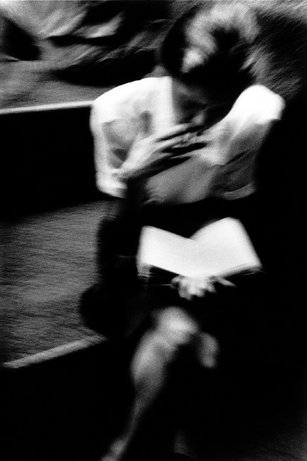
SYDNEY, Australia—An office worker on Pitt Street Mall reads a book during lunch hour, 1999.

Untitled by James Dodd
This frame looks like the opening shot of a movie I want to watch.
Amen.
Each time he took a walk, he felt as though he were leaving himself behind, and by giving himself up to the movement of the streets, by reducing himself to a seeing eye, he was able to escape the obligation to think, and this, more than anything else, brought him a measure of peace, a salutary emptiness within… By wandering aimlessly, all places became equal and it no longer mattered where he was. On his best walks he was able to feel that he was nowhere.
You can afford to expose yourself to uncertainties in art that you wouldn’t allow yourself in real life. You can allow yourself to get into situations where you are completely lost, and where you are disoriented. You don’t know what’s going on, and you can actually not only allow yourself to do that, you can enjoy it.
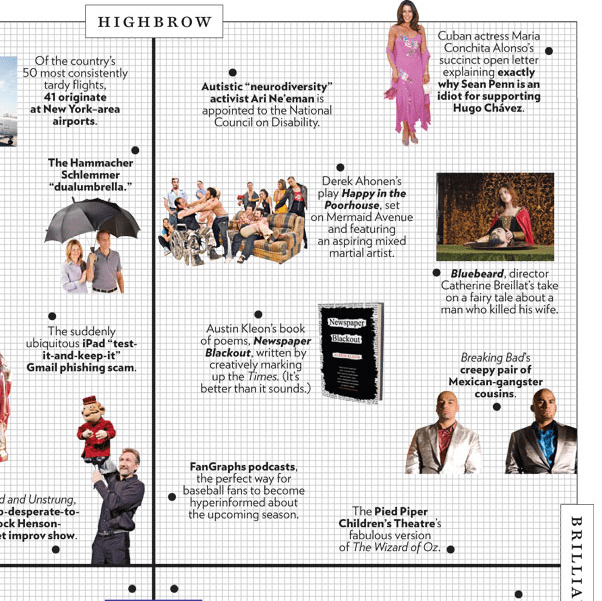
Austin Kleon’s new book of poems, Newspaper Blackout, makes New York Magazine’s Approval Matrix somewhere between Highbrow and Brilliant.
Last week we released Austin’s fourth edition on 20×200, The Travelogue.
Hurrah!

Beach House soundchecking at the Pabst Theatre in Milwaukee
I see them live in ATL in 24 days. Can’t wait.
L.A. is the apocalypse: it’s you and a bunch of parking lots. No one’s going to save you; no one’s looking out for you. It’s the only city I know where that’s the explicit premise of living there – that’s the deal you make when you move to L.A.
The city, ironically, is emotionally authentic.
It says: no one loves you; you’re the least important person in the room; get over it.
Bing Crosby sings “Moonlight Becomes You” from the Road to Morocco.

Plein Soleil (Purple Noon). This movie is wonderful. From 1960, it was the first adaptation of Patricia Highsmith’s 1955 book, The Talented Mr. Ripley. I really liked the 1999 version with Damon, Law, Paltrow, etc., and I’d say this one is even a smidge better. Compared to what I remember of the newer one, it seemed like there were fewer vignettes–the thread of the story spools out a bit more naturally. There’s a bit less prologue and a bit more watching the anti-hero trying to save his own ass. Fascinating stuff. In addition, some camerawork that winks its eye at the viewer, some of the best fashion on film and an excellent, unobtrusive soundtrack from Nino Rota. Recommended.
A History of the Sky. A grid of 126 time-lapse movies, each showing the sky on a different day. (via)

Tintin means, literally, “Nothing”. His face, round as an O with two pinpricks for eyes, is what Hergé himself described as “the degree zero of typeage” – a typographic vanishing point. Tintin is also the degree zero of personage. He has no past, no sexual identity, no complexities. Like Cocteau’s Orphée, who spends much of the film in the negative space or dead world on the far side of the mirror, he is a writer who does not write.
— Tom McCarthy, Tintin and the Secret of Literature (excerpted in the Guardian)

 Mark Larson