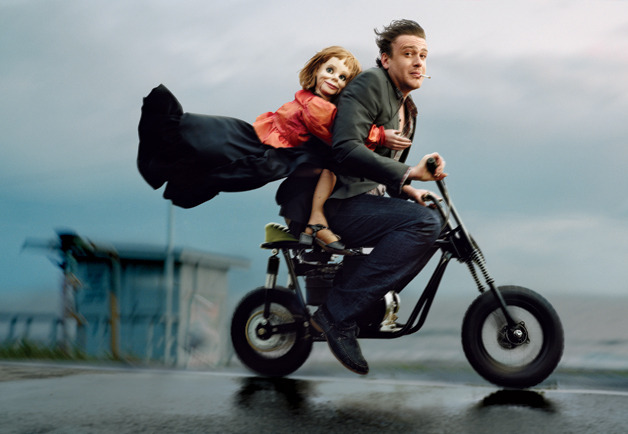
Because growth curves are asymptotic, I am convinced it is better to get pretty good at a lot of things rather than investing your scarce time in becoming marginally better at a couple of things.
Category: uncategorized

This is a surprisingly great interview with Jason Segel (via Austin). My favorite bit:
I had two friends in high school who sort of showed me how a piano works. And I just spent two years being terrible at it until I was good at it. That’s just me. There’s no way I’m actually intrinsically talented at writing, acting, playing music, puppeteering. It’s that I’m willing to be shit at them for a while, until I’m good at them.

101 Fast Recipes for Grilling. Note to self.
DOCUMERICA Project by the Environmental Protection Agency
For the Documerica Project (1971-1977), the Environmental Protection Agency (EPA) hired freelance photographers to capture images relating to environmental problems, EPA activities, and everyday life in the 1970s.
Reflexiones del Comandante en Jefe
Fidel Castro has a blog, apparently. Recent posts focus on the World Cup and the coming nuclear war.

A modular bike for gettin’ groceries. It reattaches to the seat/rear wheel when you hit the road again. Fixed Gear Gallery :: Grogery Getter Contest Submission. (via)
The War on Mediocrity – Meta-MetaFiltered wisdom
A digest of advice from the masses.
What’s the relationship between money, ambition, and happiness? – Barking up the wrong tree
Peers have an effect on your own ambition. More money acquired → more happiness. More money desired → less happiness. I like Eric Barker’s 3-point takeaway near the end, too.
What’s the relationship between money, ambition, and happiness? – Barking up the wrong tree
It’s fine to go through life happy, in other words, but I suspect we also want to go through life without becoming big fat self-absorbed jackasses. Children really help in that regard.
The World’s Reaction to Landon Donovan’s Game Winning Goal. Awesome. That was such a good moment. Goosebumps over and over.
The best vacation ever – The Boston Globe
Lots of good ideas here. Positive psychology seems cooler and cooler every day.
How long we take off probably counts for less than we think, and in the aggregate, taking more short trips leaves us happier than taking a few long ones. We’re often happier planning a trip than actually taking it. And interrupting a vacation — far from being a nuisance — can make us enjoy it more. How a trip ends matters more than how it begins, who you’re with matters as much as where you go, and if you want to remember a vacation vividly, do something during it that you’ve never done before. And though it may feel unnecessary, it’s important to force yourself to actually take the time off in the first place — people, it turns out, are as prone to procrastinate when it comes to pleasurable things like vacations as unpleasant ones like paperwork and visits to the dentist.

Here is portion of a very cool map of the path of the main characters in Larry McMurtry’s Lonesome Dove. It’s in the July 2010 edition of Texas Monthly magazine.
One of my favorite books ever. Usually my first recommendation for people looking for something, anything to read.
The first strong external revelation of the Dry Rot in men, is a tendency to lurk and lounge; to be at street-corners without intelligible reason; to be going anywhere when met; to be about many places rather than at any; to do nothing tangible, but to have an intention of performing a variety of intangible duties to-morrow or the day after.
“Night Walks” by Charles Dickens
For a while there, Charles Dickens was suffering from insomnia, so he took up walking “houseless” around London until the sun came up. A great portrait of a city and state of mind:
The restlessness of a great city, and the way in which it tumbles and tosses before it can get to sleep, formed one of the first entertainments offered to the contemplation of us houseless people. It lasted about two hours. We lost a great deal of companionship when the late public-houses turned their lamps out, and when the potmen thrust the last brawling drunkards into the street; but stray vehicles and stray people were left us, after that. If we were very lucky, a policeman’s rattle sprang and a fray turned up; but, in general, surprisingly little of this diversion was provided. […]
At length these flickering sparks would die away, worn out–the last veritable sparks of waking life trailed from some late pieman or hot-potato man–and London would sink to rest. And then the yearning of the houseless mind would be for any sign of company, any lighted place, any movement, anything suggestive of any one being up–nay, even so much as awake, for the houseless eye looked out for lights in windows.
To Invigorate Literary Mind, Start Moving Literary Feet
Through childhood I hiked, roamed, tirelessly explored the countryside: neighboring farms, a treasure trove of old barns, abandoned houses and forbidden properties of all kinds, some of them presumably dangerous, like cisterns and wells covered with loose boards.
These activities are intimately bound up with storytelling, for always there’s a ghost-self, a “fictitious” self, in such settings. For this reason I believe that any form of art is a species of exploration and transgression.
Interview with Joyce Carol Oates | Arch Literary Journal
Who knew Joyce Carol Oates was a runner? On how running and dreaming are alike:
I think that when we’re stationary, we have a somewhat thickened sense of the ego or the “I,” and we’re just sort of self-conscious and aware of ourselves. But when we’re in motion, or when we’re in a dream, the “I” entity starts to dissolve. Some people, including myself, and possibly you, are capable of having dreams in which your own personality is really almost dissolved. You know, way, way down in the depths of the ocean there are creatures that are transparent. They’re like jellyfish, a lot of very transparent creatures. And I was thinking it’s almost analogous to the human experience of sleep, where when you’re really, really deep into sleep, your own physical self is often not even there. It’s like you’re transparent. And, it may be a process that we just will never understand, descending somehow deep into the primitive brain – like the brain almost at the brain stem – and away from the consciousness. And, somehow running replicates that, I think. I would think that if you were running very fast, if you were in an instinctive situation where you were terrified – say you were being pursued, and your life was in danger – you would be flooded with adrenaline. I would think probably the “I” or ego was almost gone, that you’re just running like a physical entity, the way a soldier might just start [running], or a boxer, or someone like that. But when you’re writing, there’s … as I say, we have this more thickened or more solid sense of the self, because it’s usually in some stationary situation with social definitions.

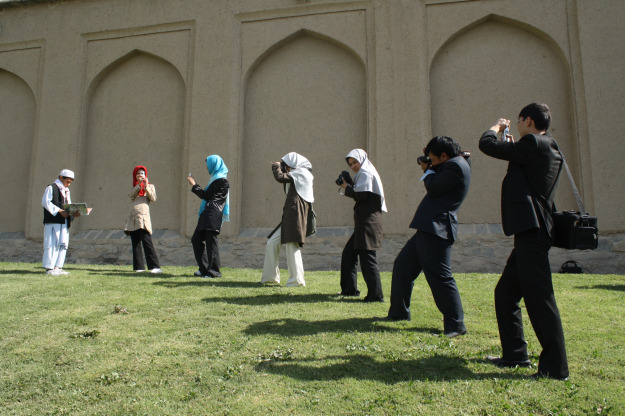
Afghanistan Through Teenagers’ Eyes | Foreign Policy. “Last year, a group of teenagers at Afghanistan’s Marefat School were given cameras as part of a photography project with teens at Philadelphia’s Constitution High School. The students snapped away, and what emerged from the Afghan side were images of culture, friends, and daily life.” (via)