Still trying to make sense of it all but I know I liked it.
Category: uncategorized
I frequently hear music in the very heart of the noise…
George Gershwin on Rhapsody in Blue’s inspiration, the rhythm of the city train. (via adamnorwood)
This reminds me of what I called and still call one of my favorite pieces of music ever, Steve Reich’s City Life, which uses a bunch of samples from New York City street scenes: hawkers, sirens, car and boat horns, screeching tires, subway whooshings. Luckily all five parts are online for your listening pleasure.
Intel Visual Life – The Sartorialist. (via)
It seems odd, but it’s almost like going out there and letting yourself fall in love a little bit every day, letting yourself be seduced a little bit every day.
I also like his idea of the internet as a “digital park bench”, where you can see the entire world passing through your neighborhood.
(Source: https://www.youtube.com/)
The 10 best foreign films of 2010 – Roger Ebert’s Journal
Biutiful, Cell 211, and Home look good. I didn’t like Mother all that much, but what do I know?
“Death and the Compass” by Jorge Luis Borges
Still trying to make sense of it all but I know I liked it.
Black Swan And Bathrooms – Mirror: Motion Picture Commentary
Interesting essay on self and Black Swan. (via)
Solitude welcomes a self or selves that does not, cannot, appear when in the company of others. Private selves refuse to manifest in public because other personas are at the front lines. Like mother Elephants circling their calves, our public selves form ranks. Each is a layer of armor, tweaking our interactions in the unconscious name of self defense.
Black Swan And Bathrooms – Mirror: Motion Picture Commentary
Black Swan And Bathrooms – Mirror: Motion Picture Commentary
Interesting essay on self and Black Swan. (via)
Solitude welcomes a self or selves that does not, cannot, appear when in the company of others. Private selves refuse to manifest in public because other personas are at the front lines. Like mother Elephants circling their calves, our public selves form ranks. Each is a layer of armor, tweaking our interactions in the unconscious name of self defense.
Black Swan And Bathrooms – Mirror: Motion Picture Commentary

“Sunset Portraits, From 8,462,359 Sunset Pictures on Flickr, 12/21/10”. A photo illustration by Penelope Umbrico for The New York Times. I’ve probably become inured to news images, but this was one of those rare ones that stopped me in my tracks. If there were a print of this, I’d probably buy it. Cyberspace When You’re Dead.
10/40/70 – Nicholas Rombes – The Rumpus.net
“This ongoing experiment in film writing freezes a film at 10, 40, and 70 minutes, and keeps the commentary as close to those frames as possible.” I’ve only read the 10/40/70 on Moon (which I liked), but this seems like a really cool series.
There are two ways of walking through a wood. The first is to try one of several routes (so as to get out of the wood as fast as possible, say, or to reach the house of grandmother, Tom Thumb, or Hansel and Gretel); the second is to walk so as to discover what the wood is like and find out why some paths are accessible and others are not. Similarly, there are two ways of going through a narrative text.
Umberto Eco, in Six Walks in the Fictional Woods. (via)
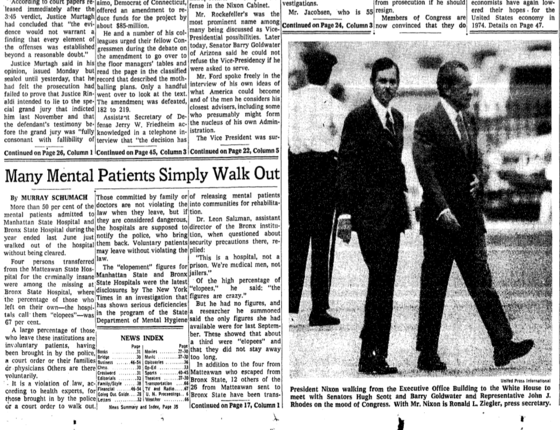
In response to the The New York Times’ Cheney layout gaffe, a reader writes:
I still have a copy of the New York Times from August 8, 1974 — one day before Richard Nixon resigned the presidency. On the front page at the bottom is a photo of Nixon, walking from the Executive Office Building to the White House, juxtaposed with an article headlined, “Many Mental Patients Simply Walk Out.”
Read more here.
Life gets a lot easier when you give up being outwardly sad about anything.
Colin Marshall. Still pondering this one.
Sabotage

Sabotage. I’ll give Hitchcock credit for starting off in a snappy manner without much preamble, but my attention drifted a good bit here and there. Especially after the heartless, classic package delivery scene, which is both an impossible-to-beat mid-story climax and a colossal waste of time. It’s also really effective, even if you know what’s coming. I kind of resent Hitchcock’s skill at jerking my emotional chain for a few minutes, and then leaving me not caring very much when the moment passes. To his credit, he came to regret the scene later in his career as he developed as a storyteller.
My updated Hitchcock rankings:
Life gets a lot easier when you give up being outwardly sad about anything.
Colin Marshall. Still pondering this one.
To find out who “you” are, focus not on your intentions but on how to interpret your behaviors.
Justin Wehr paraphrasing Sheena Iyengar.
Kingdom of the Blind: Revenge missions in the films of Clint Eastwood by Matt Zoller Seitz – Moving Image Source
“Is Eastwood an exploitation filmmaker with aspirations to importance, or an artist who uses violent action to entice viewers into experiencing his films’ more complex aspects?” Part two.
Company Man: Why Bud Selig Is Wrong For Baseball & Why It Doesn’t Matter by Ben Birdsall
Winning in sport matters because it doesn’t matter in any grander scheme. Because nothing beyond a game rests on which team scores the most runs, we can give it our all without having to consider anything else. Our team is righteous, our opponent is craven precisely because nothing outside the field of play is at stake.
Company Man: Why Bud Selig Is Wrong For Baseball & Why It Doesn’t Matter by Ben Birdsall
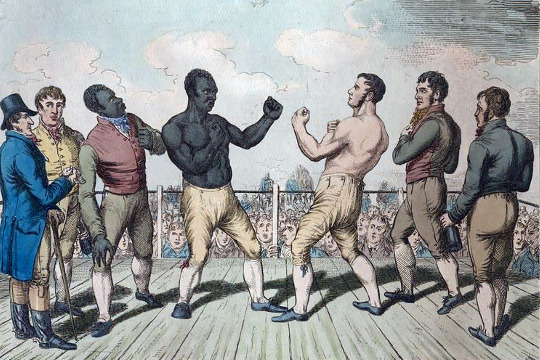
Counterpunch: History Robs Tom Molineaux by Graydon Gordian – Norman Einstein’s Sports & Rocket Science Monthly. The tale of a boxing match in 1810.
Kingdom of the Blind: Revenge missions in the films of Clint Eastwood by Matt Zoller Seitz – Moving Image Source
“Is Eastwood an exploitation filmmaker with aspirations to importance, or an artist who uses violent action to entice viewers into experiencing his films’ more complex aspects?” Part two.
 Mark Larson