Category: Science
The Galileo Project at Rice University has some awesome primary sources about everyone’s favorite astronomer. They’ve got his collection of sunspot drawings from the sumer of 1613, as well as composite movies of those. I’m trying to imagine how he felt when he first observed them. I can totally see him making little flip books of his illustrations and watching the sunspots dance across the face of the sun.
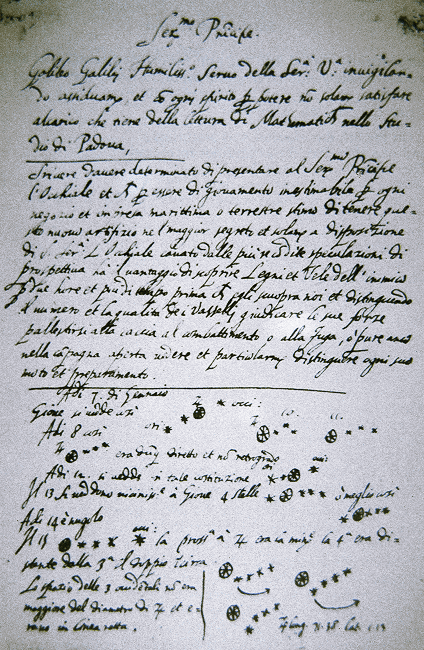
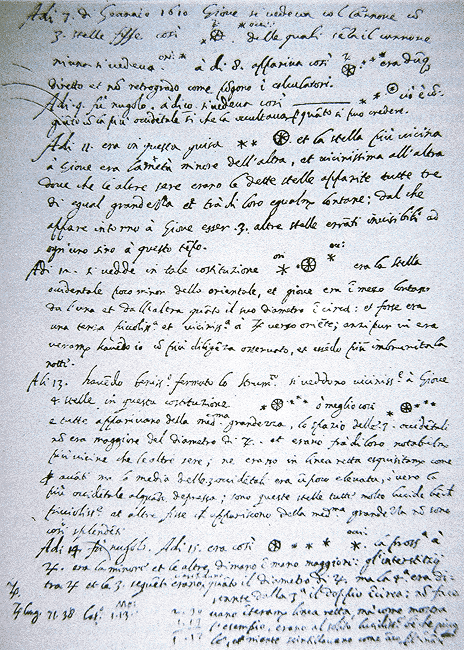
They’ve also got scans of the manuscripts from the Jupiter observationsÄînote that the images are embedded right there in the text. So cool. And the moon drawings are pretty sweet, too.
Exploring the question: Is philosophy progressive?
Finally, we have caffeinated doughnuts.
The God Delusion (review: dnf)
Comprehensive, but a bit scatterbrained. I made it about 1/3 of the way through.
Concert pianist Byron Janis share some interesting anecdotes about his struggles with acoustics: “music’s most unpredictable partner.”
If you liked Flatland the book, you’ll be glad to know there will soon be an animated movie for it. Alan Nelson links to several places you can read the book online (or get the gist of it anyway). [via seat 1a]
“Over the past thirty years, a new breed of ‘anthropometric historians’ has tracked how populations around the world have changed in stature. Height, theyÄôve concluded, is a kind of biological shorthand: a composite code for all the factors that make up a societyÄôs well-being.” [via justin blanton]
“Popular performers or groups are pleasing not because of any particular virtuosity, but because they create an overall timbre that remains consistent from song to song.” The neuroscience of music.
Richard Dawkins makes the scientific argument for keeping Saddam Hussein alive. “His mind would have been a unique resource for historical, political and psychological research: a resource that is now forever unavailable to scholars.” It’s an interesting thought. While there is a lot of good social science work analyzing tyranny, for the psychological angle “the sample size is small.”
“Popular performers or groups are pleasing not because of any particular virtuosity, but because they create an overall timbre that remains consistent from song to song.” The neuroscience of music.
An interview with Steven Johnson.
I came out of college in the late ’80s amid the science wars. Literary theorists were deconstructing the scientists, and scientists were making fun of the literary theorists. There was no realm where you’d come into a classroom and say, “This complexity theory might be useful in thinking about the kind of urban system Dickens is describing.” If you talked about science, it was entirely to show how it was Eurocentric or something.
I always felt like that was a total waste of time. There were obviously insights that both domains could productively share. A lot of what I’ve been trying to do since then is figure out what those connections could be, and figure out a way to work them into the books.
[via… Steven Johnson]
A couple additions to my growing series of links about understanding large-scale concepts. Here’s a timeline of evolution from the beginning of Life up to Now. The image of the timeline is 135 feet long, and homo sapiens showed up right at around last pixel. And via infosthetics, a video comparing the planets, the Sun, and a number of other stars.
The first five links in my scalar collection were about the scale of the atom, the Earth’s population, the stars in the sky, showing 570 million years in 1 hour, and visualizing enormous numbers. Oh, as a bonus there’s also the one I linked a while back where you can learn about existing in 10 dimensions.
New York Times on the science of free will.
Rebecca Blood points to a massive New Year’s resolution-keeping experiment and a news article about the whole thing. The idea is that you sign up, tell them the resolution, then the psychologists/automated mailing system will pester you via e-mail to see how you’re coming along. All the data-gathering will help scholars figure out how humanity can follow through better in the future. I’d join, but I haven’t yet resolved anything.
“We again asked the Princeton University community to submit imagesÄîand, for the first time, videos and soundsÄîproduced in the course of research or incorporating tools and concepts from science. Out of nearly 150 entries from 16 departments, we selected 56 works to appear in the 2006 Art of Science exhibition.”
I just learned about Open Culture yesterday. Their mission, as they describe it:
To explore the best of contemporary intellectual life.
To connect users with free, high-quality online media — podcasts, videos, online courses, etc. — that makes learning dynamic, convenient and fun.
To keep users apprised of new cultural developments and resources worth their limited time.
Looks like a lot of good brainy media there.
The science of free-throw shooting: “The punch line with our paper is that this is the first evidence that neural activity–brain activity that happens well before the movement ever begins–has a lot to say about the variability or the exact movement that you’re going to get.”
A very good, and very critical review of Richard Dawkins’ book The God Delusion.
 Mark Larson