Jen Stark makes incredible sculptures from hand-cut stacks of construction paper. [via dooce]
Category: design
Distorted maps of the earth, redrawn to be proportionate to wealth, disease, toy imports, war & death, etc. Plenty more over at Worldmapper.
Interesting graph charting relationships, potentially useful as a guide for writing screenplays. I love the “null set” portion.
Some cool infographics drawing on aspects of American culture, using pictures of 2 million prison uniforms, or 15 million sheets of paper, etc.
I love these renditions of the Republican elephant logo. I wonder if there are any good ones for the Democrat donkey, too?
I’d like to cover a friend’s car in post-it notes, but I haven’t decided which one yet.
Kottke points to the audio and video for a talk that Chris Ware recently gave at the University of Nebraska-Lincoln.
An interview with Ootje Oxenaar, designer of Dutch currency. [via kottke]
An archive of rare books on calligraphy, penmanship, and pen art; they’re all out of print, but still available as PDF and image files. I can’t believe how clean some of the illustrations are, like this deer.
Here’s some artwork that represents everyday scenes by using the names of the objects to build them.
Here’s an interesting idea for highbrow post-ironic art-qua-self-conscious-subject (etc.): paintings of the descriptions of paintings.
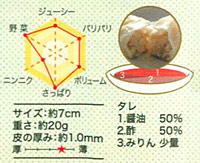
Check out the infographics in these Japanese stadium menus at the bottom of the post. Description of the data available:
Graph (clockwise from top): Juicy, Crispy (Wrapper), Volume, Oily (lower = oilier), Garlic Amount, Vegetable Amount.
Stats: Size, Weight, Wrapper’s Thickness (Star Chart from Thick to Thin)
Sauce Breakdown: Soy Sauce %, Vinegar %, Extras
Here’s a sample image and the entire menu. (pdf, 3.2mb) Thanks for sharing this, Cabel.
Check out these amazing curtains crafted by Nienke Sybrandy. I don’t think I’ve ever been impressed by curtains before. [via not martha]
I love it when professors put their materials online. John Boyd, professor at University of Michigan, has his lecture notes for Engineering 503: Scientific Visualization & Information Architecture. The second chapter is called “The Gospel According to Tufte”. It’s a wonderful collection that I’ll be spending some time on this weekend.
LilyPond looks like an interesting musical notation program. It relies on ASCII text input, and translates it into high-quality graphical notation, harking back to the professional engravings of yore. This reminds me of the LaTeX markup and typesetting language—you get to focus on your product and stop futzing around so much with the visuals. I’ll have to give it a try. The developers have written an interesting essay about the nuance and perfection that most computer-generated notation lacks, and thus, the inspiration for LilyPond. Typography in music! Sweet!
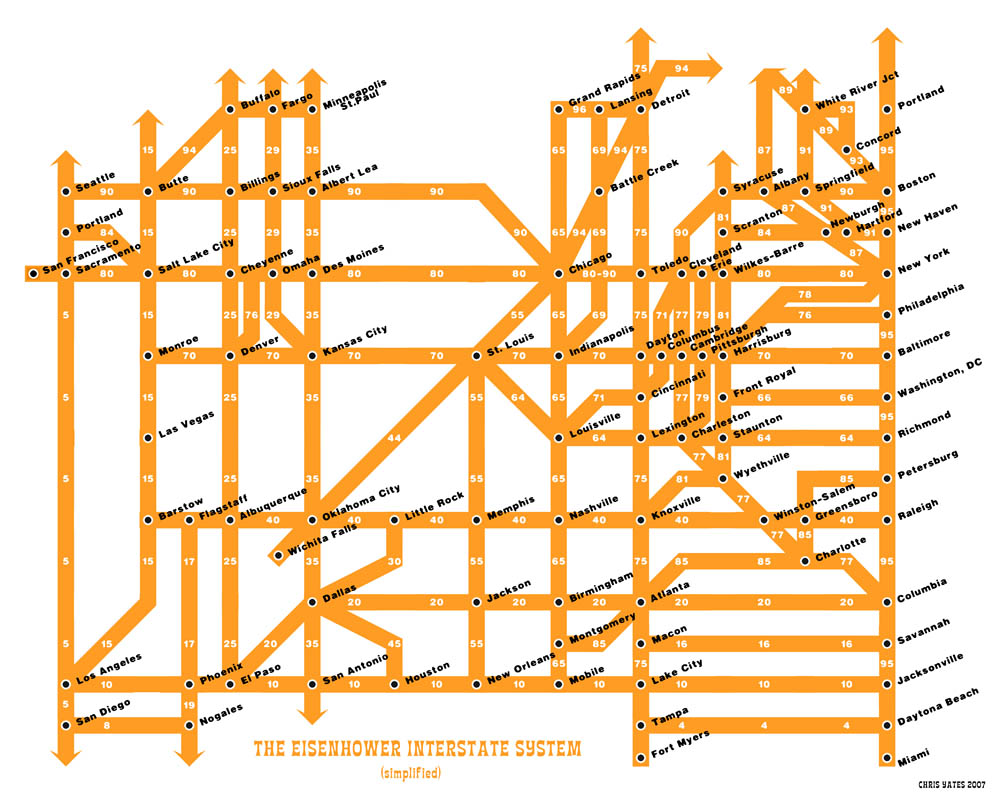
A nicely supersimplified map of the United States Interstate System. There are 16″× 20″ prints available.
Signal v. Noise pointed to a couple cool things the other day. New to me is the Humument, a really cool illustrated treatment/ reincarnation of an old Victorian novel. Check out the gallery. Also getting a blurb are Austin Kleon’s blackout poems. This brings to mind that essay in Harper’s I linked to the other day, the one about plagiarism, copyright, and public imagination.
Today, when we can eat Tex-Mex with chopsticks while listening to reggae and watching a YouTube rebroadcast of the Berlin Wall’s fallÄîi.e., when damn near everything presents itself as familiarÄîit’s not a surprise that some of today’s most ambitious art is going about trying to make the familiar strange. In so doing, in reimagining what human life might truly be like over there across the chasms of illusion, mediation, demographics, marketing, imago, and appearance, artists are paradoxically trying to restore what’s taken for ÄúrealÄù to three whole dimensions, to reconstruct a univocally round world out of disparate streams of flat sights.
Here’s a cool animated interpretation of John Coltrane’s tune, Giant Steps. “The musical theme defines a space and the musical improvisation is like someone drifting in that imaginary space.” Pretty darn cool. I wish there were a full length version—where’s the piano solo?
 Mark Larson