Robert Niles writes on the silliest and most destructive debate in journalism. “They don’t know how we make the sausage, or even who makes it. They just want to eat.” This also relates to Steven Johnson’s Five Things. [via magnetbox]
Category: business
Brian K. Vaughan on breaking into comics: “Oh, and “writer’s block” is just another word for video games. If you want to be a writer, get writing, you lazy bastards.”
A pretty cool Line Rider video, including an insane jump over a busy freeway. And the Jagged Peak Adventure is pretty classic, too. Despite the fact that Line Rider has already jumped the shark (wikipedia), soon, the game will be coming to the Nintendo Wii and the DS.
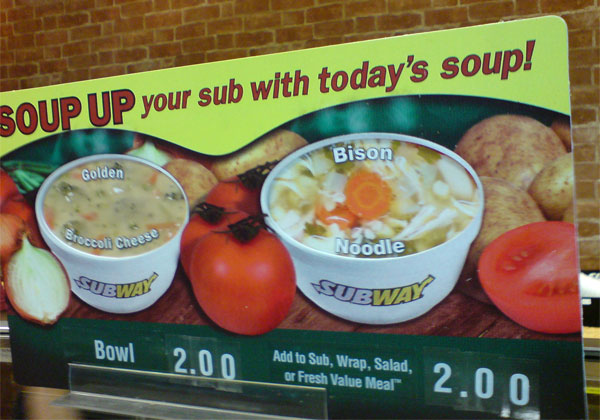
Cabel Sasser introduces the Stupid Subway Sign Prank. “The game here is to pick something funny, but not so funny as to elicit questions.” Check out this pitch for Bison Noodle Soup. There’s also Sunset Minestrone, Fiesta Queso con Queso, and lots of good suggestions in the comments.
Using Enron as the foil for his argument, Malcolm Gladwell writes about mysteries as opposed to puzzles. He’s talking about situations where there is no magical missing piece, but instead we often have an overload of information, a tangle that requires finesse and interpretation that isn’t necessarily open-and-shut.
In the case of puzzles, we put the offending target, the C.E.O., in jail for twenty-four years and assume that our work is done. Mysteries require that we revisit our list of culprits and be willing to spread the blame a little more broadly. Because if you canÄôt find the truth in a mysteryÄîeven a mystery shrouded in propagandaÄîitÄôs not just the fault of the propagandist. ItÄôs your fault as well.
There’s a couple related posts in his blog. Gladwell writes about the strange fact that Wall Street insiders–those with motivation to really care ($)–didn’t publicize the weirdness around Enron’s financial statements. Enter the journalist hero: “Maybe we have underestimated the value of impartial, professionally-motivated, under-paid and overworked generalists in tackling the kind of information-rich, analysis-dependent ÄúmysteriesÄù that the modern world throws at us.”
K.G. Schneider, the Free Range Librarian: “I hear klaxon horns whenever I hear of a management model that claims it will permanently change the nature of work. This would require permanently changing the nature of people. The reality (or, perhaps, my reality) is that work is an essentially dysfunctional activity. We are not wired at the most fundamental level to put on monkey suits and spend dozens of hours every week united in the common cause of an institution.”
That’s in response to her first hearing the term “Management 2.0”. It’s already here, folks! Get ready! Whoo!
An interview with Jacob Covey, art director for leading comics publisher Fantagraphics. [via design observer]
BookSwim is aiming to be the Netflix for literature. You can draw up your list of books and have them mailed to you (for free). When you’re done you mail’em back (for free), and they mail the next titles on your list. You just pay a monthly fee and read as much as you desire. I really hope this is wildly successful. It could be really dangerous for me, though, as I’ve got about 35 books sitting on the shelf in my to-read queue. Last thing I need is to make it easier.
Michael Stephens shares some good comments:
“Add this to Starbucks book clubs, wifi, and music sales, iTunes movie downloads and “third place” contenders like the aforementioned Starbucks or Panera Bread and you have a whole bunch of services, physical spaces and web sites competing for what libraries used to have a hold on.” Indeed, where will the library fit in? Can’t afford to move too slowly. [via tame the web]
The Wall Street Journal is shrinking their newspaper. I’m really going to miss those 3 inches. I love giant newspapers like WSJ that make me feel like I’m flipping through billboards. Maybe there’s a niche market for people like me who want huge newspapers? I’m thinking 36 inches by 48 inches or so for each page. Something I’d have to spread out on the floor and read like I did when I was a kid.
The Bubble Project puts comics-style bubbles on street ads for passers-by to fill in.
Andrew at Songs to Wear Pants to writes songs according to your instructions. I like the hip-hop remix on the Tetris theme.
“In these songs, bricks, squares, pies, stones, and yams are coke, and the cooking, mixing, and weighing required to prepare the drug for clients becomes the inspiration for often inscrutable wordplay.” New Yorker on cocaine and rap. (so… why is this cool?)
Comics legend Stan Lee talks with NPR about superheroes.
If I got a superpower, I wouldn’t say, ‘Oh, I gotta get a costume and put on a mask.’ I would say, ‘Hey, I can do something better than other people. How can I turn it into a buck?’
The creator of Marvel Comics mainstays like Spiderman, the Hulk, and the Fantastic Four celebrated his 84th birthday yesterday.
Just for Fun (review: 3/5)
Linus Torvalds, creator of the Linux kernel and eventually one of the godfathers of open-source software development, tells all in Just for Fun: The Story of an Accidental Revolutionary. I don’t care much for biography, but this one did pretty well for itself. It starts off with the story of young Linus, growing up playing on his grandfather’s computer–and never really stopping. The subsequent years are a typical nerd routine of sleeping, eating, and computing away in a dark room. He developed Linux as a side project, an exercise in operating system development and exploration in low-level PC hardware. The first public release was a tentative version 0.01 that managed to catch the interest of a couple other folks involved in that geek niche.
And from there Linux just kept growing and growing, with its steadily improving quality and open-ness as its only real advertising. It’s that “accidental” aspect that makes it so interesting–Torvalds didn’t really set out to start an empire, and doesn’t really seem to want one now, either. Torvalds on Bill Gates:
I’m completely uninterested in the thing that he’s he best in the world at. And he’s not interested in the thing that maybe I’m the best in the world at. I couldn’t give him advice in business and he couldn’t give me advice in technology.
I like this bit on the freedom that open entails, freedom from mega-personalities, control freaks, and their whims:
The point about open source has never been that I’m more accessible than anybody else. It’s never been that I’m more open to other people’s suggestions… the issues is that even if I’m the blackest demon from Hell, even if I’m outright evil, people can choose to ignore me because they can just do the stuff themselves. It’s not about me being open, it’s about them have the power to ignore me. That’s important.
Near the end, there are a couple of philosophical chapters on intellectual property, control, and some industry prognostication. I like this gem from the intellectual property section: “The patent system of today is basically a Cold War with IP instead of nukes.” Most of the book isn’t that dogmatic, but just as enjoyable.
In praise of Dilbert’s 9-point financial plan, which reads:
1. Make a will
2. Pay off your credit cards
3. Get term life insurance if you have a family to support
4. Fund your 401k to the maximum
5. Fund your IRA to the maximum
6. Buy a house if you want to live in a house and can afford it
7. Put six months worth of expenses in a money-market account
8. Take whatever money is left over and invest 70% in a stock index fund and 30% in a bond fund through any discount broker and never touch it until retirement
9. If any of this confuses you, or you have something special going on (retirement, college planning, tax issues), hire a fee-based financial planner, not one who charges a percentage of your portfolio
Makes sense to me.
Pentagram just completed a new identity/ packaging design for Saks Fifth Avenue.
Coudal is selling pins with letters. You can spell whatever you like as a custom set, or just get a box full of letters. I love these little spin-off enterprises that Coudal does, like the sweet Jewelboxing products, the Chicago Bears victory t-shirts, and the multi-faceted live music packages. So cool.
In another grand infringement of property rights, the U.S. Mint has announced a ban on melting pennies and nickels. The price of copper is up to $3 a pound, so you can potentially make more money by selling the coins as raw metal. Whose metal is it, really?
 Mark Larson