The latest album from Feist is due out on May 1—which is far too long to wait. In the meanwhile, the album cover is absolutely incredible, and a single has surfaced: “My Moon, My Man”. Go look for it on the Hype Machine.
Category: art
Kottke points to some pretty amazingly intricate origami creations by origamist/ scientist Robert Lang. Pretty amazing little creations.
There’s a Wikipedia article that lists where you can find images in the public domain.
Signal v. Noise pointed to a couple cool things the other day. New to me is the Humument, a really cool illustrated treatment/ reincarnation of an old Victorian novel. Check out the gallery. Also getting a blurb are Austin Kleon’s blackout poems. This brings to mind that essay in Harper’s I linked to the other day, the one about plagiarism, copyright, and public imagination.
Today, when we can eat Tex-Mex with chopsticks while listening to reggae and watching a YouTube rebroadcast of the Berlin Wall’s fallÄîi.e., when damn near everything presents itself as familiarÄîit’s not a surprise that some of today’s most ambitious art is going about trying to make the familiar strange. In so doing, in reimagining what human life might truly be like over there across the chasms of illusion, mediation, demographics, marketing, imago, and appearance, artists are paradoxically trying to restore what’s taken for ÄúrealÄù to three whole dimensions, to reconstruct a univocally round world out of disparate streams of flat sights.
The Ecstasy of Influence, a new essay in Harper’s about plagiarism.
Visual, sound, and text collageÄîwhich for many centuries were relatively fugitive traditions (a cento here, a folk pastiche there)Äîbecame explosively central to a series of movements in the twentieth century: futurism, cubism, Dada, musique concr?®te, situationism, pop art, and appropriationism. In fact, collage, the common denominator in that list, might be called the art form of the twentieth century, never mind the twenty-first. But forget, for the moment, chronologies, schools, or even centuries. As examples accumulateÄîIgor Stravinsky’s music and Daniel Johnston’s, Francis Bacon’s paintings and Henry Darger’s, the novels of the Oulipo group and of Hannah Crafts (the author who pillaged Dickens’s Bleak House to write The Bondwoman’s Narrative), as well as cherished texts that become troubling to their admirers after the discovery of their ÄúplagiarizedÄù elements, like Richard Condon’s novels or Martin Luther King Jr.’s sermonsÄîit becomes apparent that appropriation, mimicry, quotation, allusion, and sublimated collaboration consist of a kind of sine qua non of the creative act, cutting across all forms and genres in the realm of cultural production.
“Poetryfoundation.org has invited some of todayÄôs most vital graphic novelists to interpret a poem of their choice from the more than 4,500 poems in our archive, reaching from Beowulf to the present.”
Interview with comics genius Alan Moore on the BBC.
I’m slightly entranced by Joshua Petker’s paintings. I’d say this portrait or this one is my favorite. Makes me think of Dave McKean and Dan Brereton, but lighter. Cool stuff, anyway.
Prog Rock. One of my favorites from the past couple weeks of Prom Night Fist Fight.
Leah Peterson is asking you to mail her things to put in her next painting. Yes, you. Look at her other paintings.
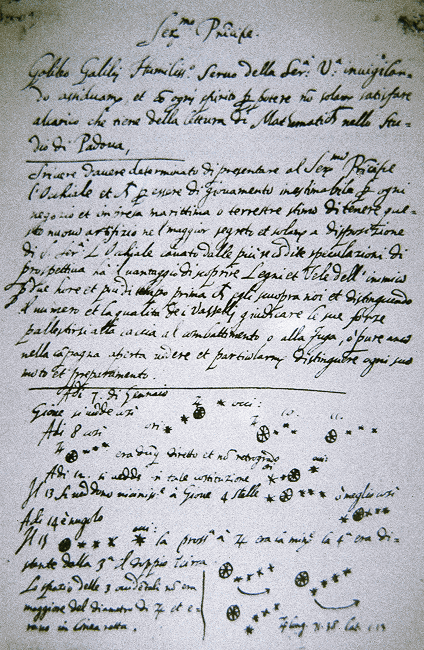
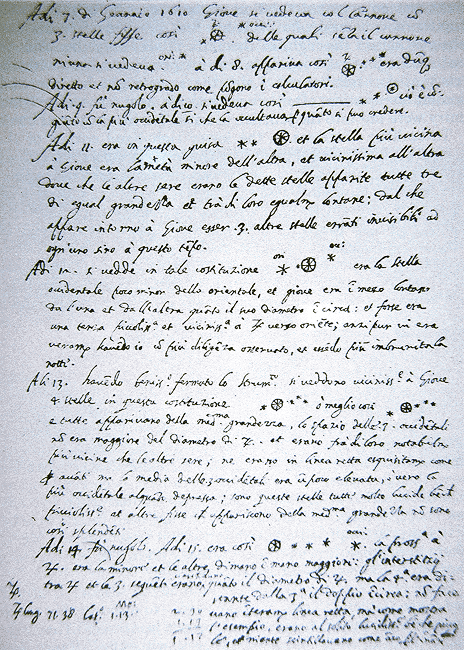
The Galileo Project at Rice University has some awesome primary sources about everyone’s favorite astronomer. They’ve got his collection of sunspot drawings from the sumer of 1613, as well as composite movies of those. I’m trying to imagine how he felt when he first observed them. I can totally see him making little flip books of his illustrations and watching the sunspots dance across the face of the sun.
They’ve also got scans of the manuscripts from the Jupiter observationsÄînote that the images are embedded right there in the text. So cool. And the moon drawings are pretty sweet, too.
Cartoon of the problem with Wikipedia.
Here’s a great essay exploring the connections between comics, games, and world-building.
Perhaps when we find ourselves disturbed or bewildered by the popularity of a new genre or medium, itÄôs precisely by giving it that “serious consideration” that we will begin to get to grips with what it is and how it works. But how do we do this, when the new work often seems to have so little to do with our existing aesthetic criteria?
Scanned images from Astrology: A New and Complete Illustration of the Occult Sciences, by Ebenezer Sibly, 1806.
Austin Kleon has drawn up a cool mind map about comics and information design. Apparently he’ll be working on a thesis on some aspect of the relationship between the two. Cool.
Just by folding paper correctly, you can have your own Desktop Necromancer.
A bevy of fake Apple i-products. My favorite of the bunch so far are iPuffs, for the tech-savvy smoker.
Christian outreach for adult film stars begins with these Bibles featuring custom marketing covers. [via daniel simmons]
Heavy Water, a collection of crisp, detailed illustrations about water and architecture and stuff.
Winsor McKay agrees to make four thousand pen drawings that will move. In this silent film from 1911, cartoonist Winsor McKay (of Little Nemo comics fame) demonstrates some of the first animation, AND it’s in color. The actual cartoon starts around the 7:30 mark. [via four color comics]
 Mark Larson