Mike Clelland’s illustrations are relentlessly cheerful. The lines are so relaxed but precise and I love the heavy use of arrows and labels:


Mike Clelland’s illustrations are relentlessly cheerful. The lines are so relaxed but precise and I love the heavy use of arrows and labels:
Perfume is the art for your sense of smell, just as music is for hearing and art for your eyes and cuisine is for taste. This past weekend at the Decatur Book Festival, my favorite author to hear, by far, was Chandler Burr. Chandler Burr currently writes about perfume for the New York Times. He talked a bit about his book The Perfect Scent and led us through a bunch of perfumes, often drawing analogies with the art world. One fragrance was like Francis Bacon. Another with “a broad wash of abstract fruit” brought Mark Rothko to mind. I’d never given perfume a second thought before but it was really mind-opening to hear about the experimentation and the science and the perfumers cooking it all up. Crazy stuff.
A Day in the Life of a Musician by Erik Satie:
An artist must regulate his life.
Here is a time-table of my daily acts. I rise at 7.18; am inspired from 10.23 to 11.47. I lunch at 12.11 and leave the table at 12.14. A healthy ride on horse-back round my domain follows from 1.19 pm to 2.53 pm. Another bout of inspiration from 3.12 to 4.7 pm. From 5 to 6.47 pm various occupations (fencing, reflection, immobility, visits, contemplation, dexterity, natation, etc.)
Dinner is served at 7.16 and finished at 7.20 pm. From 8.9 to 9.59 pm symphonic readings (out loud). I go to bed regularly at 10.37 pm. Once a week (on Tuesdays) I awake with a start at 3.14 am.
Sculptor Richard Serra gave the 2008 commencement speech at Williams College. I like his comments about thinking, obsession, and play:
If itÄôs not broken, break it. One way of coming to terms with the prevailing language of a cultural orthodoxy is to reject it. It may be necessary to invent tools and methods about which you know nothing, to act in ways that allow you to utilize the content of your personal experience, to form an obsession and to cut through the weight of your education. Obsession is what it comes down to. It is difficult to think without obsession, and it is impossible to create something without a foundation that is rigorous, incontrovertible, and, in fact, to some degree repetitive. Repetition is the ritual of obsession. DonÄôt confuse the obsession of repetition with learning by rote. I am suggesting a form of inquiry, a procedure to jumpstart the indecision of beginning.
The solution to a given problem often occurs through repetition, a continual probing. The accumulation of solutions invariably alters the original problem demanding new solutions to a different set of problems. In effect, as solutions evolve, new problems emerge. To persevere and to begin over and over again is to continue the obsession with work. Work comes out of work.
But solutions need not only be the result of constant repetition. There is another route, not so structured but rather free-floating and more experimental but no less obsessive. It is to be found in the activity of play. I cannot overemphasize the importance of play. The freedom of play and its transitional character encourage the suspension of beliefs whereby a shift in direction is possible; play ought to be part of the working process. Free from skepticism and self-criticism play allows you to relinquish control. Playful activity provides an alternative way to see, to imagine, to do, to make, to think otherwise. In play there are no ends, there are only means, however, means inadvertently can lead to ends. Rules can be made up as you go along or even in hindsight.
[via michael surtees]

I’ve been flipping through The Collected Prose of Robert Frost and came across this marvelous bit:
No one given to looking under-ground in spring can have failed to notice how a bean starts its growth from the seed. Now the manner of a poet’s germination is less like that of a bean in the ground than of a waterspout at sea. He has to begin as a cloud of all the other poets he ever read. That can’t be helped. And first the cloud reaches down toward the water from above and then the water reaches up toward the cloud from below and finally cloud and water join together to roll as one pillar between heaven and earth. The base of water he picks up from below is of course all the life he ever lived outside of books.
Frost speaks elsewhere of “the person who writes out of the eddy in his mind.” Great images.
As an aside, not only is this a really great metaphor, but it also strikes me as a killer opening paragraph. It starts with a kind of odd idea, but not too uncomfortable (I mean, I know what a bean is, but I haven’t looked at one in the ground in decades). Then the contrast of beans with what he really wants to talk about, poets. And waterspouts. What? Then a couple short prep sentences. Then the rolling polysyndetonic waterspout of a sentence to flesh out the metaphor and to be a sort of pillar in itself connecting the odd ideas at the opening with real-world experience down at the bottom of the paragraph. The language here mirrors the concepts in a very cool way.

When you are outside drawing a tree, YOU are choosing what is in focus, what is not—there is an exchange between subject and viewer. That is the art. To be present in that moment.
[thanks, austin]

Public sculpture can be hit or miss, but I think the Sibelius Monument is pretty sweet.


Really impressive linocuts + lithographs. See more of Edward Bawden’s artwork at BiblioOdyssey.
The Singing, Ringing Tree is a sculpture in Lancashire, England that makes wooooing and oooooohhhhing sounds as the wind blows over the hilltop.

“I lied in my ad. I hate Wallace Stevens.” Mike Twohy, New Yorker, 1995.

The Brooklyn Museum has some great photos on Flickr. Currently in the commons are a great set of old lantern slides in Egypt, and a lot of images from the 1900 Paris Exposition.

In the Paris set, it’s cool how the primitive coloring job kind of flattens the images. They look almost like paper cut-outs or watercolor:


I like the idea of a corporate artist in residence. Surely a few companies would buy into it?
I watched Old Joy last week (trailer, Ebert) and recommend that you do the same. It’s based on a short story by Jonathan Raymond and uses its 70-something minutes very well.
In 1800s America, Shakespeare productions had juggling and singing amidst the acts, and theatergoers would cheer the heroes, boo the villains, shout out lines along with the actors, even walk about on the stage. Opera divas would sing “Yankee Doodle,” “Home Sweet Home,” Irish ballads and other folk songs, and take requests from the audience. Orchestras would choose a few excerpts from Beethoven, Mozart, Bach, and mix them in with popular reels, jigs, and other dance tunes. It was a different world:
GRAND CONCERT OF MUSIC…
An African Monkey
and several
CHINESE DOGS
Come One Come All
I dog-eared Highbrow/Lowbrow: The Emergence of Cultural Hierarchy in America more heavily than any book in recent memory. Lawrence Levine doesn’t argue that the old ways of interacting with art were necessarily better. But it is important to know that it was different. The book gives a whole different history and perspective on our inherited rituals, kind of like hearing a whole new arrangement of a familiar melody.
Levine opens the book with a focus on Shakespeare in American cultural life. Shakespeare was really popular. At home, in books (like Mark Twain’s parodies in Huckleberry Finn), on the road, in the theaters. Even the illiterate mountain man Jim Bridger knew it was worth hiring someone to read it to him enough that he could recite long passages.
In performance, this popularity and relevance made it fairly common for the actors to shorten or lengthen the monologues as they saw fit, and companies would commonly rewrite the endings. In a typical account from a local newspaper, when the audience disapproved, “Cabbages, carrots, pumpkins, potatoes, a wreath of vegetables, a sack of flour and one of soot, and a dead goose, with other articles, simultaneously fell upon the stage.” What’s cool is not only that the audience was carrying vegetables to the show, but also that they knew Shakespeare well enough to know the difference when changes were made to voice their opinion. And audience and performers alike weren’t just mutely receiving the Greatness of Shakespeare, but participating and engaging with it.
Events like the Astor Place Riot in 1849 helped mark the growing division between the audiences for art (the Cultured and the Masses), and the “sacralization” of the works themselves. A lot of it was tied to the economics of the art industry. Amateur actors and musicians were gradually replaced with professional payrolls. Wealthy patrons became the primary financial support for the organizations, so the programming was less reliant on popular approval and ticket sales at the door. With the Masses weeded out, the new superstar conductors began to program entire works, instead of just excerpts.
And along with that came programs of behavioral control (dimming the lights, refusal to encore, training audiences in when to clap, etc.). Levine ties in “the taming of the audience” to a broader cultural change that separated public and private space, and public and private behavior. As art became more hierarchical, the classes weren’t attending the same types of performances or sharing the same spaces. The cultural institutions were active in “teaching their audiences to adjust to the new social imperatives, in urging them to separate public behavior from private feelings.” By the early 1900s,
the masterworks of the classic composers were to be performed in their entirety by highly trained musicians on programs free from the contamination of lesser works or lesser genres, free from the interference of audience or performer, free from the distractions of the mundane; audiences were to approach the masters and their works with proper respect and proper seriousness, for aesthetic and spiritual elevation rather than mere entertainment was the goal.
In other words, it changed to the modern, frosty atmosphere that lingers in performance halls and museums today. No more audience outrage, no more spontaneous celebrations. The groups were transformed “strove to concentrate on the music rather than the performance.” The orchestra plays, the audience receives. You see a similar transformation in museums and libraries at the same time. They change from the fantastic freak shows and cabinets of curiosity to sacred archives, filled with carefully curated items for preservation or quiet contemplation.
One really interesting bit that Levine touches on is how knowledge of these cultural manners (like knowing when to clap) helps classes distinguish themselves. In this way, knowledge becomes both a status symbol and a barrier to entry:
Thorsten Veblen constructed his concept of conspicuous consumption, he included not only the obvious material possessions but also the “immaterial” goods—“the knowledge of dead languages and the occult sciences; of correct spelling; of syntax and prosody; of the various forms of domestic music… of the latest proprieties of dress, furniture, and equipage”; of the ancient “classics”—all of which constituted a conspicuous culture that helped confer legitimacy on the newly emergent groups. This helps explain the vogue during this period of manuals of etiquette, of private libraries and rare books, of European art and music displayed and performed in ornate—often neoclassical—museums and concert halls.
It’s a really fantastic book. Levine to close it out:
When the art forms that had constituted a shared culture for much of the nineteenth century became less accessible to large segments of the American people, millions of them satisfied their aesthetic cravings through a number of the new forms of expressive culture that were barred from high culture by the the very fact of their accessibility to the masses: the blues, jazz or jazz-derived music, musical comedy, photography, comic strips, movies, radio, popular comedians, all of which though relegated to the nether world culturally, in fact frequently contained much that was fresh, exciting, innovative, intellectually challenging, and highly imaginative. If there is a tragedy in this development, it is not only that millions of Americans were now separated from exposure to such creators as Shakespeare, Beethoven, and Verdi, whom they had enjoyed in various formats for much of the nineteenth century, but also that the rigid cultural categories, once they were in place, made it so difficult for so long for so many to understand the value and importance of the popular art forms that were all around them.
David Byrne has a new art installation that connects an organ keyboard to various parts of a large building. Playing the Building makes a giant musical instrument out of the structure of columns, walls, pipes:
I’d like to say that in a small way it turns consumers into creative producers, but that might be a bit too much to claim. However, even if one doesn’t play the thing, it points toward a less mediated kind of cultural experience. It might be an experience in which one begins to reexamine one’s surroundings and to realize that cultureÄîof which sound and music are partsÄîdoesn’t always have to be produced by professionals and packaged in a consumable form.
The Most Wanted Song and the Most Unwanted Song were written in response to survey results, just like the earlier creation of the world’s Most Wanted Paintings. The Most Unwanted Song features an operatic, rapping soprano and children singing a holiday polka:
The most unwanted music is over 25 minutes long, veers wildly between loud and quiet sections, between fast and slow tempos, and features timbres of extremely high and low pitch, with each dichotomy presented in abrupt transition. The most unwanted orchestra was determined to be large, and features the accordion and bagpipe (which tie at 13% as the most unwanted instrument), banjo, flute, tuba, harp, organ, synthesizer (the only instrument that appears in both the most wanted and most unwanted ensembles). An operatic soprano raps and sings atonal music, advertising jingles, political slogans, and “elevator” music, and a children’s choir sings jingles and holiday songs. The most unwanted subjects for lyrics are cowboys and holidays, and the most unwanted listening circumstances are involuntary exposure to commericals and elevator music. Therefore, it can be shown that if there is no covarianceÄîsomeone who dislikes bagpipes is as likely to hate elevator music as someone who despises the organ, for exampleÄîfewer than 200 individuals of the world’s total population would enjoy this piece.
ROTHKOesque, a group of photos with Mark Rothko-ish qualities.
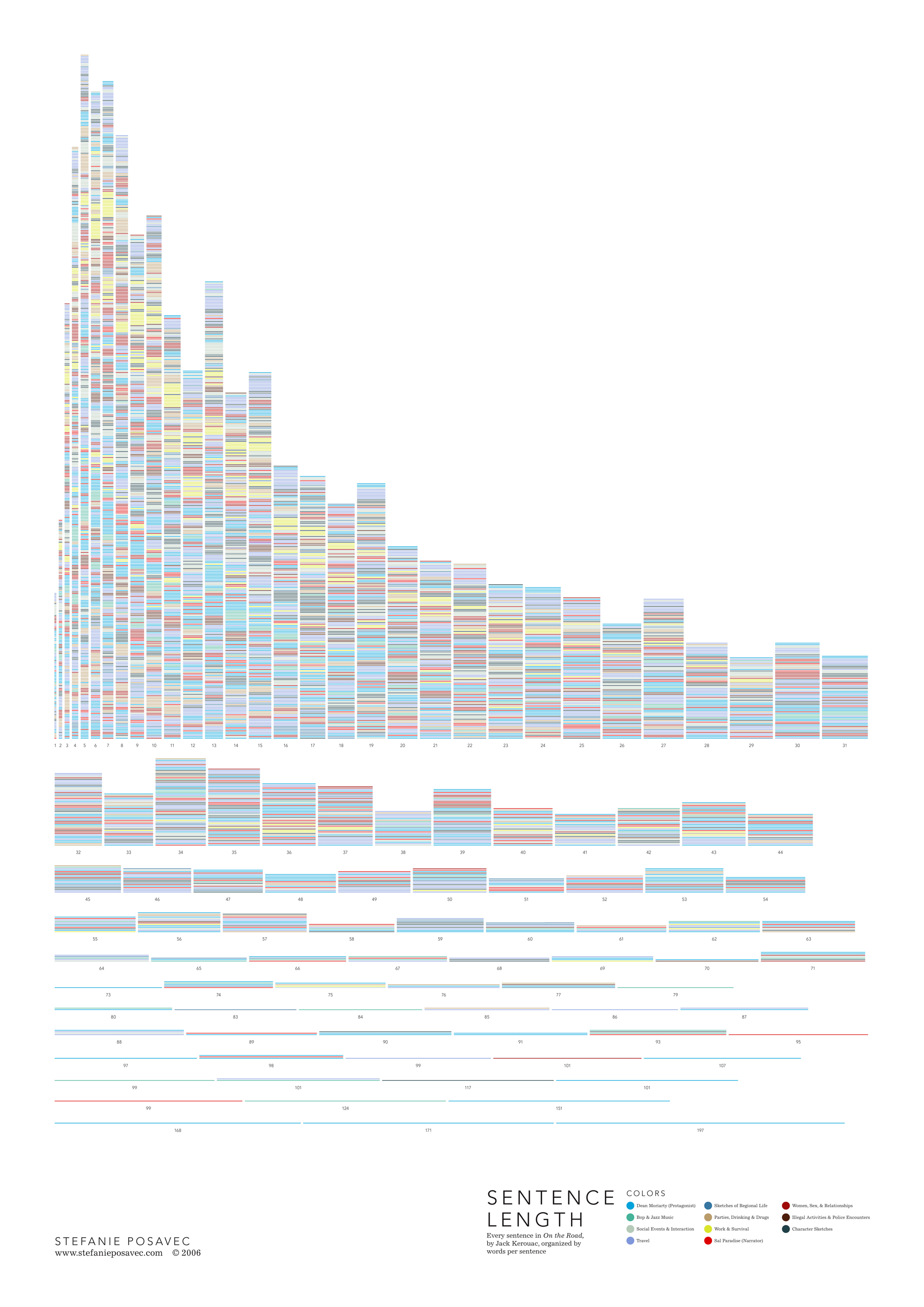
Stefanie Posavec made a diagram of every sentence in On the Road organized by words per sentence. Here are more literary diagrams.
 Mark Larson