A pretty cool Line Rider video, including an insane jump over a busy freeway. And the Jagged Peak Adventure is pretty classic, too. Despite the fact that Line Rider has already jumped the shark (wikipedia), soon, the game will be coming to the Nintendo Wii and the DS.
Category: art
“I confess I’ve been increasingly dissatisifed with the direction of modern pop, which has more and more privileged screechy and/or whiny vocalists who are utterly unable to play any instrument themselves, and thus, usually, unable to actually write music or songs themselves.” Over at Collision Detection, Clive Thompson points to a recent article by Chuck Klosterman about how YouTube is reviving musical virtuosity. Klosterman:
One of those depressing paradoxes about rock ‘n’ roll: Very often, profoundly exceptional guitar playing is boring to listen to… It’s difficult for nonmusicians to appreciate world-class guitar playing through solely sonic means, mostly because a) the difference between great guitar playing and serviceable guitar playing is often subtle, and b) every modern listener assumes production tricks can manufacture greatness. (As a result, radio audiences are automatically skeptical of what they hear.) Guitar brilliance usually comes across as ponderous. But that changes dramatically when one adds the element of video; somehow, watching changes the experience of hearing. There are certain things that sound good only when (and if) you can see them. And YouTube lets you see them.
Two comments on the side:
One, for great example of YouTube sanctifying musical skill, check out the video of Stanley Jordan playing “Autumn Leaves” that I linked to earlier. Seeing is believing there.
And two, I’m really curious why Esquire didn’t put the links directly in the body of Klosterman’s essay–we’re talking about the internet, here. Is there a reason to list a plain-text web address buried in a footnote?
Coming to a theater near you: a movie version of Marjane Satrapi‘s graphic novel of growing up in Iran, Persepolis.
There’s some cool doppelg?§nger action in these photos tagged with “multiplicity”–showing the subject in more than one place at the same time.
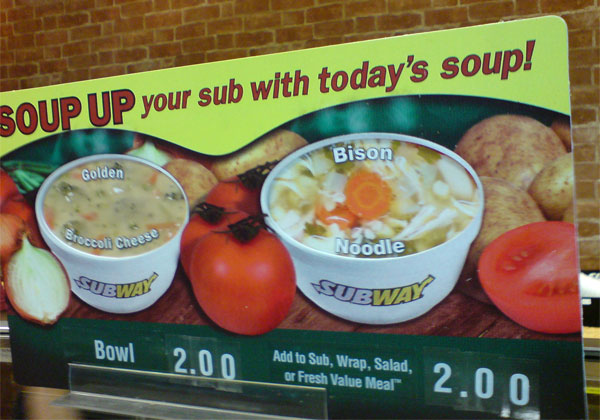
Cabel Sasser introduces the Stupid Subway Sign Prank. “The game here is to pick something funny, but not so funny as to elicit questions.” Check out this pitch for Bison Noodle Soup. There’s also Sunset Minestrone, Fiesta Queso con Queso, and lots of good suggestions in the comments.
An interview with Jacob Covey, art director for leading comics publisher Fantagraphics. [via design observer]
The Nonist mulls the next step in blogging and more importantly, in art:
Much of what IÄôve learned about blogging, from the standpoint of a creative pursuit, reinforces my perception that the form, which includes as a subset all preconceptions and consumer habits, may be an artistic dead-end.
The Bubble Project puts comics-style bubbles on street ads for passers-by to fill in.
Andrew at Songs to Wear Pants to writes songs according to your instructions. I like the hip-hop remix on the Tetris theme.
From Bob Becker‘s classic article on the paradoxes of percussion: “Substantial preparation time is often required for only a few seconds of actual performance… A performer who resigned his position as a percussionist with a major symphony orchestra once explained that, ‘Ninety percent of the time I was bored to death, and the other ten percent of the time I was scared to death.'”
The Early Comics Archive offers samples of comics work dating from around 300AD up to the early 1900s.
“We again asked the Princeton University community to submit imagesÄîand, for the first time, videos and soundsÄîproduced in the course of research or incorporating tools and concepts from science. Out of nearly 150 entries from 16 departments, we selected 56 works to appear in the 2006 Art of Science exhibition.”
The Saints Row videogame for Xbox 360 has some pretty severe bugs. Cabel Sasser filmed some of the more egregious ones… and set them to an original musical score. Absolutely incredible! I really hope he does more of these. [via daring fireball]
An interview with SNL writer Bryan Tucker.
One thing people still don’t seem to get is that the show is actually live and on Saturdays – just like the title says (when I got the job my mom asked me what night the show came on), Things are literally being rewritten and changed until minutes before they get on the air – usually not radically changed, but definitely tweaked. The whole show is put together in about four days, and it’s frustrating when people compare SNL to other comedy shows that have the tremendous advantage of pre-taping things and controlling every aspect of what ultimately gets produced.
And here is part two.
Comics legend Stan Lee talks with NPR about superheroes.
If I got a superpower, I wouldn’t say, ‘Oh, I gotta get a costume and put on a mask.’ I would say, ‘Hey, I can do something better than other people. How can I turn it into a buck?’
The creator of Marvel Comics mainstays like Spiderman, the Hulk, and the Fantastic Four celebrated his 84th birthday yesterday.
Google Video has some good old-school cartoons by Winsor McKay.
 Mark Larson