atlurbanist:

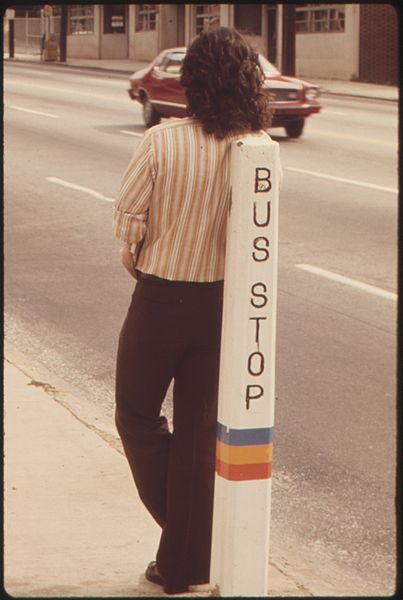
Waiting for a MARTA bus in 1974

Cool dude waiting for a MARTA bus in Atlanta, 1974. This photo comes from Wiki Commons, with a note that there was a spike in ridership at this time because the fare was reduced from 40 cents to 15 cents. Also, new routes and buses had been recently added.

Current MARTA fare for buses and trains is $2.50, with an increase possible later this year if budgeting measures (and proposed privatization) are unsuccessful at alleviating financial woes at the agency.

I really like these old bus stop obelisks.

How to read a book

I think people who want to read more but don’t, or people who don’t like to read, are sometimes just putting too much pressure on themselves. And perhaps not being smart or creative enough about it. Here are ways around reading a book that are still kinda reading a book:

  • Don’t read the book, read the author’s flurry of blog posts and essays on sites everywhere that appeared around the time of the book’s launch.
  • Don’t read the book, read a bunch of smart book reviews.
  • Read the introduction and/or conclusion. I used to skip intros all the time when I was in high school because I was cool, but when I started Histories, I realized that smart context can be among the best parts. And the intros are also good for selling you the ideas in the rest of the book…
  • Read the index and look for entries with lots of sub-entries. No seriously, read like every line. It’s just a way to get yourself oriented, and more importantly, maybe you’ll catch a name or phrase that gets you curious, which leads me to…
  • Start wherever you feel like it. Page 53 is fine if it’s interesting. This is another good way to sell yourself the book. All you need is a foothold. Pages 1-52 will always be there later.
  • Skim it. For things that interest you. Gloss over numbers or the anecdotes if they bore you. When I read The Information and The Signal and the Noise recently I semi-skimmed, with dramatic impatient sighs, the sections about medicine, health, environment. These have long been areas of maximal boredom for me and I’m happy to acknowledge that and move on to something cooler.
  • Take notes, which is to say, use the book as a way to make your own writing.
  • Read your notes.
  • Reread your older notes.
  • Stop reading. As in, no sentences at all from anywhere. You’ll be back. Mark my words.

And as I finish this brain dump I remember that Ryan Holiday has said many of the same things already.

Gibson-Faulkner space = “The future is already here—it’s just not very evenly distributed.” × “The past is never dead. It’s not even past.”

The Ikea Effect – The New Inquiry

The self-care of beauty work is part of how we physically enact our self-assigned value. There’s a reason one sign of depression and some other mental illnesses is neglected grooming: When your brain decides that you’re not as valuable as you once believed, you’re less likely to keep doing the labor that represents that value.

The Ikea Effect – The New Inquiry

Warrior

Warrior. I’ve raved about this movie before. A few things I appreciate on third viewing… 1. The efficiency of the startup. A few bits of dialogue, usually barbs hinting at old wounds. Some are too vague to be effective (“That shit you pulled”), but some are so wincingly perfect for character and delivery (“Must be tough to find a girl who could take a punch nowadays.”) 2. Shot, reverse-shot. Sports movies have to deliver on dialogue when you’re not at the relevant events. This is why you care about Rocky or Rudy. Style-wise, these shots reminds me of Michael Mann, peering over the shoulder. 3. Obstructing the shots. I’m thinking of the husband-wife conversation in the bathroom and the father-son scene in the hotel room. Doorways and bodies block the view, so you instinctively want to tilt your head a bit. It also works in the fight scenes cage, where you’re trying to peek through the fence to get closer to the action. In a way, those shots feel more like you’re “there” in the arena than when you get the clean close-ups. 4. This movie is now 3-for-3.

The Net Is a Waste of Time – New York Times

I stay in. Hooked. Is this leisure – this browsing, randomly linking my way through these small patches of virtual real-estate – or do I somehow imagine that I am performing some more dynamic function? The content of the Web aspires to absolute variety. One might find anything there. It is like rummaging in the forefront of the collective global mind. Somewhere, surely, there is a site that contains … everything we have lost?

Oldie but a goodie. William Gibson in 1996.

Today, in its clumsy, larval, curiously innocent way, it offers us the opportunity to waste time, to wander aimlessly, to daydream about the countless other lives, the other people, on the far sides of however many monitors in that postgeographical meta-country we increasingly call home. It will probably evolve into something considerably less random, and less fun — we seem to have a knack for that — but in the meantime, in its gloriously unsorted Global Ham Television Postcard Universes phase, surfing the Web is a procrastinator’s dream. And people who see you doing it might even imagine you’re working.

The Net Is a Waste of Time – New York Times
Looper

Looper. Solid scifi. Just take a nugget of a concept and let it spool out around a handful of people. It makes movie sense in the moment even if it doesn’t later. I love this vision of a possible future. Dystopic, but not totally dire. Just worn out. Good job with the makeup, and especially how Gordon-Levitt takes on some Willis mannerisms. I love Jeff Daniels’ character. There is some violence that a certain demographics won’t take to very well, but I appreciate that he did it anyway, it fit the story, and that it wasn’t over-the-top exploitative. It was sad. I also liked some of the audio editing and they he played with the sound stage. There’s too much leeenns flaaare. But good movie! Rian Johnson knows his craft. Makes me want to watch Brick again.