The Atlanta malaise

I needed this laugh today:

You know how it’s been around here – no one has jobs, certain people didn’t win certain elected offices so we have to treat them as private citizens, baby animals are dropping dead left and right and the AJC won’t let Mark Davis cover this so we don’t even know how to feel about the whole thing, not a single DJ in Atlanta will play Jermaine Stewart when we ask for it, we had to ride home on buses marked with red Xs a couple of weeks ago, and all the gourmet popsicles in the world can’t make us feel excited about summer because we didn’t even have time to get over spring’s runny allergy eyes before the humidity kicked in.

The Atlanta malaise

College and the Art of Life – David Salesin, Convocation Address, 28 September 2003

College is such an amazing time of freedom. For many of you, this is the first time in your life when it’s completely up to you, and you alone, to decide what you study, what activities you engage in, and how you structure your day. One idea I came up with as an undergrad was to try to maintain balance by making sure I engaged in four different types of activities every single day. These were:

-something intellectual (not so difficult at school);
-something physical (like running, biking, a team sport);
-something creative (like music, art, or writing); and
-something social (like lunch with a friend).

College and the Art of Life – David Salesin, Convocation Address, 28 September 2003

Connecting some threads: a well-balanced life

Me, tweetin’ earlier this evening:
Well-balanced

And I went on to remind myself: “Gotta be constantly tweaking the recipe, right? I kinda know the ingredients but the ratios get out of whack”. I say all this because it reminded me of something that I bookmarked a couple months ago and forgot to share, which is Seth Roberts on Optimal Daily Experience (via Justin Wehr):

Everyone knows about RDAs (Recommended Daily Allowances) of various nutrients. In a speech to new University of Washington students, David Salesin, a computer scientist, advised them to “maintain balance” by getting certain experiences daily:

  • something intellectual [such as a computer science class] (not so hard in college);
  • something physical (like running, biking, a team sport);
  • something creative (like music, art, or writing); and
  • something social (like lunch with a friend).
  • This served him well in college, he said, and he continued it after college.

    Roberts goes on to propose his own list. This isn’t rocket surgery. Make some basic priorities, try to check them off on a regular basis, re-evaluate every so often. So I think to myself, how simple would it be to take a basic calendar, divide each day into four quadrants for these four, and add a little check marks as appropriate so you can track yourself? Very simple. Done.

    It also kinda ties in with Austin Kleon’s tumble about Ben Franklin and pros and cons lists. Says Ben:

    And tho’ the Weight of Reasons cannot be taken with the Precision of Algebraic Quantities, yet when each is thus considered separately and comparatively, and the whole lies before me, I think I can judge better, and am less likely to take a rash Step; and in fact I have found great Advantage from this kind of Equation, in what may be called Moral or Prudential Algebra.

    First off, I love the phrase “Moral or Prudential Algebra”. It ties in with my general attitude of 19th-century optimism (which phrase I stole for my Twitter bio), the idea that with a little forethought and pluck and some striving, you can make Good Life Decisions. And secondly, there’s that idea that you should lay it all out where you can look at it–and this is not just for quote creative unquote stuff. The point is, your life is the Ultimate Creative Project, if you will, so you’d best keep an eye on the how the stuff’s accumulating. Not the details themselves, but the pattern, the trend. To quote Colin Marshall again:

    Satisfaction is a product not of where you are, but of where you’re going. To get calculistic, it ain’t about your value, it’s about your first derivative (and maybe your second). In this light, statements like “When x happens, I’ll attain happiness” don’t make sense, but ones like “While x is happening, I’ll be happy” make somewhat more.

    And a bit later in the evening I was reading Derek Sivers’ excellent notes on The Happiness Hypothesis (in the bookpile now) and I came across a couple quotes that tie in with Roberts, Salesin, and Franklin. First on moral education:

    Moral education must also impart tacit knowledge – skills of social perception and social emotion so finely tuned that one automatically feels the right thing in each situation, knows the right thing to do, and then wants to do it. Morality, for the ancients, was a kind of practical wisdom.

    and then on choices vs. conditions:

    Voluntary activities, on the other hand, are the things that you choose to do, such as meditation, exercise, learning a new skill, or taking a vacation. Because such activities must be chosen, and because most of them take effort and attention, they can’t just disappear from your awareness the way conditions can. Voluntary activities, therefore, offer much greater promise for increasing happiness while avoiding adaptation effects.

    Note to self: moral education (not just ethics stuff, but we’re venturing into Franklin’s thirteen virtues here) involves a set of skills that you can practice. Practice and it becomes voluntary, habitual, sustaining. That’s my working theory, in any case. So what have I learned today? Pay attention. Make good choices. Nail the basics, consistently. Basically, the most vague, mundane things ever, but sometimes having a new sense of the gestalt of the whole endeavor can be very refreshing.

    Colin Marshall: Openearedness

    I went to City Skies Electronic Music Festival again last night and it reminded me of Colin Marshall’s post:

    Take heed, experimental music-loathers: it’s not that us enthusiasts possess (or believe ourselves to possess) some higher discernment that allows us to draw infinitely more pleasure from the same sound waves you can’t stand. It’s that we enjoy the culture surrounding it.

    Or at least I do; it’s the one live music “scene” whose adherents don’t irk me in some distinctive way. The experimental crowd lacks the pious immortal-worship of jazz fandom, the dried-out shushery of the classical set or the pro forma disenchantment/enchantment of young rockdom, replacing it with a relaxed yet eager openmindedness. Or openearedness. Whatever. The point is that they’re willing to listen seriously and see what sort of an art experience results, pretty much no matter what.

    Colin Marshall: Openearedness

    The Fifty Twentieth-century Works Most Cited in the Arts & Humanities Citation Index

    “In Essays of an Information Scientist (Vol. 10, 1987), Eugene Garfield reported the findings of a quantitative analysis of cited works in the Arts & Humanities index.” See also Most-cited authors of books in the humanities, 2007, which summarizes my ambivalence nicely: “What this says of modern scholarship is for the reader to decide – and it is imagined that judgments will vary from admiration to despair, depending on one’s view.” My nerd side is excited to see lists like this, my mildly-cynical/skeptical-about-academia side isn’t so sure.

    The Fifty Twentieth-century Works Most Cited in the Arts & Humanities Citation Index

    Then We Came to the End (review: 3.5/5)

    Then We Came to the End

    We were delighted to have jobs. We bitched about them constantly. We walked around our new offices with our two minds.

    Then We Came to the End was Joshua Ferris’ first novel. I knew about it before I read it mostly because it was written in the first-person plural. We did this, then we did that, so-and-so told us about that guy. The cast is a group of employees in an advertising agency on the down-and-out. I think this one could have been chopped down a bit, but what’s there is still pretty good. And it reads so quickly, it’s not a big deal. The setting and tone reminded me a lot of Matt Beaumont’s book, “E”. The employees gossip, connive, overreact, speculate. Ferris has a great ear and eye for the office, a great observer of office life:

    He came by each one of our individual offices, he visited the cubicles and the receptionists. We even saw him talking to one of the building guys. They hardly said anything to anyone, the building guys. Just stood on their ladders handing things up and down to one another, speaking in hushed tones.

    And body language:

    You didn’t talk about money or job security during a time of layoffs, not in the tone she had taken, and not when you were friends. The silence extended into awkward territory.

    […]

    “I wasn’t trying to be snide just then,” she said, finally sitting down, reaching out to touch the edge of his desk as if it were a surrogate for his hand.

    And this bit about cuts and promotions:

    The point was we took this shit very seriously. They had taken away our flowers, our summer days, and our bonuses, we were on a wage freeze and a hiring freeze, and people were flying out the door like so many dismantled dummies. We had one thing still going for us: the prospect of a promotion. A new title: true, it came with no money, the power was almost always illusory, the bestowal a cheap shrewd device concocted by management to keep us from mutiny, but when word circulated that one of us had jumped up an acronym, that person was just a little quieter that day, took a longer lunch than usual, came back with shopping bags, spent the afternoon speaking softly into the telephone, and left whenever they wanted that night, while the rest of us sent e-mails flying back and forth on the lofty topics of Injustice and Uncertainty.

    They all have the ring of truth. Sandwiched between the sillier bits, there’s a pretty amazing little intermezzo chapter, “The Thing to Do and the Place to Be”. That one focuses on one of the characters, a manager, who’s struggling to face an upcoming surgery. It’s quite touching.

    As the book carries on, the loose, manic tone can start to wear a bit thin. But then, the mood does change. Employees are fired or move on. This “we” that you’ve been a part of breaks up. Former co-workers reunite, have a few drinks, and move on. In the end, the most clever part about that narration is that I really related to it, as corny as it might sound. What makes this book worthwhile is not that it pokes fun at office life, but it helps you to value it.

    There is plenty of good discussion of the book elsewhere. I also thought this comparison of “Then We Came to the End” with Tim O’Brien’s “The Things We Carried” was really interesting.

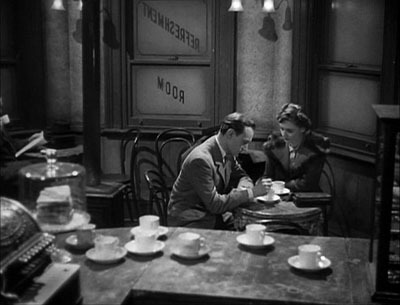
    Brief Encounter

    Brief Encounter. This was pretty good. I enjoyed it. It’s about an affair between two people, pretty tame by today’s standards. But that was a different era. Here’s a Criterion essay. And I got a couple semi-related thoughts:

    1. One of the most enjoyable things about old/foreign movies is that I often don’t know the cast. It can feel more immediately immersive to see the characters as characters, rather than recognizing actors and trying to set aside that I know they’re portraying people. There’s no baggage, no expectations, no known quirks or ticks. It all feels very fresh.

    2. This movie’s soundtrack relies heavily on Rachmaninov’s Piano Concerto No. 2, a few sections in particular. I wonder what it would be like, instead of scoring a film, to film a score. That is, take some work of music and make a movie such that every bit of imagery fits or bolsters (or undermines, why not?) the music in some way. Like Fantasia, I guess, but live-action and only focusing on one piece of music. Is there anything else in that vein? At the least, it would be an interesting constraint on the filming.

    Cassidy had no idea what made Andrea so different, but he could sense that she had somehow survived twenty years as an attractive female in the republic without having had her mind reamed out by mama, the Junior League or Helen Gurley Brown.

    The best line from John L. Parker’s otherwise okayish book, Once a Runner.

    Getting Their Guns Off – Magazine – The Atlantic

    Certainly one of the reasons why World War II came to be called “the Good War,” and those who fought it “the Greatest Generation,” and why Americans have reserved their utmost sentiment for the European theater of that war, is because the 1945 discovery that we’d helped shut down a genocide redeemed that theater’s carnage—ex post facto—and bestowed upon that campaign a narrative, moral, and even aesthetic appeal that is exceptional for any war. Saving Private Ryan and Band of Brothers epitomize that theater’s irresistible appeal, with their mix of commendably upsetting, technically brilliant combat scenes and more general uplift. Every mangled limb, every shattered facade, every act of conditioned violence stage-whispers “Sacrifice” amid the gently weeping soundtrack and the faded–Saturday Evening Post color palette, with the overall effect evoking stateliness, esteem, even nostalgia—emotional luxuries that only a comfortable remove can give to the hectic, terrifying nature of combat. All of which takes viewers half out of the moment, despite the kinetic you-are-there cinematography.

    Getting Their Guns Off – Magazine – The Atlantic