Lunch Doodles: How To Draw Faces. The Kleon Media Empire expands! Blogs, books, videos, webinars. Waiting for the action figure.
(Source: https://www.youtube.com/)
Lunch Doodles: How To Draw Faces. The Kleon Media Empire expands! Blogs, books, videos, webinars. Waiting for the action figure.
(Source: https://www.youtube.com/)
By now it should be clear that you'll be most comfortable with my arguments if you fully accept yourself as a fitness-flaunting consumer narcissist who has been deluded, throughout your whole life, into irrational spending habits by advertising euphemisms and peer pressure. In other words, you'll probably feel uneasy for much of the time you're reading it.
That line comes about 100 pages into the book. I stumbled on it when I was flipping through and it's the passage that convinced me to take it from the library. Geoffrey Miller's book, Spent: Sex, Evolution, and Consumer Behavior turned out to be very good. If I could just block-quote the entire thing right here, I probably would.
You get a sense of the tone from the quote above. It's fairly conversational. There's a counter-cultural bent to it that comes across as more detached and bemused, rather than left-wing-ish panic or conservative haughtiness. He picks on both perspectives fairly evenly. Some of it I found genuinely funny, some was awkward funny ("Mobile phones are already becoming too Lilliputian for adult males to use without feeling like a palsy-pawed giant ground sloth."). Most of it offered plenty of brain-tweaking "I hadn't thought of it that way" moments. The book got quite a collection of dog-ears by the time I got through with it.
He starts out with a discussion of the "Big Five" personality traits, explaining what they are and how he'll be using them to guide the discussion. The discussion at hand hinges around the idea of signaling: basically, how we inform others (and exaggerate) our worthy traits and minimize the appearance of less worthy traits. We signal in really primitive ways based on evolutionary learning (e.g. nice, white teeth = healthy) and in really modern ways, such as conspicuous consumption (e.g. nice, white teeth covered with a grill = wealthy).
Anyway, as you make it to page 75, he lists a few reasonable assumptions for the rest of the book:
- We are social primates who survive and reproduce largely through attracting practical support from kin, friends, and mates.
- We get that support insofar as others view us as offering desirable traits that fit their needs.
- Over the past few million years, we have evolved many mental and moral capacities to display those desirable traits.
- Over the past few thousand years, we have learned that these desirable traits can also be displayed through buying and displaying various goods and services in market economies.
And a few pages later, he brings the connection with consumerism and marketing, and hints and hints at the anti-consumerist arguments that he'll get into later in the book:
Consumerism depends on forgetting a truth and believing a falsehood. The truth that must be forgotten is that we humans have already spent millions of years evolving awesomely effective ways to display our mental and moral traits to one another through natural social behaviors such as language, art, music, generosity, creativity, and ideology. We can all do so without credentials, careers, credit ratings, or crateloads of product.
The next bit ranges into a really interesting discussion on the three basic ways we signal: conspicuous waste, conspicuous precision, or conspicuous reputation. Conspicuous waste is fairly self-explanatory: gigantic cars, 30oz steaks, liquid-cooled gaming PCs. Conspicuously precise products rely on refinement, intricacy, low tolerances for error: luxury cars, fine sushi, Apple products. Conspicuous reputation is about envy or facade. Miller mentions BMWs and well-regarded postal codes in this category. Those aren't perfect examples, and the categories can bleed, but you get the idea.
In one great leveling passage, he writes:
Each signaling principle has its distinctive pros and cons from the viewpoint of the signaler, the audience, and the population and ecology at large. These distinctions are significant but often overlooked. For example, socialist and environmentalist critiques of runaway consumerism apply most forcibly to cruder forms of conspicuous waste, which sequester matter and energy for the rich at the expense of the poor, and which impose the largest ecological footprint (resource and energy requirements). It is much harder to raise socioecological objections to an iPod nano than to an H1 Hummer. Aristocrats differ from the nouveaux riches not in their freedom from consumerism, but in their preference for conspicuous precision and reputation ("the finer things in life") over conspicuous waste ("the crass and the vulgar").
Later parts brought to mind the idea of social objects: "As a self-display strategy, it is very inefficient to buy new, branded, mass-produced products from stores at the full manufacturer's suggested retail price. The product comes into one's life naked and mute, without any social context, memorable circumstances, or narrative value." It's not just what you have, but how you earned it and how it brings you closer to those you love.
And I just love this one bit, about 3/4 through the book. He's spent a couple sentences talking about buying a Toyota Camry or a comparable Lexus. Both are made by the same mother company to similar quality levels:
If you must have the Lexus, that's OK, as long as you consciously accept two things: (1) apart from its higher mass, you are paying an extra $40,000 for the Lexus badge, and (2) everyone who sees you driving the Lexus, and who has read this book, will assume that you could think of nothing in the world more creative, kind, or conscientious to do with $40,000.
Zing! Boom! That's something to think on.
The last 10% or so of the book wasn't as good the beginning. It got more prescriptive than descriptive, and it just wasn't as interesting. But man, that first 90% was so worth it.
More elsewhere:
I haven't talked about work much in the 3 or so years I've been running this site, but I thought it was time to share a side project I've been involved in. I'm a co-host of Stuff from the B-Side [iTunes link], wherein, twice a week, my friend John and I have a conversation about some aspect of the musical world. John knows about 38 times as much as I do and we always a good, low-key time. I was looking back through the RSS file for our episodes and realized I'd been doing recordings for a half-year-ish now. The first couple (dozen) episodes I was in were pretty rough. But I always listen every week and it's nice to hear (what I think somewhat resembles) progress. It's certainly feels more comfortable in front of the microphones. It's not nearly as strange to listen to my own voice anymore.
It's nice that we get a lot of freedom to be the curious people that we are, exploring topics as we get fascinated by them or as listeners request them. Favorite episodes? I'm partial to the ones in which we talk about:
Also, I'd be silly not to mention that I've got smarter, even more well-spoken colleagues that do many other podcasts [iTunes] that are even better.
Please don’t repeat that tired old meme about how I shouldn’t believe everything I read on Wikipedia. It knows a damned sight more than I do.
Foreign Policy magazine discusses hip-hop and realpolitik. (via noah brier)
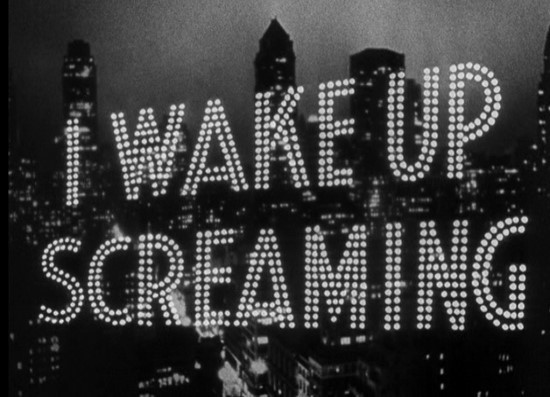
With a title like I Wake Up Screaming, it should have been so much better. I’ve noticed that a lot of these old soundtracks tend to loop and repeat and reprise the same melody over and over. In this case it’s “Somewhere Over the Rainbow”. But there were some nice shots:
I also have a new crush on Carole Landis.
Bookselling This Week: What has been the most satisfying part about all your success?
David Foster Wallace: What do you mean by success?
BTW: Being accepted by a major publisher, all the acclaim.
DFW: Well there’s no better feeling than working hard at something and having it come out good, even before you put the stamp on it. But with all the public stuff… it’s sort of how you like people to be nice to your child. There’s so much bullshit to trying to get accepted – reading a mean letter from someone you don’t even know, getting rejected. I think you need to invest way more into how it feels when you are in a room writing by yourself.
Synesthesia on Vimeo. (via wehr in the world)
(Source: https://player.vimeo.com/)
Shannon Duff, the independent college counselor… says she ordinarily charges families “in the range of” $15,000 for guidance about the application process. […] While the going national rate for such work is about $185 an hour, a counselor in Vermont and another in New York City are among those who charge some families more than $40,000. Their packages might begin when a child is in eighth grade.
Someone please tell me this isn’t real.
Before College, Costly Advice Just on Getting In - NYTimes.com
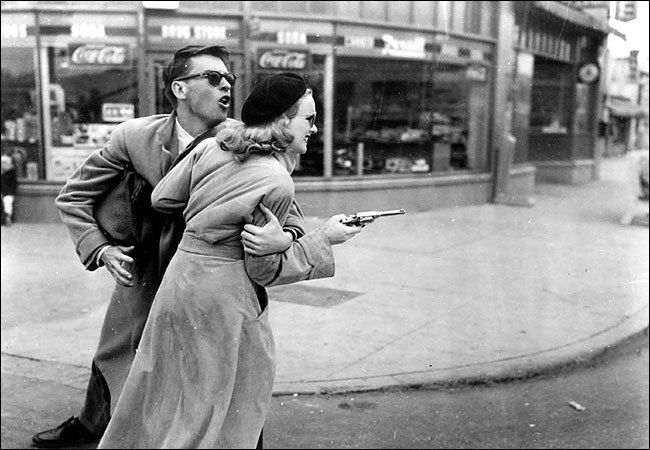
A recent screening: Gun Crazy, continuing my old-school kick after watching Laura and The 39 Steps a while ago. I didn’t like the female lead character in this one much, but the guy was cool. Some of these old movies still feel so weird in how they just END. There’s not a lot of the modern-day closure process that I’m used to.
The hollow mask illusion. My mind is blown.
(Source: https://www.youtube.com/)

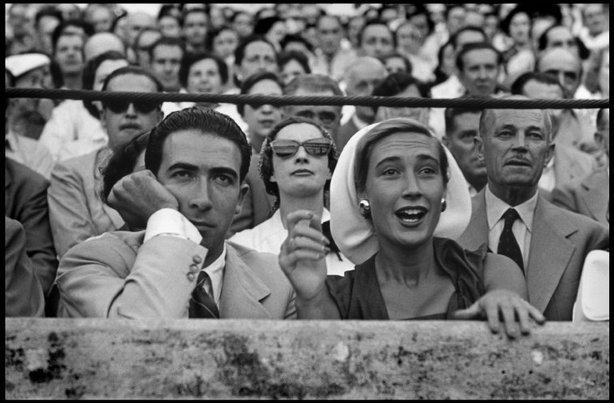
Old photos from the Festival of San Fermín. Lately I’m enjoying the Slate/Magnum galleries more than The Big Picture (which also has some nice photos from San Fermín this year). It’s a little less newsy, more old-school and artsy, I guess.
David Foster Wallace reads Laughing with Kafka, which was later published in Consider the Lobster. Other speakers at the Metamorphosis: A New Kafka symposium included Paul Auster, E.L. Doctorow, Susan Sontag, and David Remnick. (via bibliokept)
Love, the camera, and the microphone. Jay Smooth is one of my favorite thinkers.
(Source: https://www.youtube.com/)
Poets put lovers under trees, and nobody asks where that tree came from. Why can’t Kubrick put his aging man in a bedroom?

Hazmat team removes suspicious package | ajc.com. This looks like something from a music video.
If you like love and/or music, I think you will like Love Is a Mixtape: Life and Loss, One Song at a Time. Rob Sheffield wrote the book after the unexpected death of his wife of five years, Reneee. He didn't write it right away---the story came welling up again as he was moving to a new apartment, unpacking some old tapes of theirs. The book's 15 chapters each touch on a different mixtape and a different time. It explores the music and life and love they shared. It captures part of the Charlottesville music scene (they were both DJs) and the bigger stuff in the '90s: Nirvana, Pavement, R.E.M., etc.
I liked Sheffield's writing. The passage of time helps to bring out this sort of humorous self-awareness, like when he describes a moment shortly after they were married:
Now we were alone with each other.
Which meant we had all these neighbors to deal with. The old lady next door dropped by with a plate of muffins one Sunday afternoon, right in the middle of Studs. Renee explained that in the South, this is normal---you just drop in on your married neighbors. I was aghast. I was a husband in the South now. We had married into this alien landscape with its strange customs.
Or when he talks about his love as a supporting role, after a moment when he was driving and singing back-up on "Midnight Train to Georgia":
When we got to the final fade-out with Gladys on board the train and the Pips choo-chooing their goodbyes, Reneee cocked an eyebrow and said, 'You make a good Pip.' That's all I ever wanted to hear a girl tell me. That's all I ever dreamed of being. Some of us are born Gladys Knights, and some of us are born Pips. I marveled unto my Pip soul how lucky I was to choo-choo and woo-woo behind a real Gladys girl.
And everywhere it's saturated with pop-culture references, so the time comes alive. And that's what makes it (and other good memoirs?) special: that the story is so specific. It's not just a love story, but a story about what it's like to be a music-lover in love with a music-lover mostly in Charlottesville in the early and mid-'90s. And when you read his enthusiasm ("how lucky I was to choo-choo"), you can't help be a bit jealous/understanding of what he has, and you feel the loss more acutely than in a story that seems like it could be set anywhere (The Notebook, maybe, or how about Romeo and Juliet?). I think you should read it.