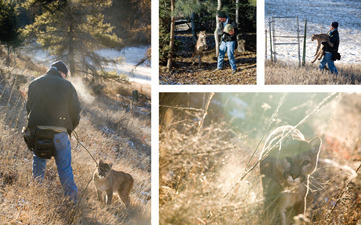
Phony wildlife photography warps nature and is rarely revealed.
From historian Daniel Boorstin’s introduction to The Image, his book from 1961:
When we pick up our newspaper at breakfast, we expect — we even demand — that it bring us momentous events since the night before. We turn on the car radio as we drive to work and expect “news” to have occurred since the morning newspaper went to press. Returning in the evening, we expect our house to not only shelter us, but to relax us, to dignify us, to encompass us with soft music and interesting hobbies, to be a playground, a theater, and a bar. We expect our two-week vacation to be romantic, exotic, cheap, and effortless. We expect a faraway atmosphere if we go to a nearby place; and we expect everything to be relaxing, sanitary, and Americanized if we go to a faraway place. We expect new heroes every season, a literary masterpiece every month, a dramatic spectacular every week, a rare sensation every night. We expect everybody to feel free to disagree, yet we expect everybody to be loyal, not to rock the boat or to take the Fifth Amendment. We expect everybody to believe deeply in his religion, yet not to think less of others for not believing. We expect our nation to be strong and great and vast and varied and prepared for every challenge; yet we expect our “national purpose” to be clear and simple, something that gives direction to the lives of nearly two hundred million people and yet can be bought in a paperback at the corner drugstore for a dollar.
We expect anything and everything. We expect the contradictory and the impossible. We expect compact cars which are spacious; luxurious cars which are economical. We expect to be rich and charitable, powerful and merciful, active and reflective, kind and competitive. We expect to be inspired by mediocre appeals for “excellence,” to be made literate by illiterate appeals for literacy. We expect to eat and stay thin, to be constantly on the move and ever more neighborly, to go to a “church of our choice” and yet feel its guiding power over us, to revere God and to be a God.
Never have people been more the masters of their environment. Yet never have people felt more deceived and disappointed. For never has a people expected so much more than the world could offer.
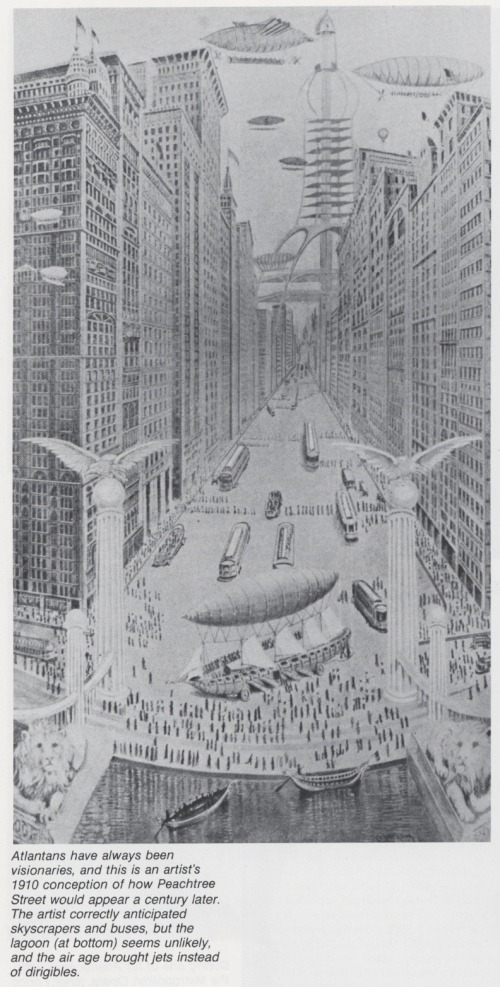
A 1910 illustration of how Atlanta’s Peachtree Street would look in 2010. The future is now! « pecanne log.
P.J. O'Rourke goes to Afghanistan.
A Pashtun tribal leader told me that a “problem among Afghan politicians is that they do not tell the truth.” It’s a political system so new that that needed to be said out loud.
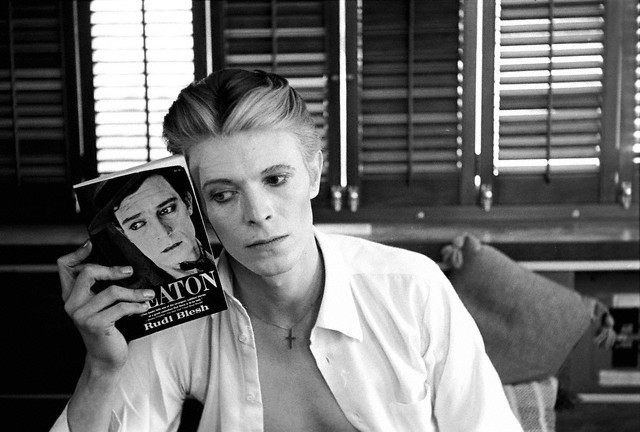
Bowie + Keaton. Photo by Steve Schapiro, I believe.
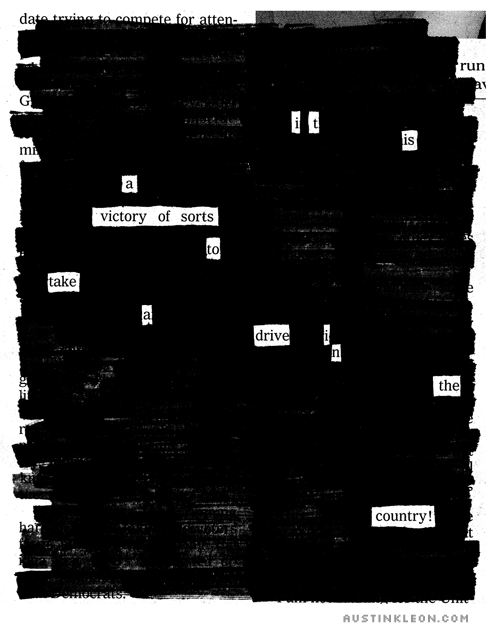
A VICTORY OF SORTS : a newspaper blackout poem by Austin Kleon
This was nicely juxtaposed in my tumblr stream.
George Saunders in a wonderful, wonderful interview.
Success is nice because then you don’t have to worry so much about having been unfairly robbed of your very richly deserved success. Success is bad because momentary good fortune can temporarily hide the fact that you are still, despite your success, full of shit.
So much good stuff here:
Interviewer: So much of your fiction is charged with social import. Given our recent political upheavals, have you ever thought of writing overt political satire?
Saunders: I’m not very interested in that kind of satire because it works on the assumption that They Are Assholes. Fiction works on the assumption that They Are Us, on a Different Day.
And:
Any mastery you can achieve in writing is totally personal and incredibly nuanced. It’s a sort of antimastery, feeling comfortable with being unsure.
And also:
One of the wonderful benefits of energetically pursuing a writing career is that I’ve come to understand the staggering limitations of my abilities. […] So one way I cope with this humbling state of affairs is via a little mantra: If I just stay fully engaged in whatever has presented itself, things will be fine. That is, I try not to think about things like: Next, I begin MY NOVEL!
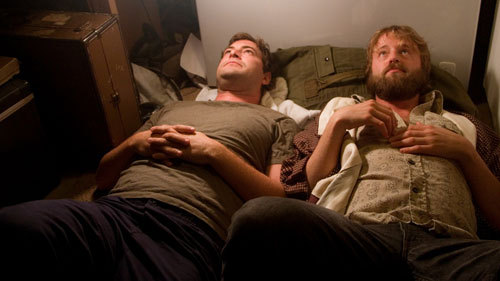 Humpday. I thought this was a really great movie. One on level it’s a sort of male bonding tale with a tone that is somewhere between the melancholy, awkward (and excellent) Old Joy and the goofy, chummy I Love You, Man. There’s bro love and macho one-upsmanship and adventurousness there, to be sure. But one thing that it shows–the wholly improvised dialogue probably helps here–is the halting, roundabout way that caring people make space for each other and test new emotional waters. A refreshing reminder of how surprisingly thoughtful people can be. Alycia Delmore is especially good. And on a whole different level it’s about the call of art and the challenge of performance. “We’re doing this because it scares us more than anything else.” Also, I have a new crush on writer/director/producer Lynn Shelton. Worth seeing.
Beware the barrenness of a busy life.
That’s attributed to Socrates, but who knows? Nonetheless, mental note. It pays to keep a healthy skepticism of how you spend your time, busy or not.
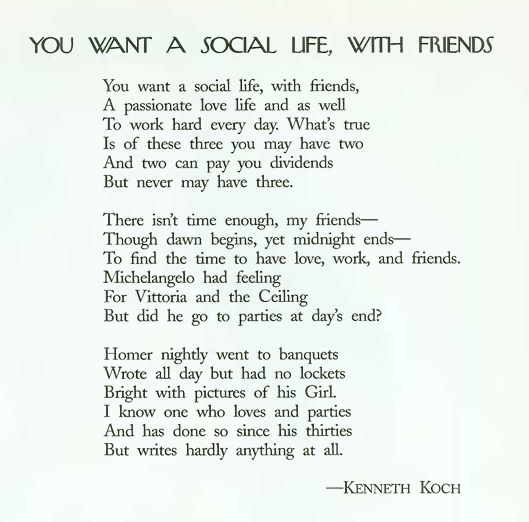
This is pretty much perfect. See also the wisdom of Communicatrix: “Family. Friends. Health. Work. Pick any three.”
Gratuitous sports pr0n. Oh, New York Times. What next?
Women's Tennis — The Beauty of the Power Game - Video Feature - NYTimes.com
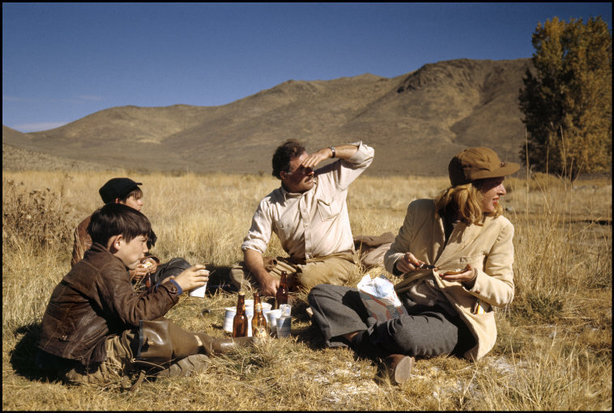
Ernest Hemingway with his sons and his wife Martha Gellhorn. Sun Valley, Idaho, 1941. Photo by Robert Capa. Today’s Pictures: Picknicking.
Where I live is culturally neutral. If I lived in New Orleans I’d have to embrace the local culture because it’s so good. In California you can be your own person.
Richard Thompson, in the Financial Times.
After listening to an interesting interview with Richard Florida on the “personal economics” of location, I’m not sure this is 100% why I feel so comfortable in L.A. I suspect it’s more a perfect stew of things—the autonomy/anonymity provided by a large metropolis, the proximity to likeminded souls, the insane cultural diversity and, hey, let’s not forget about the exceptional quality of Western light. But yeah, Chicago? Seattle? Portland? (Which would be a strong contender, except for that pesky light thing.) All distinctive. And maybe a little oppressive, because of it.
Warrants thought, anyway. Or maybe I’m just nuts, and really like thinking about shit like this.
[via]
“Cultural neutrality” is just the phrase I’ve been looking for. It’s one of the reasons Atlanta has really grown on me as I’ve been able to compare it to other cities.
When I get a little money, I buy books; and if any is left I buy food and clothes.
Erasmus (via austinkleon)
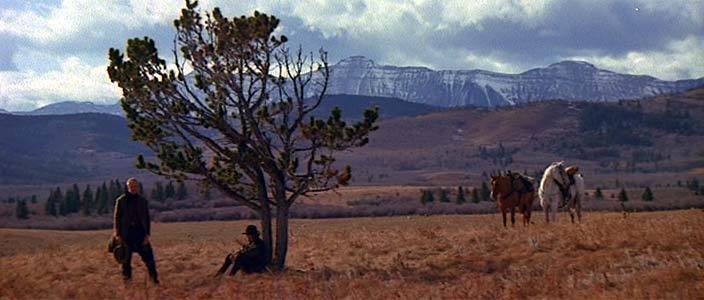 Unforgiven. This is a very, very good movie. There’s so much psychological fodder here: regret, revenge, greed, vanity. Beautifully shot and edited. A killer starring cast and a deep bench of side characters that round out the town life. My favorite part is the subtext with the biographer W.W. Beauchamp and his parasitic/symbiotic relationship with the narcissistic, murderous men in the film. He’s the everyman, fascinated and terrified of the violence, jotting down every detail while pissing his pants. Eastwood dedicated the movie to Don and Sergio.
Attributed to Chris Rock: “When you’re talking to someone, you’re not talking to that person, you’re talking to their agent.”
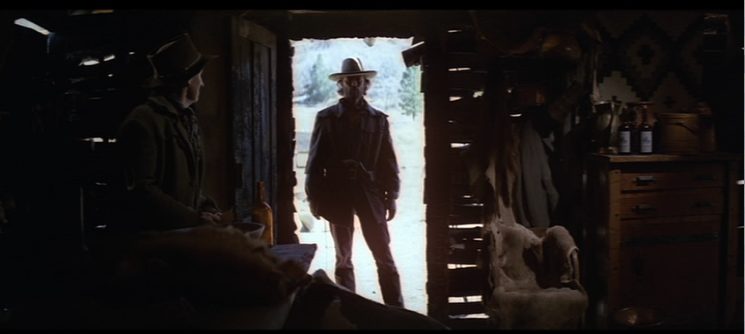 The Outlaw Josey Wales. I wouldn’t call this a Great Movie, but it was fun, thoughtful, and I was never bored. The gunplay was the least interesting part. Nice character color. Nice soundtrack. Nice to see a love interest of sorts. And look at all those guns.