NPR's 100 most important American musical works of the 20th century, with excerpts from each.
RogueApron soup line
 I joined rogueApron this past weekend for the soup line. Good stuff all around: welcomed with pumpkiny spirits, fed with a trio of soups and East Atlanta Brewery concoctions, topped off with cupcakes and whiffle ball. More pictures in the rogueApron photo pool.
Umberto Eco on "How I Write"
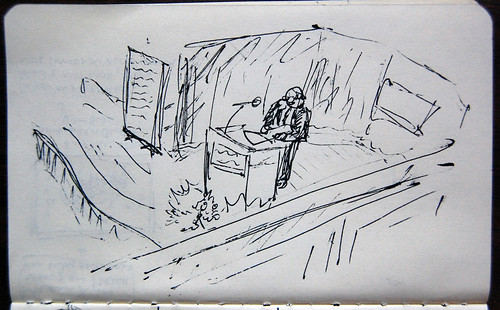 This year, Emory University's Ellmann Lectures in Modern Literature are delivered by Umberto Eco. I didn't know much about him before, but he kind of blew my mind. This afternoon I stopped by to hear him talk about "How I Write". I was *really* impressed with how much he plans out his worlds beforehand, even making maps, blueprints, and sketches of his characters. I would love to see some of his doodles. These are mine:

Here are some notes deciphered from my handwriting:
- He describes himself at age 76 as "a young and promising novelist"---he's only been doing novels for 30 years or so.
- When he was a kid, he would start with an image. He drew his stories from end to end, only later going back to put the text in juvenile block letters.
- "At 16 I started to write poems like everybody else."
- Most of his fictional works start with an image: "I wanted to poison a monk in his study," a pendulum, a trumpet, Constantinople in flames.
- When he first does research he starts with collecting documents, travel, drawing maps, and even sketching the faces of his characters. When doing the travel research, he walks around with a recorder to describe everything he sees, hears, smells, street names, etc.
- "The structure of the world is fundamental to the writing." Though the writer may choose to withhold information about the fictional world and bamboozle the reader, "You have to take account of the reaction and collaboration of the reader."
- One *very* cool anecdote: a movie director loved the dialogue Eco wrote in The Name of the Rose, saying that it was the perfect length. Eco knew it was the perfect length because he had mapped out the monastery so completely that he knew the length of time it would take his characters to walk from one place to another. (!!!)
- Connected with this idea of world-building is the ancient practice of ecphrasis. Ecphrasis is the genre of "complete description"---retelling another work so vividly that the audience can know it without directly experiencing it. Eco says it's a good tool for writers because it "gives us more ideas than actually witnessing the thing itself."
- Some "postmodern" characteristics of his writing: intertextual irony (e.g. quoting real-life works in works of fiction), metanarrative (commentary on the tale in progress) and double-coding (speaking to multiple audiences, like a Pixar movie). It "establishes a smart complicity with some readers, and also provokes other readers to read twice."
- These postmodern intricacies "are not an aristocratic tic, but a way of respecting the brightness and curiosity of the audience."
And some aphorisms:
- "Constraints are fundamental to any artistic endeavor."
- "For novels, stick to the subject, and the words will follow. For poetry, stick to the words, and the subject will follow."
- He has an interesting take on making engaging academic work: "Literary research must be narrated. Scientific papers should be written like a whodunit." (Scott McCloud made a parallel comment when I heard him a couple weeks ago. His statement was about the shared challenge of teaching and writing non-fiction: "After you explain it, is it still interesting?")
The event was followed by a reception with wine and cookies (and some other things, but I had my priorities).

A Romance on Three Legs (review: 4/5)
 Spoiler: Katie Hafner's book, A Romance on Three Legs: Glenn Gould's Obsessive Quest for the Perfect Piano, is one of the most enjoyable I've read this year, a really nice little page-turner.
Glenn Gould was one of the great pianists of the 20th century, known as much for his personal quirks as for his musicianship. Gould's eccentricities are pretty well documented. His increasingly reclusive, kind of paranoid personality led him to eventually abandon the concert stage in favor of the recording studio:
Gould had come to hate the risk-taking associated with live performances and grew tired of what he called the "non-take-two-ness" of the concert experience. He believed that people were just waiting for him to mess up, and he resented it. 'To me this is heartless and ruthless and senseless. It is exactly what prompts savages like Latin Americans to go to bullfights.'
The new-to-me, perhaps even more interesting character in this book is Verne Edquist. Edquist got cataracts as a child. Surgery didn't work and he lost most of his sight. He was sent to a school for the blind to learn a trade, where he took up piano tuning. His ears were very good, and he gradually worked his way up the ranks from basic tuning, to regulating the piano action (tweaking the mechanics), to tone regulating (tweaking the timbre and tone color across the full range of the instrument).
The third character in this book is CD 318, a Steinway concert grand piano. Gould was an extremely sensitive musician. His enviable technique and his own neuroses made it especially hard to find a decent piano. After flirting with a couple other pianos, the light, fast touch of CD 318 won him over. Edquist would become the primary tuner to understand Gould's needs and service his instrument. The book tells their story.
Along the way, there are a couple nice digressions that lead into how pianos are made, how piano tuners work, the origins of sponsored musicians with exclusive company endorsements, and the history of Steinway & Sons (during wartime they were forced into making coffins and airplanes, among other things). And there are a couple nice tidbits like, "in the early twentieth century, piano tuners outnumbered members of any other trade in English insane asylums."
interview with Anthony Bourdain
From an interview with Anthony Bourdain, a passage on those beautiful moments and how they feel kind of sucky at the same time:
IÄôve talked elsewhere about there are times in your life... IÄôll use the example of youÄôre standing alone in the desert, and you see the most incredible sunset youÄôve ever seen and your first instinct is to turn to your left or right and say, ÄúWow, do you see that?Äù Okay, thereÄôs no one there, what do you do? Next, whereÄôs the camera? Look through the viewfinder and you realize you know, what you see through that little box is not what youÄôre experiencing. There comes this terrible moment when you realize well, this is for me. There is no sharing this. Worse: if you try to share it with old friends or someone you love itÄôs almost an insult. "How was your day?" "Well, we did three hundred covers tonight, somebody sent back a steak..." "Well, in the Sahara there was this sunset and you wouldnÄôt believe it." You know?
A place called Sandar
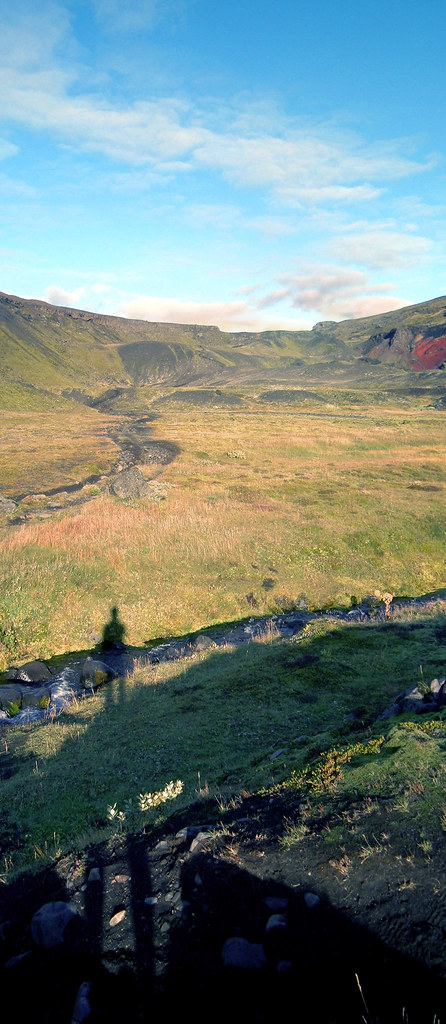 A small glacial outwash plain near the Entuj??kull glacier.
The poetry of Donald Rumsfeld, via Austin Kleon
The poetry of Donald Rumsfeld, via Austin Kleon. That stuff is so good. I remember a couple years ago, at a thrift store, I saw a copy of Poetry Under Oath: From the Testimony of William Jefferson Clinton and Monica S. Lewinsky. I wish I'd bought it. This review of Poetry Under Oath has quite a few excerpts and some of them are pure gold. "The Word 'Is'" is a classic:
It depends on what the meaning of the word 'is' is
If the--- if he--- if 'is' means is and never has been that is not---
that is one thing
If it means there is none that was a
completely true statement
A little plant
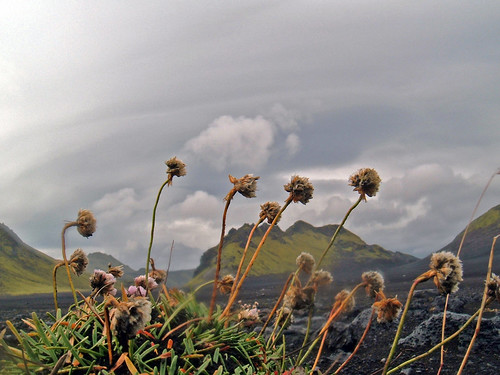 In the middle of a volcanic wasteland in Iceland.
Super Spy (review: 3.5/5)
 I picked up Super Spy at the Decatur Book Festival last month. I was talking with the guys at the Top Shelf Comics booth, asking them to steer me away from ennui and towards something a bit more exciting. This was their pick of the pile, on the genre fiction side of the spectrum. Matt Kindt's book is a spy novel.
It story starts off really well, and then settled down to a comfortable "good." The different chapters jump around in time, changing focus among a cast of characters whose stories intertwine. The pace of the storytelling is very quick. People you get to know in 4 or 5 panels are dispatched a page or two later. I don't think I spoil much by saying it happens a lot. Lots of dispatching. Or that's how it seemed when I was reading.
The art gave me pause for a second, but grew on me. It's not super-realistic or refined, but more slashy and dramatic, lots of contrast and rough edges and changes in perspective. It's a muted palette throughout. The design of the book is pretty cool. Each chapter is a dossier and the space behind the panels is colored to look like a worn folder. In one scene, a death in the panels is underscored with blood spatter in the gutters:

Nice detail there. The whole thing is worth a look. Here are some sample pages from Super Spy.
I don't avoid repeating myself
"I don't avoid repeating myself. I rip myself off all the time." -Chip Kidd
9 ways to use space in your presentation
Here are 9 ways to use space in your presentation, basically ways to use your body on stage while you're speaking. This reminds me of Scott McCloud's presentation here in Atlanta a couple weeks ago, when he said something along the lines of, "Any way you can describe a story has a spatial/visual equivalent."
Let’s make a trailer for what that movie would look like
"After hearing Matt DamonÄôs brilliant comparison of a Sarah Palin presidency to a bad Disney movie, I called up Sam and said 'LetÄôs make a trailer for what that movie would look like.'" [via daring fireball]
Reason Magazine has a great illustrated flowchart showing how hard it is
Reason Magazine has a great illustrated flowchart showing how hard it is to immigrate to the United States.
Appalachian Pages
Looks like a couple people already wrote the book I was thinking about creating: Appalachian Pages, a thru-hikers' guide for the Appalachian Trail. The real winning idea here, the one that I wanted to see, was having the elevation profile watermarked on each page so you can sneak a peek at the day's challenges in a glance: 
Thank God they saved me the work. It looks great. If I ever end up on the AT again, I wouldn't be surprised if I carried this book instead of the classic AT Data Book.
The latest MacArthur Fellows got their genius grants today
The latest MacArthur Fellows got their genius grants today. Among them is one of my favorite writers, Alex Ross.
Mike Clelland's illustrations are relentlessly cheerful
Mike Clelland's illustrations are relentlessly cheerful. The lines are so relaxed but precise and I love the heavy use of arrows and labels: 


Mike Clelland and another NOLS instructor demonstrate proper backcountry poopin
In this video Mike Clelland and another NOLS instructor demonstrate proper backcountry poopin'. Classic squat, telemark pose, one-bunning. Hiker humor. May not be universal? Mike Clelland is a great illustrator, too---I've liked his work in books like Lighten Up!: A Complete Handbook for Light and Ultralight Backpacking and in Allen and Mike's Really Cool Backpackin' Book: Traveling & Camping Skills for a Wilderness Environment.
A House by the Park
It's been really wonderful to keep an eye on A House by the Park, "a first-hand chronology of the design, planning, and construction of a modern home in Seattle." I'm not in the market now, nor do I plan to be in the near future, but it's cool to watch and learn from a safe distance.
A waterfall called Gullfoss

A street called Njarðagata
 I'm still sorting through my photos from Iceland, sifting out the worthwhile from the not-so-great. I plan to take my time and upload them over the next week or so. This is from my first morning in Reykjavik. More to come.