First there was Easy Cheese and now there's spray dog food.
Something to shoot for
Something to shoot for:
What is the function of a critic? So far as I am concerned, he can do me one or more of the following services:
1. Introduce me to authors or works of which I was hitherto unaware. 2. Convince me that I have undervalued an author or a work because I had not read them carefully enough. 3. Show me relations between works of different ages and cultures which I could never have seen for myself because I do not know enough and never shall. 4. Give a ÄúreadingÄù of a work which increases my understanding of it. 5. Throw light upon the process of artistic Äúmaking.Äù 6. Throw light upon the relation of art to life, to science, economics, ethics, religion, etc.
This reminds me of Auden's Notes on the Detective Story, by an Addict that was featured at Harper's recently, wherein he dissects whodunits and argues for why they're escape and not art... "The most curious fact about the detective story is that it makes its greatest appeal precisely to those classes of people who are most immune to other forms of daydream literature."
the cruel and the kind
I divide this world into two classes---the cruel and the kind; and I think a thousand times more of a kind man than I do of an intelligent man. I think more of kindness than I do of genius, I think more of real, good, human nature in that way---of one who is willing to lend a helping hand and who goes through the world with a face that looks as if its owner were willing to answer a decent question---I think a thousand times more of that than I do of being theologically right; because I do not care whether I am theologically right or not. It is something that is not worth talking about, because it is something that I never, never, never shall understand; and every one of you will die and you wonÄôt understand it either---until after you die at any rate. I do not know what will happen then.
The Public School
At The Public School anyone can propose a course, anyone can sign up for courses, and if there's enough money to fund it, the course is offered (flowchart). How hard is that? Take a look at the current offerings, or if you have expertise, the classes that need teachers. [via lined & unlined]
Weekly muxtape, unusual edition
The only reason I put together the unusual edition is because of the first track "Strange Overtones". I've been repeating that religiously since I heard it earlier this weekend. I haven't had a track get such heavy play since "Weird Fishes". Other highlights include Victor Wooten's sick bass solo around the 2-minute mark in "Oddity," and Paul Desmond's saxophone work in "Strange Meadow Lark," which has some unusual 10-bar phrases.
New York Times article about boredom
A New York Times article about boredom reframes it as an opportunity rather than an unavoidable state:
The brain is highly active when disengaged, consuming only about 5 percent less energy in its resting Äúdefault stateÄù than when involved in routine tasks... That slight reduction can make a big difference in terms of time perception. The seconds usually seem to pass more slowly when the brain is idling than when it is absorbed. And those stretched seconds are not the live-in-the-moment, meditative variety, either. They are frustrated, restless moments. That combination, psychologists argue, makes boredom a state that demands relief---if not from a catnap or a conversation, then from some mental game.
Some evidence for this can be seen in semiconscious behaviors, like doodling during a dull class, braiding strands of hair, folding notebook paper into odd shapes. Daydreaming too can be a kind of constructive self-entertainment, psychologists say, especially if the mind is turning over a problem. In experiments in the 1970s, psychiatrists showed that participants completing word-association tasks quickly tired of the job once obvious answers were given; granted more time, they began trying much more creative solutions, as if the boredom Äúhad the power to exert pressure on individuals to stretch their inventive capacity."
Hamlet, the Facebook News Feed Edition
Hamlet, the Facebook News Feed Edition. My favorite part: "Hamlet became a fan of daggers." [via funkaoshi]
Why we love a good yarn
Weekly muxtape, daybreak edition
Highlights in my fifth Monday muxtape include a more relaxed, non-heavy-metallic Judas Priest; my good friend and brilliant jazz vocalist Kat Edmonson; an obscenely catchy tune from Peter, Paul & Mary; a quiet little number for percussion ensemble; and some Yeasayer---the bass just kills me. Can't sit still when that one comes up.
My 100th Book Review
That last post was my 100th book review. The first one I did here was July 30, 2006, which works averages out to about one every week. Though their quality varies widely, I'm glad I've put them up consistently.
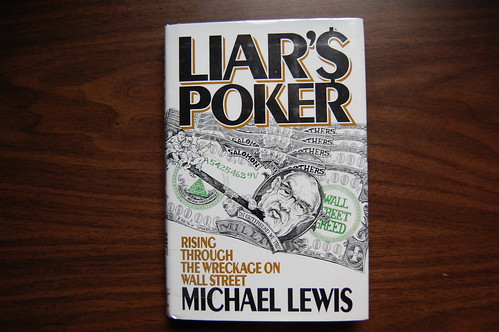
Liar's Poker: Rising Through the Wreckage on Wall Street (review: 4/5)
This makes the third Michael Lewis book I've read (see also my take on Moneyball and The Blind Side from last fall). It's another good one. Liar's Poker is Lewis' first book. He writes about his years on Wall Street working with the Salomon Brothers investment firm during the heady 1980s. It's a biography of the company's internal breakdown and the revolutions that swept through the investment banking industry (like mortgage-backed securities and junk bonds) that made some people piles and piles of money.
Lewis' writing is good and often funny:
The greatest of absurdity of the college investment banking interview was the people the investment banks sent to conduct them. Many of them hadn't worked on Wall Street for more than a year, but they had acquired Wall Street personas. One of their favorites words was professional. Sitting stiffly, shaking firmly, speaking crisply, and sipping a glass of ice water are professional. Laughing and scratching your armpits are not...
I did not learn much from my stack of Wall Street rejection letters except that investment bankers were not in the market for either honesty or my services (not that the two were otherwise related). Set questions were posed to which set answers were expected. A successful undergraduate investment banking interview sounded like a monastic chant.
Lewis manages to get in to Salomon Brothers through some lucky connections, makes it through the months of lectures and hazing of the training program, and finally gets to the trading floor that's dominated by a law-of-the-jungle ethos. Some of the best parts are these antics among the workers. People throwing phones at trainees, office pranks, verbal abuse, gluttony ("We'd order four hundred dollars of Mexican food," says a former trader. "You can't buy four hundred dollars of Mexican food. But we'd try---guacamole in five-gallon drums, for a start."). It's wonderfully disturbing.
If you are a self-possessed man with a healthy sense of detachment from your bank account and someone writes you a check for tens of millions of dollars, you probably behave as if you have won a sweepstakes, kicking your feet in the air and laughing yourself to sleep at night at the miracle of your good fortune. But if your sense of self-worth is morbidly wrapped up in your financial success, you probably believe you deserve everything you get. You take it as a reflection of something grand inside you. You acquire gravitas and project it like a cologne.
Lewis nails both the bizarre sociology inside the firm and the broader industry shifts. A lot of the stuff about mortgage bonds and junk bonds gives a good background on what's happening on the market right now. Definitely worth reading.
The Collapse of This City's Community
Did this one on the train from work---warming up for the Newspaper Blackout Contest.
It All Ends
Igor Stravinsky
"And, anyway, money is not the only ingredient; to have subsidized a Bach, or Fulbrighted a Beethoven would have done no good at all. Money may kindle but it cannot by itself, for very long, burn." ---Igor Stravinsky
Against Intellectual Property
Against Intellectual Property is a worthwhile paper summarizing IP law, some libertarian arguments for and against, and why IP can't be justified.
Remembering the genius whom Stanley Kubrick stole music from
Remembering the genius whom Stanley Kubrick stole music from, a nice remembrance of the life and music of Gy??rgy Ligeti. Ligeti is well-known for Po?®me Symphonique For 100 Metronomes and his piano etudes like Devil's Staircase. And lots of other good stuff. I also came across an interesting video of a visual listening score for Artikulation, one of Ligeti's electronic works.
George Orwell has a blog
George Orwell has a blog, or will starting on August 9, when each entry of the Orwell diaries will be put online 70 years later to the day. I think this will be awesome. [via maud newton]
A worthy bit from The Disadvantages of an Elite Education
A worthy bit from The Disadvantages of an Elite Education:
The opportunity not to be rich is one of the greatest opportunities with which young Americans have been blessed. We live in a society that is itself so wealthy that it can afford to provide a decent living to whole classes of people who in other countries exist (or in earlier times existed) on the brink of poverty or, at least, of indignity. You can live comfortably in the United States as a schoolteacher, or a community organizer, or a civil rights lawyer, or an artistÄîthat is, by any reasonable definition of comfort. You have to live in an ordinary house instead of an apartment in Manhattan or a mansion in L.A.; you have to drive a Honda instead of a BMW or a Hummer; you have to vacation in Florida instead of Barbados or Paris, but what are such losses when set against the opportunity to do work you believe in, work youÄôre suited for, work you love, every day of your life?
Innocent people should never talk to the police
Innocent people should never talk to the police. Take the 5th. Very good advice from a couple of law school lectures. [via waxy]
Weekly muxtape, inclement weather edition
My fourth muxtape is ready for your aural pleasure.