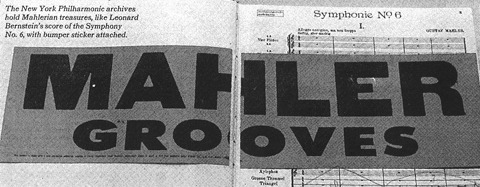
Mahler Grooves [via alex ross]
Mahler Grooves [via alex ross]
A notable selection from American Movie Critics: From the Silents Until Now, which I’m working my way through this week.
"The Gangster as Tragic Hero" - Robert Warshow on the Gangster Film
You care about things that you make, and that makes it easier to care about things that other people make.
Ya gotta make stuff. That’s Louis Menand talking about Creative Writing programs, but I think it applies to the life outside just as well.

If you ever get stuck on that next note/chord, try Musician’s Dice. [via classicalconvert]
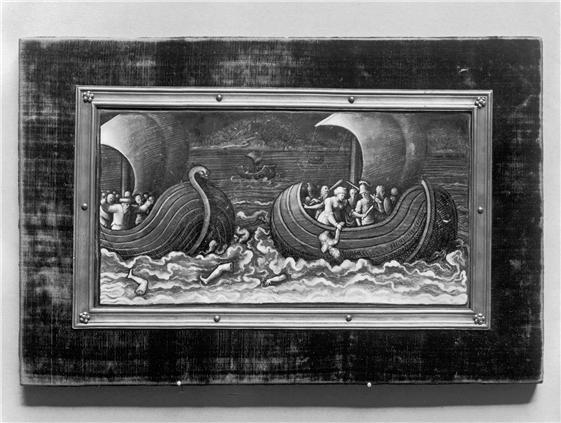
Plaque with Medea’s Murder of Absyrtus by Martin Didier Pape. I think this will be my last selection from the Walters Art Museum. I love the odd body parts floating in the ocean. Such gore for the late 1500s.
I never think of anything as finished until it’s released. If you came round to my house one day and I said, “This is something I haven’t finished yet, but it’s going to be much better when I’ve mixed it,” and blah blah blah – all these defenses – and then I played it for you, that’s one thing. But if you pick up my album at a shop and take it home and put it on your record player and I’m not there to give you all those excuses, that’s quite a different thing. A work is finished for me when it’s no longer in the domain of my excuses about it.
Brian Eno in Interview magazine, 1990. By the way, there is a massive archive of interviews with Brian Eno, which I am wont to plunder when I need a little something to think on.
I prefer the pink and the brown/red noise. They’re all great for the office.
SimplyNoise.com - The best free white noise generator on the Internet.
“My freedom thus consists in my moving about within the narrow frame that I have assigned to myself for each one of my undertakings. I shall go even further: my freedom will be so much the greater and more meaningful the more narrowly I limit my field of action and the more I surround myself with obstacles. Whatever diminishes constraint diminishes strength. The more constraints one imposes, the more one frees oneself of the claims that shackle the spirit.”
— Igor Stravinsky, The Poetics of Music (via)
“There are a few basic principles that you have to master before you can move on to wild, uninhibited streetplay.” Hilarious. Creepy.
“PICKING UP GIRLS MADE EASY will teach you a whole new system for picking up girls — a system that is so complete and so absolutely foolproof you’ll soon be picking up girls automaticallly!!! Absolutely everything is spelled out for you… Picking up girls can be as easy as opening a beer! And the more you listen to the album, the better you’ll get. It’s INCREDIBLE!”
The Street Pick Up (6:00)
Love In The Library (5:11)
Single’s Bar Action (6:12)
Women’s Clothing Store Pick Up (6:39)
The Ballet Is A Ball (4:08)
Museum Pick Up (5:42)
Walking The Dog (5:53)
Pick Up At The Beach (5:46)From UbuWeb’s 365 Days Project:

Profile Head of a Young Woman by Leopold Carl Müller. The other half of the pair.
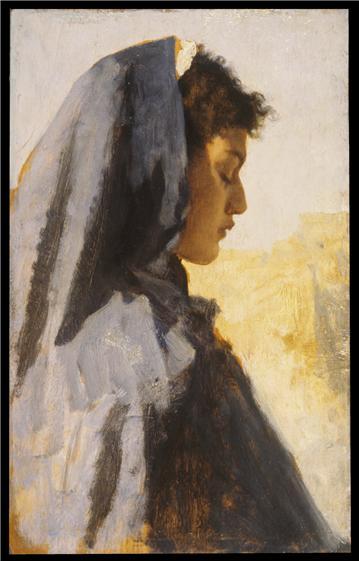
Profile Head of a Young Woman by Leopold Carl Müller. One of a pair, another selection from the Walters Museum that I really liked.
 I drove over to Charleston, SC for Memorial Day weekend. It was Spoleto Festival season, I finally got to see the Alvin Ailey Dance Company (after a mad dash from the parking deck to arrive in our seats *just* before it started). My favorite piece was Suite Otis, a tribute to the awesome (Georgia-born!) Otis Redding. Later the same day we stumbled upon Theatre 99, where we saw a good improv show by a group whose name I can't recall. Moving on to food...
There's good pizza at Social. But the drink (read: beer) list was uninspired (I'm spoiled by living a few steps away from Brick Store) and I didn't quite fit with the crowd. Ditto Rooftop Bar at the Vendue Inn, but the views are nice. I did like the vibe and the jukebox at Recovery Room. The people at Joe Pasta were very kind and I also liked Monza.
We went to the renowned Hominy Grill but the Sunday brunch line was absurd so we went across the street to Fuel, which has great plantains and an enormous serving of chicken & waffles. If I'm ever there again, I'd like to check out Pano e Vino.
Out on Folly Beach, I recommend Taco Boy and maybe Lil' Mama's if you don't mind a little waiting.
You probably recall Jonah Lehrer's New Yorker article about the kids who were told not to eat the marshmallow. Those who were able to hold out were better behaved, higher achievers later in life.
Low delayers, the children who rang the bell quickly, seemed more likely to have behavioral problems, both in school and at home. They got lower S.A.T. scores. They struggled in stressful situations, often had trouble paying attention, and found it difficult to maintain friendships. The child who could wait fifteen minutes had an S.A.T. score that was, on average, two hundred and ten points higher than that of the kid who could wait only thirty seconds.
When I was reading it, it reminded me of some ideas that have been around for in economics for a couple centuries or so: time preference and intertemporal choice. Someone with high time preference will tend to consume sooner rather than later. People with low time preference are the savers---the ones who can hold out. The same applies to social groups or societies. For example, married folks or people who have children (or expect them) tend to have lower time preference and set aside more for the future. And they tend to display fewer risky behaviors, so they can actually see the eventual benefits of their saving. It's the opposite for the single, childless, young. This relates to why single males in their 20s tend to have high car insurance, lots of cool electronics stuff, and little in their IRAs. Consume more now, have less later.
As a kid, I imagined that going on a trip meant either (a) decamping for two weeks to some sun-drenched “paradise” like Hawaii (I don’t like the sun or anything it nourishes), (b) staring at a series of post card-y landmarks and feigning engagement, © roughing it like some Rick Stevesite through narrow cobblestone streets in a pair of underpants you washed in the sink, desperately dodging swarms of filthy urchins, their dozens of tiny hands grabbing tirelessly for your dorky, inconvenient money belt or (d) a truly unpalatable cocktail of all three. Only relatively recently has it occurred to me that you can do whatever you want with your time abroad, like exploring cities and whatnot.
I find that more and more nonfiction authors are confusing Book Idea with Long Magazine Article Idea.
Brian Eno - Music For Airports Interview:
I thought that it would be much better to have music that said, “Well, if you die, it doesn’t really matter.”
(Source: https://www.youtube.com/)
Furnishing music completes one’s property.
Erik Satie. Furniture music.
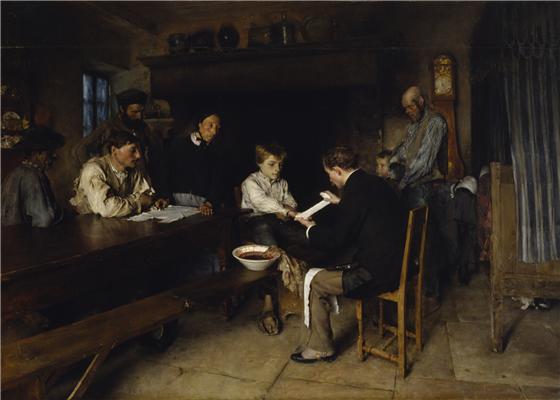
An Accident by Pascal Adolphe Jean Dagnan-Bouveret. “In this scene, a country doctor bandages a boy’s injured hand, while his family looks on with varying degrees of concern.”