Mental note: I need to check out Art House in Decatur. In the meanwhile, I think I'll sign up for this Million Little Pictures interactive exhibit thing they're doing: "We're sending out disposable cameras to hundreds of people and then we're going to plaster our walls with the photos."
What I've Learned by Reviewing Books
I noticed something the other day. For all of my book reviews, I'll give a capsule rating with scores ranging from 0-5. I put a pretty good bit of time into each one, flipping back through my notes, looking over the dog-eared pages, tracking down links online, etc. When I first start writing the review, I'll go ahead and write the draft title in the usual format: Title (review: rating). What I've found is about ¾ of the time, my rating for the book will creep upwards as I write my review for it. I read this good advice about learning the other day: "If you don't understand something, try to explain it out loud, then listen to yourself." It's a challenge to look over a book try to sniff out the big ideas, highlight what is interesting, and articulate what I learned---and to figure out how to share that without rambling on for 5,000 words (which isn't bad, but this blog is the wrong context). It brings to mind that old quip: "Learn to pause... or nothing worthwhile will catch up with you."
There's something about the process of looking over the book again and taking a while to reflect on everything, letting ideas and impressions gel together, that increases my evaluation of it. It's no accident that "appraise" (to evaluate) and "appreciate" (to recognize quality) share the same etymological roots. It takes some time, but the result is worth it: I think more highly of what I understand more clearly.
sunset on Uluru
This is a cool set of photos of sunset on Uluru, aka Ayer's Rock.
It was pretty idyllic all around
"We ended up at one point lying on the snow, looking up at the sky and talking about the food chain and how the sun indirectly supplies energy for our bodies. It was pretty idyllic all around." I love it. That's the mix of blissful goofing off + learning that I loved when I was a kid. Playing, learning, creating, it's all the same. I hope I'll get to share that one day with kids of my own. Sledding, photosynthesis, snowball fight, maybe a little praxeology with the afternoon snack...
In The Little Book of Plagiarism, Richard Posner excerpted T.S
In The Little Book of Plagiarism, Richard Posner excerpted T.S. Eliot's famous comment about poetic imitation. I tracked it down and give a bit more of the context here. From Eliot's essay "Phillip Massinger" in The Sacred Wood: Essays on Poetry and Criticism:
Reading Shakespeare and several of his contemporaries is pleasure enough, perhaps all the pleasure possible, for most. But if we wish to consummate and refine this pleasure by understanding it, to distill the last drop of it, to press and press the essence of each author, to apply exact measurement to our own sensations, then we must compare; and we cannot compare without parceling the threads of authorship and influence...
One of the surest of tests is the way in which a poet borrows. Immature poets imitate; mature poets steal; bad poets deface what they take, and good poets make it into something better, or at least something different. The good poet welds his theft into a whole of feeling which is unique, utterly different from that from which it was torn; the bad poet throws it into something which has no cohesion. A good poet will usually borrow from authors remote in time, or alien in language, or diverse in interest.
The Little Book of Plagiarism (review: 3.5/5)
Richard Posner is an appellate judge and also a lecturer at the University of Chicago. In The Little Book of Plagiarism gives a quick 100-page tour of the historical and legal aspects of an issue that was more complicated than I thought: plagiarism. Coming from the legal world, there's plenty of critical wordplay here, defining and refining what exactly plagiarism is and how it relates to copyright infringement, in particular. The definition that Posner works towards in the first half of the book is most simply described as "fraudulent copying," which he supposes isn't always a legal misstep (or shouldn't always be, anyway). But it's certainly a grievous ethical lapse. One interesting aspect of plagiarism that I hadn't thought about is trying to suss out exactly who the "victim" is. With copyright violations, the victim is simply the author whose words were stolen and who lost recognition for or control their work. With plagiarism, the works of competing, legitimate authors are put at a disadvantage, and the reader is also misled. The plagiarist gets an unfair leg up on the competition and fools the audience.
A couple other items of note are Posner's tangential comments on universities and scholarship: "Scholars are self-selected into an activity that requires them to write, although not to write well (which means, however, that good writing is not highly valued in most scholarly fields)." Just like any other humans, it's plausible that some professors don't particularly worry about writing really, really well. I hadn't thought about that before, though I've certainly read my share of bad scholarly writing. (And written it as well, I'm sure... but I tried).
History offers us a few obvious examples of flagrant, unapologetic borrowers: Shakespeare, Martin Luther King Jr., T.S. Eliot, etc. Posner's take on the issue: "We need to distinguish between "originality" and "creativity," stripping the former of the normative overtones that rightly attend the latter." The source material may be old, but it's what you can do with it that counts. There's an object lesson here, I think. One that relieves a bit of the creative's burden. You don't have to be the first, just do it well.
An ode to the petri dish
Scholars from Reed College and Stanford reviewed over 150 praise studies
The Power (and Peril) of Praising Your Kids:
Scholars from Reed College and Stanford reviewed over 150 praise studies. Their meta-analysis determined that praised students become risk-averse and lack perceived autonomy. The scholars found consistent correlations between a liberal use of praise and studentsÄô Äúshorter task persistence, more eye-checking with the teacher, and inflected speech such that answers have the intonation of questions.Äù DweckÄôs research on overpraised kids strongly suggests that image maintenance becomes their primary concernÄîthey are more competitive and more interested in tearing others down. A raft of very alarming studies illustrates this...
An interview with Ootje Oxenaar, designer of Dutch currency
An interview with Ootje Oxenaar, designer of Dutch currency. [via kottke]
rare books on calligraphy, penmanship, and pen art
An archive of rare books on calligraphy, penmanship, and pen art; they're all out of print, but still available as PDF and image files. I can't believe how clean some of the illustrations are, like this deer.
using the names of the objects to build them
Here's some artwork that represents everyday scenes by using the names of the objects to build them.
paintings of the descriptions of paintings
Here's an interesting idea for highbrow post-ironic art-qua-self-conscious-subject (etc.): paintings of the descriptions of paintings.
The latest album from Feist is due out on May 1---which is far too long to wait
The latest album from Feist is due out on May 1---which is far too long to wait. In the meanwhile, the album cover is absolutely incredible, and a single has surfaced: "My Moon, My Man". Go look for it on the Hype Machine.

How to break in a new book
How to break in a new book. While McAuliflower had cookbooks in mind, this is also really helpful for speed reading when you want to minimize fussing with pages. [via not martha, again]
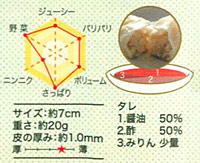
infographics in these Japanese stadium menus
Check out the infographics in these Japanese stadium menus at the bottom of the post. Description of the data available:
Graph (clockwise from top): Juicy, Crispy (Wrapper), Volume, Oily (lower = oilier), Garlic Amount, Vegetable Amount. Stats: Size, Weight, Wrapper's Thickness (Star Chart from Thick to Thin) Sauce Breakdown: Soy Sauce %, Vinegar %, Extras
Here's a sample image and the entire menu. (pdf, 3.2mb) Thanks for sharing this, Cabel.
Check out these amazing curtains crafted by Nienke Sybrandy
Check out these amazing curtains crafted by Nienke Sybrandy. I don't think I've ever been impressed by curtains before. [via not martha]
A study of internet weather forecast accuracy
A study of internet weather forecast accuracy. [via waxy]
On NPR, Terry Gross interviews cartoonist couple Robert and Aline Crumb
Engineering 503: Scientific Visualization & Information Architecture
I love it when professors put their materials online. John Boyd, professor at University of Michigan, has his lecture notes for Engineering 503: Scientific Visualization & Information Architecture. The second chapter is called "The Gospel According to Tufte". It's a wonderful collection that I'll be spending some time on this weekend.
points to some pretty amazingly intricate origami creations
Kottke points to some pretty amazingly intricate origami creations by origamist/ scientist Robert Lang. Pretty amazing little creations.